How the rigid new snap rules under obbba are reshaping low-income nutrition benefits
Federal safety net adjustments introduce stricter compliance frameworks and expanded age caps across all states.
The implementation of the One Big Beautiful Bill Act (OBBBA), signed into law on July 4, 2025, has initiated a sweeping transformation of the nation’s safety net. Central to this legislative shift are the comprehensive new snap rules under obbba, which introduce structural changes to the Supplemental Nutrition Assistance Program (SNAP) that directly affect millions of program participants. As federal agencies execute these provisions, the landscape of low-income food assistance updates reveals an environment characterized by stricter work requirements, diminished state administrative flexibility, and altered benefit calculation methods. These structural modifications represent a deliberate pivot in federal nutrition policy, emphasizing workforce integration and enhanced state fiscal accountability.
Within the framework of the new statutory guidelines, the United States Department of Agriculture (USDA), Congress, and individual state agencies are navigating complex changes to enrollment data and program administration. Early administrative records indicate a significant food stamps enrollment decline across multiple jurisdictions as the revised eligibility standards take effect. A primary catalyst for this shift is the expansion of the Able-Bodied Adults Without Dependents (ABAWDs) classification, which enforces rigid time limits on food assistance unless rigorous work criteria are met. Furthermore, the new policy framework addresses structural aspects of the program, including adjustments to the USDA Thrifty Food Plan cuts, modified state matching fund snap requirements, and heightened enforcement mechanisms related to snap payment error rate penalties.
The Expansion of ABAWD Work Rules and Age Limits
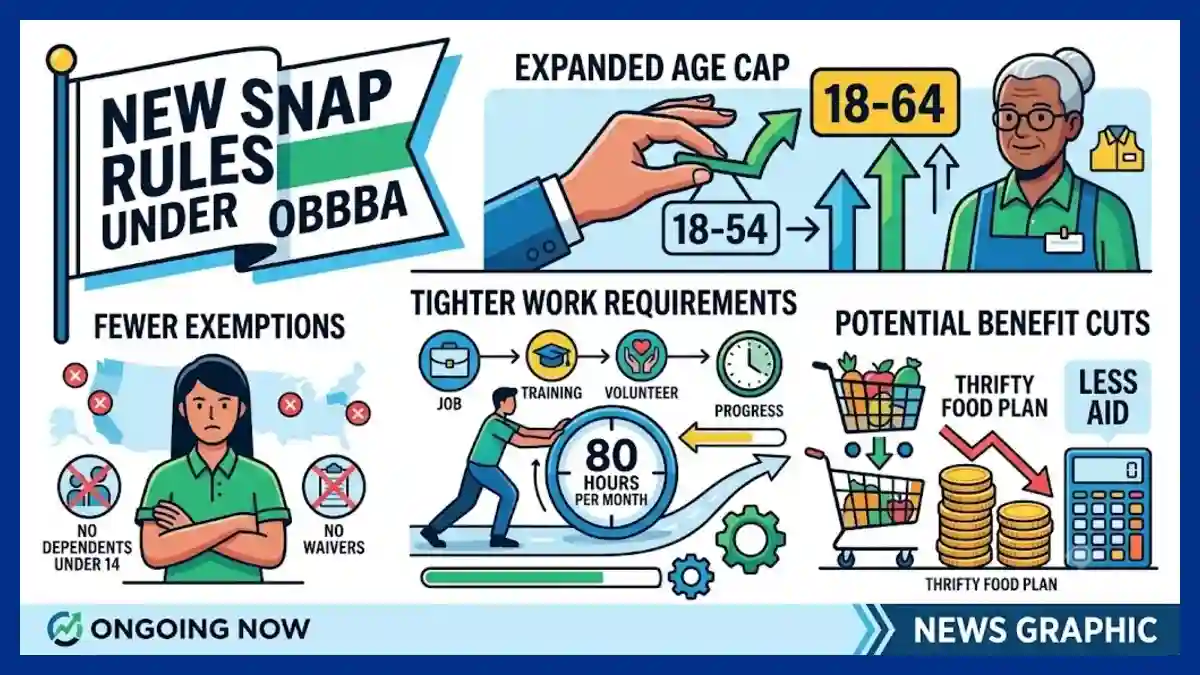
The core mechanism driving the current contraction in SNAP participation is the expansion of work requirements for individuals classified as able-bodied adults without dependents. Under the previous legislative baseline, strict work requirements and the accompanying three-month benefit limit applied exclusively to individuals between the ages of 18 and 54. The new snap rules under obbba extended this upper boundary significantly, bringing adults aged 55 to 64 under the purview of mandatory work verification.
To maintain eligibility for food assistance beyond three months in any 36-month period, these older participants must now document at least 80 hours of work per month. The statutory definition of work includes paid employment, self-employment, pre-approved volunteer services, or participation in state-sanctioned SNAP Employment and Training (E&T) initiatives. Failure to meet or report these hours results in an automatic suspension of benefits, creating a complex administrative hurdle for a demographic that frequently faces unique challenges in the modern labor market.
Beyond raising the age cap, the federal statute narrowed the traditional exemptions that previously protected household heads. Historically, any parent or guardian caring for a dependent child within the household was exempt from individual ABAWD work rules. The current regulations restrict this exemption exclusively to individuals residing with a child under the age of 14. Consequently, parents of dependents aged 14 to 17 are now fully subject to the 80-hour monthly work quota, unless they qualify under an alternative exemption such as a documented medical disability.
Elimination of Group Waivers and State-Level Flexibilities
A critical component of the OBBBA is the systematic reduction of state-level authority to mitigate federal work rules. For decades, state governors and labor departments could request localized geographic waivers from the three-month ABAWD time limit for areas experiencing severe economic downturns or structural lack of employment. The new federal framework eliminates the standard “lack of sufficient jobs” criterion, replacing it with a rigid statutory floor.
States may now only seek a temporary waiver if a specific county or municipality maintains an unemployment rate exceeding 10%. Because few jurisdictions satisfy this extreme economic threshold under current macroeconomic conditions, the USDA has permitted existing regional waivers to expire across all 50 states. This centralized enforcement mechanism marks the end of broad geographical carve-outs that once insulated economically depressed regions from strict federal timelines.
Furthermore, the legislation explicitly rescinded automatic categorical exemptions that had long protected specific vulnerable populations. Under previous federal expansions, military veterans, individuals experiencing chronic homelessness, and young adults transitioning out of the foster care system up to age 24 were shielded from the three-month benefit limit. The current administrative guidelines remove these group-level protections, requiring individuals within these cohorts to independently navigate the standardized work verification process or face a loss of nutritional support.
Data Analysis: The Direct Trajectory of Program Metrics
Initial federal and state administrative reports show the quantifiable effects of the new regulatory regime. The restriction of eligibility criteria, combined with enhanced reporting protocols, has driven measurable shifts in federal expenditure and enrollment totals.
| Program Metric | Pre-OBBBA Baseline | Current Implementation Status (2026) |
| ABAWD Mandatory Age Range | 18 to 54 years old | 18 to 64 years old |
| Dependent Child Exemption Cap | Any age under 18 | Only under 14 years old |
| State Administrative Funding Match | 50% Federal / 50% State | 25% Federal / 75% State (Phased) |
| State Benefit Funding Contribution | 0% State Share | 0% to 15% State Share (Error-Linked) |
| Minimum Unemployment for Waiver | Varies by local labor market | Must exceed 10% strictly |
Caveat: State-level reporting timelines vary, and initial enrollment declines may reflect temporary administrative backlogs alongside permanent eligibility terminations.
The fiscal restructuring outlined in the table directly correlates with the long-term projections issued by the Congressional Budget Office (CBO). The agency’s revised estimates suggest that the total reduction in federal funding for SNAP will approach approximately $285 billion over the next decade. This reduction is driven not only by individual eligibility terminations but also by systemic alterations to how the base benefit amounts are calculated and adjusted annually by the federal government.
Legislative Restructuring of the Thrifty Food Plan
Beyond changing who qualifies for assistance, the new snap rules under obbba alter the mechanism used to determine the monetary value of the benefits distributed. The statute explicitly curtails the USDA’s administrative authority to adjust the baseline value of the Thrifty Food Plan—the standard market basket of goods used to calculate the maximum monthly allotment for households.
The law permanently prohibits the USDA from increasing the underlying cost of the Thrifty Food Plan based on periodic reevaluations of dietary guidelines, consumption patterns, or nutritional science. Any future annual adjustments to the value of food assistance allotments are strictly confined to changes measured by the Consumer Price Index for All Urban Consumers (CPI-U). This change removes administrative flexibility, ensuring that benefit levels remain bound to formal inflation metrics rather than evolving definitions of nutritional adequacy.
[Traditional System: USDA Periodic Basket Reevaluation + Inflation Adjustments]
                               │
                               ▼
[OBBBA System: Strict CPI-U Inflation Cap Only (Reevaluations Prohibited)]
Additionally, the calculation of household deductions has been restricted. The statute dictates that any service fees or administrative costs associated with maintaining an internet connection can no longer be factored into the “excess shelter expense deduction.” This specific exclusion reduces the total deductions a household can claim, effectively raising their calculated net income and lowering their final monthly benefit allotment.
Enhanced State Matching Funds and Error Rate Penalties
The financial burden of administering and funding the nation’s primary nutrition program is increasingly shifting toward state capitals. Historically, the federal government covered 100% of the cost of the actual food benefits distributed, while splitting the administrative costs of processing applications evenly with the states on a 50-50 basis. The new snap rules under obbba systematically dismantle this arrangement.
Beginning in the upcoming fiscal cycles, the federal share of state administrative expenses will drop from 50% down to 25%, forcing state legislatures to absorb 75% of the operational costs required to run the program. This funding shift occurs precisely as states must build out more complex infrastructure to track and verify the expanded monthly work hours reported by participants.
Statutory Funding Shift Notice: Under Section 10105 of the Act, states will also lose the guarantee of zero-cost benefit allotments. The law establishes a brand-new state-matching fund requirement for the actual cost of SNAP benefits, ranging from 0% up to 15%. The exact financial penalty imposed on a state is directly tied to its official SNAP payment error rate, penalizing states that fail to eliminate administrative overpayments or underpayments.
Heightened Food Assistance Paperwork Requirements
The practical reality of these policy changes manifests as a substantial increase in food assistance paperwork requirements for both applicants and case managers. To verify compliance with the new guidelines, state agencies have implemented more frequent recertification cycles and more demanding documentation protocols.
Employment Verification: Participants subject to the expanded work mandates must submit monthly pay stubs, employer attestation forms, or detailed tax records if self-employed to prove they reached the 80-hour minimum.
Volunteer Tracking: Individuals utilizing community service to retain benefits must provide weekly, signed logs from certified non-profit or municipal entities confirming their hours.
Household Composition Audits: Stricter standards regarding the ages of dependents necessitate the submission of birth certificates or formal school enrollment records to verify if a child in the home is under the age of 14.
Frequent Recertification: Many states are transitioning from annual or semi-annual eligibility reviews to quarterly reporting schedules for non-disabled adults, increasing the likelihood of procedural case closures.
This rise in administrative complexity contributes significantly to the observed food stamps enrollment decline. Policy analysts note that “procedural churn”—the phenomenon where eligible households lose benefits simply because they fail to navigate the increased paperwork—is rising. For families with unstable housing, limited internet access, or irregular work shifts, maintaining compliance with monthly reporting schedules introduces a persistent barrier to accessing nutritional support.
Regional Impact and Demographic Variations
The consequences of the new federal framework are not distributed evenly across the United States. Because the law ties waiver eligibility to a strict 10% local unemployment rate, rural communities and regions dependent on seasonal industries are experiencing disproportionate impacts.
In areas formerly covered by statewide or partial waivers due to structural underemployment—such as parts of the Mississippi Delta, Appalachia, and tribal lands—the expiration of these protections has triggered immediate enforcement of the three-month cutoff. Rural participants often face constrained local job markets, making the fulfillment of the 80-hour work requirement exceptionally difficult without access to public transit or large-scale employment centers.
Demographically, the impact is most visible among older low-income workers aged 55 to 64. Individuals in this bracket often experience higher rates of chronic health conditions that may not fully meet the rigorous standard for a formal medical disability exemption, yet still limit their capacity for sustained physical labor. As these individuals encounter the new snap rules under obbba, local social service organizations report an increased reliance on private food banks and emergency pantries to fill the gap left by federal rollbacks.
Historical Context of Federal Nutrition Reform
The structural changes enacted under the OBBBA represent the most significant baseline shift in federal food assistance policy since the Personal Responsibility and Work Opportunity Reconciliation Act of 1996. The 1996 welfare reform law originally established the ABAWD category and the three-month time limit, anchoring the program to the concept of time-limited, work-conditioned public assistance.
During subsequent decades, subsequent Farm Bills and emergency federal packages generally expanded access, introduced state flexibilities, and modernized the benefit delivery system through Electronic Benefit Transfer (EBT) cards. The current statutory framework reverses this multi-decade trend of administrative expansion, returning to a restrictive model that prioritizes federal deficit reduction and strict work enforcement over broad program accessibility.
The debate surrounding these changes reflects a deep ideological division regarding the purpose of federal safety net programs. Proponents of the new regulations maintain that expanding work mandates encourages self-sufficiency, reduces long-term government dependency, and ensures that public funds are targeted strictly to the most destitute populations. Conversely, opposing policy analysts argue that the elimination of waivers and the escalation of administrative barriers undermine the program’s primary function as an automatic economic stabilizer, potentially increasing food insecurity during future localized economic downturns.
Stay sharp with Ongoing Now!
—
Source and Data Limitations: This article is based on the statutory text of the One Big Beautiful Bill Act (Public Law 119-21), signed into law on July 4, 2025, alongside administrative implementation guidelines published by the United States Department of Agriculture (USDA) Food and Nutrition Service for 2026. Financial projections and enrollment trend estimates are derived from official reports issued by the Congressional Budget Office (CBO). Enrollment data reflects state-level administrative declarations compiled through the first half of 2026. This analysis excludes speculative commentary regarding future legislative amendments or unverified local projections, focusing exclusively on enacted statutory provisions and verified federal guidelines currently in effect.