Don Lemon Arrested Following Church Protest Fallout
Federal agents arrest Don Lemon and Georgia Fort following a demonstration at a St. Paul church, sparking a constitutional debate.
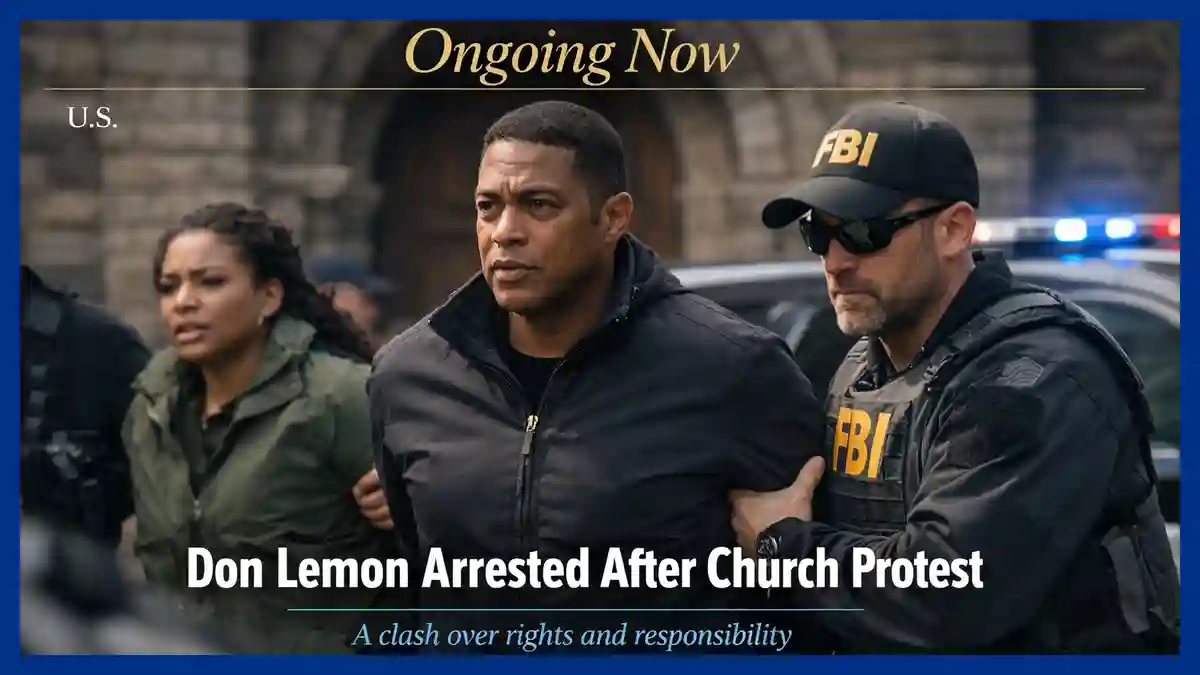
Federal authorities arrested veteran journalist Don Lemon in Los Angeles late Thursday, January 29, 2026, in connection with an anti-immigration enforcement protest at a Minnesota house of worship. The U.S. Department of Justice (DOJ) has charged Lemon with federal civil rights violations, including conspiracy to interfere with the religious freedom of worshipers at Cities Church in St. Paul. The arrest, announced by Attorney General Pam Bondi, follows a January 18 incident where activists disrupted a service to protest a pastor who also serves as an official for U.S. Immigration and Customs Enforcement (ICE).
The legal action has drawn immediate condemnation from press freedom advocates and civil rights organizations, who argue that the prosecution of Lemon and independent journalist Georgia Fort represents a significant shift in Trump administration press freedom policy. Attorney Abbe Lowell, representing Lemon, characterized the arrest as an “unprecedented attack on the First Amendment,” asserting that his client was present only to document the event as a member of the media. The arrests mark a notable escalation after a federal magistrate judge and an appeals court initially declined to approve arrest warrants for the journalists earlier in the month.
Federal Charges and the Legal Path to Indictment
The Department of Justice civil rights charges against Lemon and Fort were secured through a federal grand jury indictment, a move that bypassed earlier judicial skepticism. On January 22, Magistrate Judge Douglas Micko had refused to sign off on arrest warrants for five individuals, including Lemon, citing a lack of probable cause to believe they had committed a crime while reporting. Despite this, federal prosecutors pursued a grand jury indictment, which was confirmed by Pam Bondi arrest announcement on Friday morning.
The specific charges include conspiracy against the right of religious freedom and violating the Freedom of Access to Clinic Entrances (FACE) Act, which also protects houses of worship. Prosecutors allege that the presence of the journalists and their recording of the disruption contributed to the “coordinated attack” on the congregation. Under federal law, these charges can carry significant prison time and fines if a conviction is secured.
Key Legal Milestones in the Case
| Date | Legal Event | Outcome |
| Jan 18, 2026 | Protest at Cities Church, St. Paul | Service disrupted; journalists film event. |
| Jan 20, 2026 | DOJ applies for 8 arrest warrants | Magistrate Judge Micko approves 3, rejects 5. |
| Jan 25, 2026 | 8th U.S. Circuit Court of Appeals Review | Rejects DOJ’s bid to charge the remaining 5. |
| Jan 29, 2026 | Grand Jury Indictment | Warrants issued for Lemon, Fort, and two others. |
| Jan 30, 2026 | Federal Arrests | Don Lemon (LA) and Georgia Fort (MN) taken into custody. |
Note: The use of the FACE Act for incidents involving houses of worship has historically been focused on physical obstruction; the application to journalists filming a protest is a novel legal interpretation by the current administration.
Details of the St. Paul Church Disruption
The incident at the center of the federal case occurred at Cities Church St Paul protest during a Sunday morning service. Activists entered the sanctuary chanting “ICE out” and “Justice for Renee Good,” referencing a 37-year-old mother who was recently killed during an immigration enforcement operation in Minneapolis. The church was targeted because one of its pastors, David Easterwood, also holds a leadership position within the regional ICE field office.
Lemon and Fort were present inside the sanctuary, livestreaming the events to their respective audiences. While the DOJ characterizes their involvement as part of a “coordinated attack,” the journalists maintain they were acting independently. In his Abbe Lowell statement, the defense attorney emphasized that “Don has been a journalist for 30 years, and his constitutionally protected work in Minneapolis was no different than what he has always done.”

Press Freedom and Constitutional Concerns
The arrest of two high-profile journalists has sent shockwaves through the media industry, with organizations like the Committee to Protect Journalists (CPJ) and the Poynter Institute issuing formal condemnations. Critics argue that the Trump administration press freedom record is being tested by this use of federal law enforcement against those documenting civil unrest.
Intimidation Factor: Press advocates suggest that pursuing grand jury indictments after judges rejected warrants is a tactic intended to chill investigative reporting.
Selective Prosecution: Civil rights groups have noted that the DOJ opened a civil rights probe into the church disruption within days, while it has yet to announce a similar investigation into the shooting of Renee Good by federal agents.
Precedent Setting: A conviction in this case could redefine “conspiracy” to include the presence of journalists at unpermitted protests.
In her public announcement, Attorney General Bondi defended the move as a necessary protection of religious liberty. “You have the right to worship freely and safely,” Bondi stated. “And if I haven’t been clear already, if you violate that sacred right, we are coming after you.”
Impact on Local Communities and Civil Rights
The federal intervention has intensified existing tensions in the Twin Cities, where the immigrant community and activists are already on edge following recent enforcement actions. Georgia Fort, a three-time Emmy-winning independent journalist in Minnesota, was arrested at her home on Friday morning. Her arrest, alongside local activists Trahern Jeen Crews and Jamael Lydell Lundy, has sparked calls for a “nationwide strike” among some advocacy groups.
The societal impact is twofold: while some members of the religious community feel vindicated by the government’s protection of their sanctuary, others see the move as a weaponization of the law to suppress dissent. For the families involved in the original anti-ICE protests, the focus on the church disruption feels like a diversion from the fatalities that sparked the anger in the first place.
Analysis: A New Era of Federal Enforcement
The Don Lemon federal charges 2026 represent more than just a single criminal case; they signal a shift in how the federal government interacts with the press during moments of civil domestic conflict. Traditionally, the “reporter’s privilege” or general First Amendment protections have shielded journalists from being charged as co-conspirators in the events they cover, provided they do not participate in the illegal acts themselves.
By framing the act of filming a disruption as “conspiracy to interfere with religious freedom,” the DOJ is entering uncharted legal territory. If the courts uphold this interpretation, the line between “reporting on an event” and “participating in an event” may become dangerously blurred for independent and mainstream media alike.
Why This Matters for National Policy
Judicial Independence: The DOJ’s decision to proceed despite initial rejections from a magistrate and an appeals court suggests a high level of determination from the executive branch.
Civil Rights Balancing: The case pits the First Amendment rights of the press against the First Amendment rights of religious practitioners to worship without interference.
Federal vs. Local: These are federal charges being brought into a local community dispute, indicating a preference for federal oversight in matters involving immigration and religious liberty.
Evidence-Based Political Insights
The current administration’s strategy appears to involve a robust application of the FACE Act and civil rights statutes to address what it terms “radical activism.” Historically, the FACE Act was designed to protect reproductive health clinics, but its expansion to houses of worship—and its application to journalists—marks a pivot in prosecutorial priorities. This approach aligns with the administration’s broader platform of “law and order” and the protection of traditional institutions, even when those actions invite significant constitutional challenges from the judicial branch.
Stay sharp with Ongoing Now!
Source and Data Limitations: This report is based on official statements from the U.S. Department of Justice, social media announcements by Attorney General Pam Bondi, and court records from the U.S. District Court for the District of Minnesota. Specific details regarding the arrest of Don Lemon in Los Angeles were confirmed by statements from his legal counsel, Abbe Lowell. Information regarding the January 18 protest at Cities Church is derived from verified local news reporting by the Associated Press, the Minnesota Star Tribune, and PBS NewsHour. At this time, the full text of the grand jury indictment remains under seal or is partially disclosed through secondary official summaries. No speculative theories regarding the political motives of the defendants or the administration were included; the article focuses solely on the documented legal proceedings and institutional responses as of January 31, 2026.