How the Generic Congressional Ballot Is Shifting Control Ahead of the 2026 Midterms
Tracking executive branch approval data reveals how shifting independent coalitions are redrawing the competitive legislative landscape.
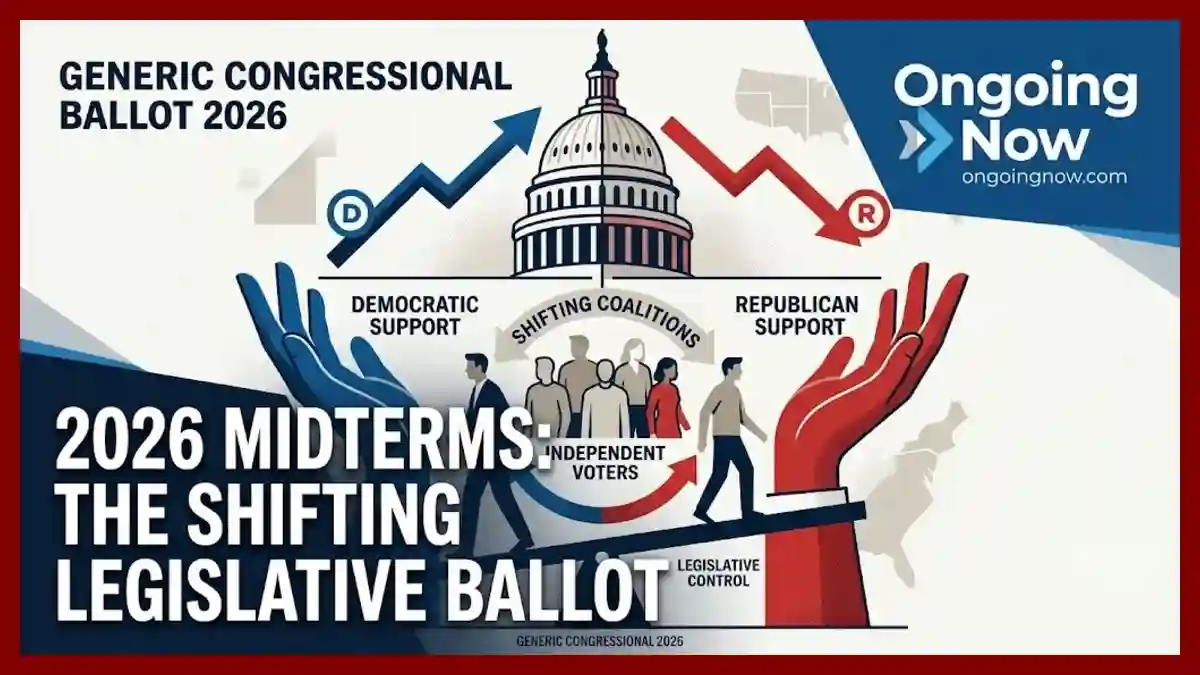
As midterms approach, tracking executive branch approval reveals shifting dynamics. The generic congressional ballot 2026 shows a noticeable shift, while the latest presidential approval rating reflects public discontent with economic conditions. According to the recent economist yougov presidential poll, independent voter approval data shows a historic drop. Simultaneously, analyzing non maga republican statistics and swing state favorability indices provides a window into changing modern political campaign strategies. The upcoming elections will depend heavily on republican voter turnout statistics and how issues perform on the partisan policy battle tracker.
Public consensus indicates significant institutional fatigue across the United States. A mid-2026 tracking survey by the Marist Poll highlighted that only 20% of Americans express a great deal or quite a lot of confidence in the U.S. Congress, while 80% express little to no confidence. This low confidence extends to the executive branch, with the presidency securing just 38% confidence against 61% reporting minimal trust. The alignment of these institutions heavily frames the policy choices facing the electorate as the legislative branch prepares for potential structural shifts.
Shifting Coalitions on the Generic Congressional Ballot 2026
The structural alignment of the national electorate suggests a competitive environment for both major political parties. The generic congressional ballot 2026 serves as a key metric for institutional health, and aggregate polling reveals distinct shifts away from traditional mid-decade baselines. In recent tracking data compiled by Ballotpedia, the Democratic Party maintains a national lead of approximately five percentage points over the Republican Party among likely midterm voters. This margin signals an evolving shift in voter sentiments regarding legislative performance and the distribution of federal authority.
Digging into these metrics reveals that party loyalty remains high among partisan blocks, but a significant drift occurs in the center. Data from the ActiVote June 2026 survey suggests that both the traditional political left and right are voting nearly unanimously for their respective candidates. However, the Democratic advantage is sustained primarily by an eight-point edge among self-identified centrist voters, a demographic that historically determines control of the House of Representatives.
This shifting foundation is forcing national committees to alter their regional strategies ahead of the November elections. Rather than relying solely on base mobilization, both parties are shifting resources to target suburban and moderate constituencies where voter dissatisfaction with federal polarization is highest. The numbers underscore a broader trend: while base enthusiasm remains solid, the ultimate direction of the legislature lies with shifting independent factions.
Tracking Executive Branch Approval and Economic Concerns
Public evaluation of the executive branch continues to influence congressional race metrics across the country. The latest presidential approval rating shows the administration navigating a challenging public opinion environment, with national aggregates placing positive marks at approximately 39% to 40%. Conversely, disapproval averages have stabilized at 56% to 57%, according to numbers monitored across major tracking platforms like RealClearPolitics and the Silver Bulletin. This persistent negative gap creates a challenging environment for down-ballot candidates aligned with the executive branch.
According to the comprehensive Economist/YouGov presidential poll conducted in early June 2026, a record 63% of American adult citizens disapprove of the administration’s management of the national economy. Price stability remains the absolute priority for the electorate, with 57% of total respondents across partisan lines identifying inflation and the cost of living as their primary policy concern. This economic strain presents a severe challenge to candidates attempting to defend the current status quo in competitive districts.
“Independent voters’ disapproval of the administration’s handling of immigration increased 17 points from last year, the economy by 13 points, and foreign policy 15 points,” noted Spencer Kimball, Executive Director of Emerson College Polling, highlighting the structural vulnerabilities facing down-ballot incumbents.
Independent Voter Approval Data Signals Realignment
The behavior of unaligned voters continues to serve as a leading indicator for systemic changes in federal control. Recent independent voter approval data indicates a sharp divergence from standard historical midterm patterns. In the late spring YouGov polling series, net job approval among self-identified independents fell to a record low of -50, with only 21% approving of executive performance compared to 71% expressing formal disapproval.
| Polling Organization | Field Dates (2026) | Sample Type | Democratic Support | Republican Support | Undecided / Other |
| Marist Poll | Nov 2025 (Baseline) | Registered Voters | 55% | 41% | 4% |
| Emerson College | April 24–26 | Likely Voters | 50% | 40% | 10% |
| ActiVote National | June 6–28 | Likely Midterm Voters | 49.2% | 43.8% | 7.0% |
| Economist / YouGov | July 10–13 | Registered Voters | 46% | 42% | 12% |
Caveat: Polling averages reflect generic national preferences; individual district outcomes vary significantly based on local candidate selection, state-level redistricting, and regional economic factors.
This notable drop in independent support directly shapes the current generic ballot metrics. According to findings from Emerson College Polling, independent voters favor Democratic congressional candidates over Republican options by a margin of 50% to 31%. This 19-point lead highlights a unique dynamic: even as unaligned voters voice deep frustration with the executive branch, they are simultaneously showing a preference for a legislative counterweight, rather than endorsing the alternative platform.
This split-ticket vulnerability introduces significant volatility into suburban congressional districts. Strategists note that when independent voters are broadly dissatisfied with both executive execution and opposition alternatives, voter turnout consistency decreases. Consequently, the outcome in key districts will likely hinge on which party can convert this general frustration into active ballot participation rather than passive polarization.
Swing State Favorability Indices and Regional Divergence
National polling often obscures the sharp geographic variations that ultimately dictate the balance of power in the U.S. Senate and House of Representatives. Recent swing state favorability indices illustrate that the competitive landscape is concentrated in a small number of critical regions. In states across the industrial Midwest and the Sun Belt, local economic conditions, agricultural output, and manufacturing employment metrics are driving voter preferences more intensely than national media narratives.
Demographic shifts within these states are further accelerating the divergence. For instance, Hispanic voters nationwide are currently breaking for Democratic congressional candidates by a 35-point margin (61% to 26%), according to Emerson College data. However, this advantage is highly variable across different states. In southwestern battlegrounds, this margin remains robust, whereas in southeastern regions, shifting trends among working-class communities suggest a much closer margin.
Furthermore, gender-based alignment continues to widen the regional gap. Women currently favor Democratic candidates by 21 points (55% to 34%), while men lean toward Republican candidates by a smaller but consistent margin. In highly suburbanized swing districts, this gender gap creates complex cross-pressures for campaigns attempting to craft unified policy messaging that appeals across household lines.
Non-MAGA Republican Statistics Altering Party Dynamics
Internal coalition dynamics within the opposition party represent another critical variable in the 2026 electoral equation. An examination of non maga republican statistics reveals a persistent ideological division over the long-term direction of the conservative platform. While executive branch pushback remains a unifying theme for the party base, a distinct segment of traditional, institutional, and moderate conservative voters expresses reservations about specific policy initiatives and governance styles.
According to YouGov tracking data, the administration’s favorability within its own party remains historically high but has experienced small, measurable declines, settling around a +61 net approval among registered Republicans. This leaves roughly 15% to 20% of the party base identifying as institutional or non-aligned conservatives who express discomfort with populist policy focus, particularly concerning international trade, tariffs, and foreign policy isolationism.
[Traditional Base Mobilization] ──> High Turnout in Rural Districts
                                           │
                                           ├──> Ideological Friction
                                           │
[Moderate / Non-MAGA Factions]  ──> Ticket-Splitting in Suburban Districts
This internal factionalism poses a distinct challenge for modern political campaign strategies. In deep-red rural districts, high-volume base mobilization strategies remain highly effective. However, in highly competitive suburban districts, candidates who align too closely with populist factions risk alienating traditional corporate and moderate conservative voters, leading to potential drop-offs in down-ballot support or localized instances of ticket-splitting.
Modern Political Campaign Strategies in a Polarized Field
In response to these fluid voter alignments, national committees are overhauling their approaches to voter contact and message delivery. Modern political campaign strategies are moving away from broad, high-cost television ad buys toward highly localized, data-driven micro-targeting. By leveraging advanced consumer metrics and voter history data, campaigns can isolate specific sub-segments of the electorate—such as independent women concerned with healthcare or traditional conservatives focused on federal spending.
Digital mobilization has also shifted heavily toward direct, text-to-web interfaces and peer-to-peer applications. Polling firms, including Emerson College, note that an increasing percentage of probability-based panels are reached via mobile messaging systems rather than traditional landline telephony. This technological shift allows campaigns to rapidly adjust their messaging based on real-time feedback from the partisan policy battle tracker, maximizing resource efficiency in the final weeks before voting begins.
Ultimately, the effectiveness of these modern platforms depends on the clarity of the core message. With an electorate deeply skeptical of institutional performance, campaigns that focus on concrete local economic relief and straightforward legislative checks tend to outperform those relying purely on nationalized ideological grievances.
Historical Precedents of Legislative Midterm Balance
The electoral volatility observed in mid-2026 aligns closely with established historical patterns of American governance. Historically, the party controlling the executive branch faces systemic structural headwinds during midterm cycles. This trend, often referred to by political scientists as “midterm loss,” has seen the president’s party lose seats in the House of Representatives in nearly every midterm election since the Civil War, with few exceptions.
Midterm Year | Executive Party | House Seats Gained/Lost
────────────────────────────────────────────────────────
2010         | Democratic      | -63
2014         | Democratic      | -13
2018         | Republican      | -40
2022         | Democratic      | -9
The data from the generic congressional ballot 2026 suggests that the current cycle is conforming to this institutional precedent, driven by similar dynamics of public dissatisfaction and economic adjustment. The scale of these historical shifts emphasizes that midterm elections function primarily as a systemic check on executive overreach, allowing the electorate to recalibrate the balance of power in Washington without changing the underlying executive leadership.
Analysis: The Institutional Impact on Legislative Governance
The primary consequence of a shifting generic congressional ballot 2026 is the direct impact it carries for the day-to-day operations of the federal government. Should current polling trends hold through November, a transition in legislative leadership would alter the functionality of congressional committees. The legislative branch would pivot sharply from passing baseline policy packages to executing rigorous institutional oversight of executive departments.
A divided government would effectively stall major partisan initiatives on the partisan policy battle tracker. Statutory priorities concerning federal immigration funding, domestic infrastructure oversight, and tax code revisions would require bipartisan compromise to clear the legislative hurdle. Consequently, the executive branch would likely rely more heavily on administrative actions and executive orders, which are inherently more vulnerable to federal judicial review and subsequent legislative funding restrictions.
Ultimately, the 2026 midterm metrics reflect an electorate seeking structural equilibrium. The tension between low executive approval and a preference for legislative checks indicates that voters are utilizing the congressional ballot not necessarily as a full endorsement of opposition ideology, but as a deliberate mechanism to enforce institutional constraint and stability within the constitutional framework.
Stay sharp with Ongoing Now!
Source and Data Limitations: This analysis relies on national and regional probability-based sample surveys conducted between November 2025 and July 2026. Primary statistical inputs are sourced from official publications by the Marist Poll, Emerson College Polling, ActiVote, and the Economist/YouGov tracking series. Demographics and voter registration weights conform to U.S. Census parameters and official state voter files. National polling margins of error across these instruments range from ±3.0% to ±3.6%. Readers should note that generic ballot testing measures aggregate national sentiment and cannot precisely account for localized factors, uncontested districts, or late-stage changes in voter turnout models.