How the high court birthright citizenship ruling alters noncitizen family limits
The Supreme Court strikes down Executive Order 14160, reinforcing Fourteenth Amendment protections for children of temporary visa holders and undocumented parents while tightening procedural reviews.
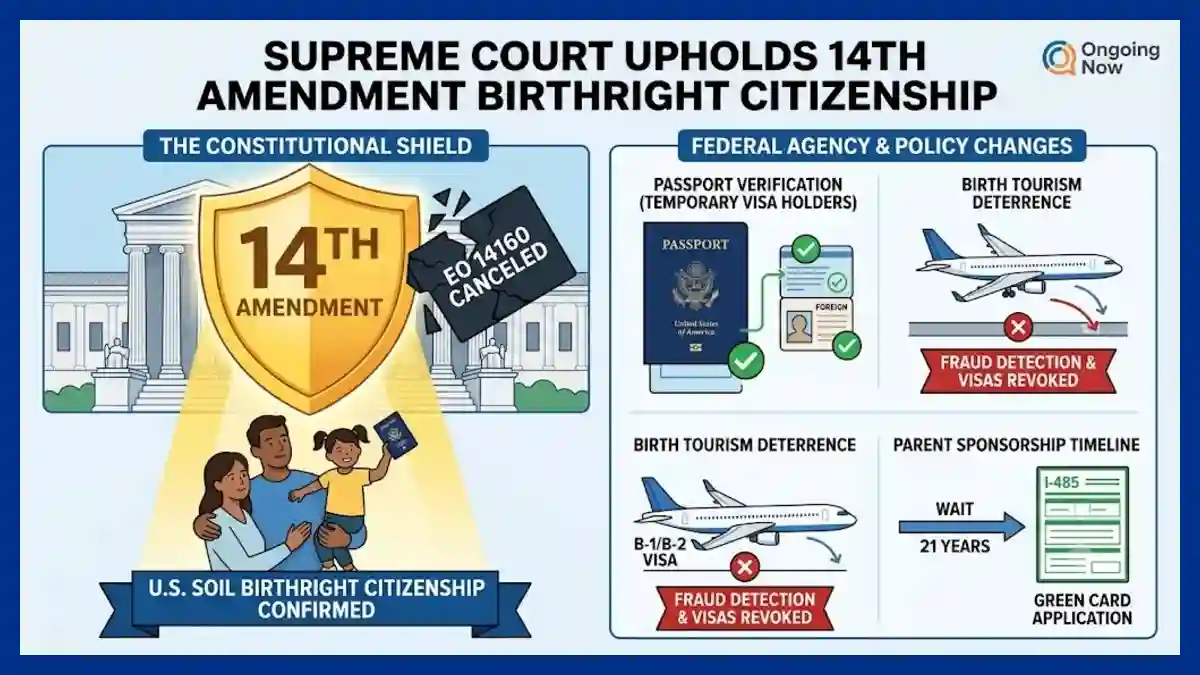
The structural boundaries of American citizenship have been reaffirmed following a decisive legal challenge to the nation’s foundational immigration framework. Under the Citizenship Clause of the Fourteenth Amendment, the rule of birthright citizenship establishes that anyone born on U.S. soil is a United States citizen at birth, regardless of the immigration status of their parents. In the landmark case Trump v. Barbara, decided on June 30, 2026, the Supreme Court of the United States struck down Executive Order 14160, a day-one directive aimed at denying automatic citizenship to children born to undocumented immigrants and temporary visa holders. This ruling decisively preserves a century-long legal consensus, leaving the core mechanisms of U.S. citizenship by birth soil vs blood rights intact while shifting the enforcement focus of federal agencies toward border controls and visa scrutiny.
The executive action, signed on January 20, 2025, attempted to reinterpret the constitutional phrase “subject to the jurisdiction thereof” to exclude individuals without permanent lawful status. By invalidating this policy, the high court solidified the traditional doctrine of jus soli (right of the soil) over jus sanguinis (right of blood) for all children born within U.S. territory. However, while the ruling safeguards the legal status of U.S.-born children, it introduces complex administrative shifts. New federal agency guidelines after birthright citizenship ruling emphasize tighter border screening, targeted investigations into birth tourism networks, and rigorous verification processes for passport applications for children of temporary visa holders. Furthermore, the decision highlights the rigid statutory limits governing the undocumented immigrant parent citizenship sponsorship timeline, reinforcing that birthright citizenship does not provide immediate regularized status or a protective shield against deportation for noncitizen parents.
The Legal Architecture of U.S. Citizenship: Soil vs. Blood Rights
The United States operates primarily on the principle of jus soli, a common-law doctrine inherited from England that links nationality directly to the territory of birth. This stands in contrast to jus sanguinis, the principle prevailing across much of Europe and Asia, where citizenship is inherited strictly through parental lineage. The legal foundation for American jus soli is anchored in the Fourteenth Amendment, ratified in 1868 to overturn the Dred Scott decision and guarantee citizenship to formerly enslaved individuals.
The text of the amendment states that all persons born or naturalized in the United States, and “subject to the jurisdiction thereof,” are citizens. For over a century, the authoritative precedent on this matter has been United States v. Wong Kim Ark (1898), in which the Supreme Court ruled that a child born in San Francisco to Chinese citizen parents—who were legally prohibited from naturalizing at the time—was a U.S. citizen at birth. The Court determined that the jurisdiction clause excluded only narrow, well-defined categories of individuals who possess sovereign immunity or are exempt from U.S. laws.
Under long-standing federal statutes, these exceptions remain highly restricted. The children of foreign diplomats birthright citizenship exceptions apply because foreign ambassadors enjoy full diplomatic immunity and cannot be prosecuted under domestic civil or criminal laws. Similarly, children born to foreign occupiers during a military invasion are excluded. Beyond these narrow classifications, all individuals physically present within the country, including temporary visitors and undocumented persons, are subject to its laws and, consequently, fall under its territorial jurisdiction.
The Constitutional Status of Outlying Territories and Non-Citizen Nationals
The territorial scope of jus soli contains distinct statutory variations established by the U.S. Congress. While the Fourteenth Amendment automatically applies to the 50 states, the District of Columbia, and incorporated territories, the status of unincorporated territories—historically termed “insular possessions”—is governed by federal statutory law rather than direct constitutional mandate.
Through amendments to the federal immigration law nationality act 1952 amendments, Congress systematically extended birthright citizenship to Puerto Rico, Guam, and the U.S. Virgin Islands. However, American Samoa remains a unique exception within the modern U.S. structural framework. Individuals born in this territory are designated under federal law as non-citizen nationals, rather than full citizens, at birth.
The Judicial Distinction of American Samoan Status
The unique status of individuals born in American Samoa has been the subject of intensive litigation. The table below outlines the judicial and statutory framework that distinguishes U.S. citizens from non-citizen nationals under federal law:
| Legal Category | Right to Reside & Work in U.S. | Federal Voting Rights | Passport Type | Path to Full Citizenship |
| U.S. Citizen | Unrestricted and permanent | Full voting rights in federal elections | Standard U.S. Passport | Automatic by birth or naturalization |
| Non-Citizen National | Unrestricted and permanent; immune to deportation | Prohibited from federal voting unless naturalized | U.S. Passport with national endorsement | Eligible for expedited naturalization after 3 months |
This statutory distinction was challenged in federal court by residents seeking full constitutional citizenship by birth. However, in major legal challenges, including appeals addressing american samoa non citizen national status scotus, the judiciary deferred to Congress’s plenary power over territories and respected the input of the local American Samoan government (the Fono), which argued that an automatic imposition of constitutional birthright citizenship could inadvertently disrupt traditional land tenure systems (Fa’amatai) and local cultural preservation laws. Consequently, American Samoa remains the only permanently inhabited territory where birthright citizenship is determined by specific congressional statutes rather than the Fourteenth Amendment.
Strict Limits on Parent Sponsorship and the Undocumented Immigrant Parent Citizenship Sponsorship Timeline
A frequent point of public confusion involves the immediate legal impact of a child’s birth on the immigration status of noncitizen parents. Under the Immigration and Nationality Act (INA), the birth of a U.S. citizen child provides no immediate lawful status, work authorization, or immunity from removal proceedings for undocumented parents. The legal mechanisms governing family-based immigration sponsorship are subject to rigid statutory timelines and strict enforcement criteria.
A U.S. citizen child cannot act as a green card sponsor rules for us citizen children until they reach the age of 21. Upon turning 21, the citizen child may file an I-130 Petition for Alien Relative, classifying the parent as an “immediate relative.” However, the path to obtaining a green card depends entirely on how the parent originally entered the United States:
Lawful Entry via Visa: If the parent entered the country legally on a temporary visa but overstayed, the 21-year-old citizen child can typically sponsor them for an Adjustment of Status (Form I-485) within the United States, provided the parent has no disqualifying criminal record.
Unlawful Entry Between Ports: If the parent entered the country without inspection, they cannot adjust status from within the U.S. They must undergo consular processing abroad. However, departing the U.S. after accumulating more than one year of unlawful presence triggers an automatic 10-year bar on re-entry.
To overcome the 10-year re-entry bar, the parent must qualify for an unlawful presence waiver (Form I-601A). Statutorily, this waiver requires demonstrating that the bar would cause “extreme hardship” to a U.S. citizen or lawful permanent resident spouse or parent. Notably, hardship to a U.S. citizen child is excluded by law from the eligibility criteria for this specific waiver.
Therefore, the undocumented immigrant parent citizenship sponsorship timeline requires a minimum wait of 21 years, and for parents who entered unlawfully, the process remains structurally blocked unless they possess an independent qualifying relative for a hardship waiver.
Executive Actions and Federal Agency Guidelines After the Supreme Court Ruling
Following the Supreme Court’s decision in Trump v. Barbara, federal immigration agencies have shifted their administrative focus. Because the Court ruled that the executive branch cannot unilaterally deny citizenship to U.S.-born children, the Department of Homeland Security (DHS) and the Department of State have issued updated guidelines designed to enforce existing statutory limits through rigorous documentation and visa screening.
The Department of State has implemented strict administrative reviews for passport applications for children of temporary visa holders. Parents holding nonimmigrant visas—such as B-1/B-2 tourist visas, F-1 student visas, or H-1B specialty occupation visas—must submit meticulous documentation proving their identity, lawful entry records (Form I-94), and continuous adherence to visa conditions.
[Passport Application Submitted]
               │
               ▼
[Parent Visa Status Verified via SEVIS/CBP Records]
               │
      ─────────┴─────────
     ▼                   ▼
[Status Verified]    [Discrepancy / Fraud Flagged]
     │                   │
     ▼                   ▼
[Passport Issued]    [Application Delayed & Referred to ICE]
Furthermore, the new federal agency guidelines after birthright citizenship ruling require immediate cross-referencing of parental visa data with Customs and Border Protection (CBP) entry logs. If a parent is found to have made material misrepresentations regarding the purpose of their travel during their initial visa interview, the agency may initiate visa revocation and refer the case to Immigration and Customs Enforcement (ICE) for potential removal proceedings against the parents, even as the child’s passport application is processed.
Counter-Exploitation Measures: Birth Tourism Regulations and the BACK OFF Act
With the constitutional avenue to end birthright citizenship closed by the judiciary, legislative and executive attention has converged on the regulation of international travel and the dismantling of commercial birth tourism operations. Birth tourism refers to the practice of traveling to the United States on a temporary visa for the primary purpose of giving birth on American soil, thereby securing automatic U.S. citizenship for the child.
The regulatory framework governing this practice is anchored in birth tourism regulations state department 2026. Under these long-standing consular guidelines, U.S. entry visas are explicitly denied to foreign nationals if the primary intent of the travel is determined to be giving birth for citizenship purposes. Consular officers are trained to evaluate whether an applicant has the financial means to cover private medical care in the U.S. and whether their stated travel itinerary aligns with legitimate medical or recreational purposes.
                    ┌────────────────────────────────────────┐
                    │  U.S. Embassy Global Enforcement 2026  │
                    └────────────────────────────────────────┘
                                        │
             ┌──────────────────────────┼──────────────────────────┐
             ▼                          ▼                          ▼
    [West Africa Network]       [European Hubs]           [North Africa Ring]
     100+ Visas Revoked          400+ Cases Tracked        100+ Visas Revoked
     Fraudulent Fixers Built     6 Corporate Schemes       Targeted Interdictions
In mid-2026, the Department of State announced the successful disruption of several transnational networks operating in West Africa, Europe, and North Africa. These commercial enterprises charged foreign nationals tens of thousands of dollars to arrange fraudulent visa applications, falsified medical appointments, and coordinated temporary housing in the United States. Federal authorities revoked more than 600 visas associated with these networks and issued permanent immigration bars to corporate facilitators.
On Capitol Hill, legislative measures have been introduced to formalize these restrictions. In May 2026, Senator John Cornyn (R-TX) introduced the Barring American Citizenship by Keeping Out Foreign Fraudsters (BACK OFF) Act. The proposed legislation seeks to amend the Immigration and Nationality Act to establish explicit criminal penalties for individuals who operate or facilitate birth tourism rings. The bill would also mandate the expedited removal of foreign nationals found to have used fraudulent tourist visas to enter the country for delivery purposes, establishing a statutory mechanism to deter the practice at ports of entry.
Societal and Institutional Impacts on Immigrant Communities
The intersection of constitutional protections and strict statutory enforcement has direct social and economic consequences for mixed-status families across the United States. A mixed-status family typically consists of U.S. citizen children residing with parents who are temporary visa holders or undocumented immigrants.
The preservation of birthright citizenship ensures that these children retain full access to public education, health insurance, and future employment opportunities within the formal economy. According to demographic data compiled by the Migration Policy Institute, a reversal of birthright citizenship would have significantly expanded the unauthorized population within the United States, potentially adding an estimated 2.7 million undocumented individuals by 2045. Such an expansion would have strained state-level social services and pushed successive generations into the informal labor market.
However, the rigid nature of the undocumented immigrant parent citizenship sponsorship timeline means that millions of families continue to operate under a dual legal reality. While the children are fully integrated citizens, their parents remain subject to the constant threat of deportation and lack access to federal safety-net programs. This structural division often manifests in lower rates of enrollment in beneficial programs—such as the Special Supplemental Nutrition Program for Women, Infants, and Children (WIC) or Medicaid—even when the children are legally entitled to receive them, due to parental fears of triggering immigration enforcement or violating public charge regulations.
Furthermore, state-level variations in policy create a fractured legal landscape for these households. States like California and New York offer access to state-funded health coverage and driver’s licenses for undocumented parents, mitigating some structural instability. Conversely, states with stricter enforcement mandates offer no such provisions, meaning the daily economic security of U.S. citizen children remains deeply dependent on the geographical location in which their families reside.
Stay sharp with Ongoing Now!
Source and Data Limitations: This policy explainer is based on official federal documents, including the Supreme Court syllabus and opinion in Trump v. Barbara (Docket No. 25-365, June 30, 2026), and Executive Order 14160 issued on January 20, 2025. Statutory references are derived directly from the Immigration and Nationality Act (INA) of 1952, as amended, including Sections 101 and 308 regarding U.S. national status. Administrative updates reflect official press releases from the U.S. Department of State regarding visa enforcement actions in June 2026, and the legislative text of the BACK OFF Act introduced in the U.S. Senate in May 2026. Demographic projections are sourced from joint publications by the Migration Policy Institute and Pennsylvania State University’s Population Research Institute. This analysis excludes speculative commentary regarding future judicial appointments or unverified internal agency memos, focusing strictly on enacted laws, published regulations, and binding court precedents available up to the current date.