Scaling New Heights: What Elite Exped Everest Package Cost Reveals About Safety
An analysis of luxury Himalayan climbing expenses, permit increases, and high-altitude risk protocols.
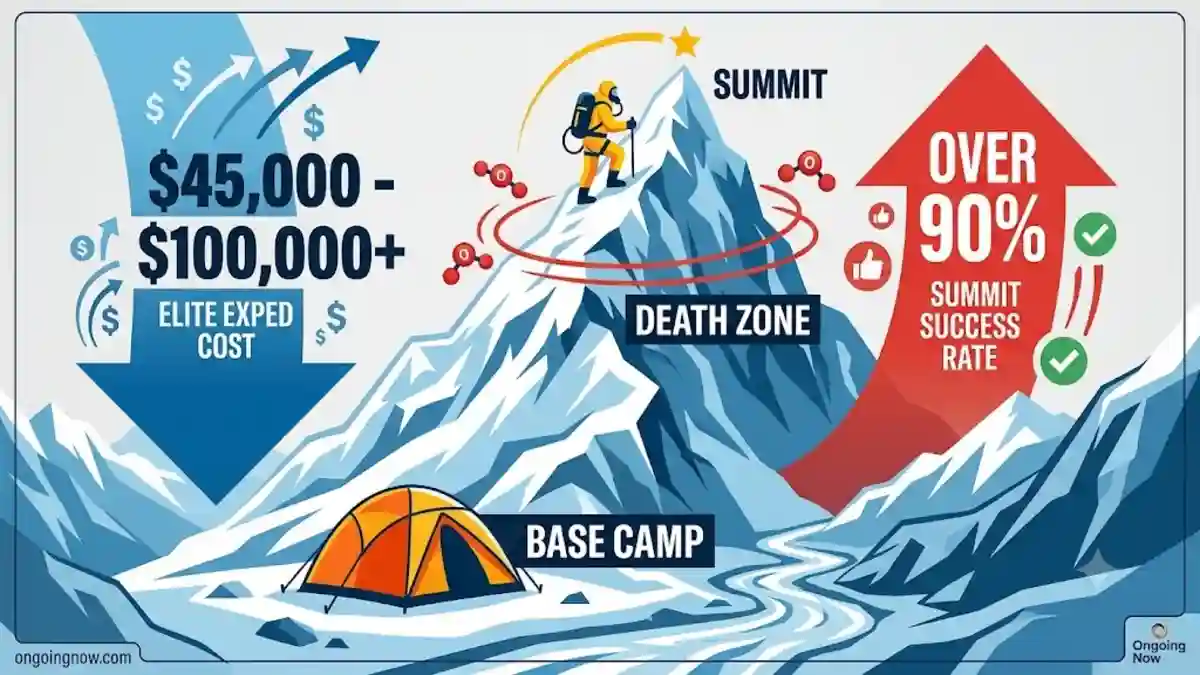
Commercial high-altitude mountaineering is experiencing a structural shift, where analyzing the elite exped everest package cost ($45,000–$100,000+) and broader commercial mountaineering guide pricing reveals how high-altitude travel has evolved. Prospective climbers examining the elite exped booking cost, nims purja expedition prices, and specific mount everest guided tour cost elite exped options evaluate these investments against the nims purja trekking agency safety record and published elite exped summit success rate. Regulatory changes, such as rising himalayan climbing permit costs and mandatory extreme altitude travel insurance nims purja mandates, define modern nims purja guided climbs. Understanding this himalayan luxury expedition pricing tier requires evaluating mount everest sherpa guide company reviews, local labor standards, and environmental management protocols.
The landscape of extreme altitude travel has transitioned from traditional alpine exploration to highly structured, luxury-supported commercial operations. Founded by former British Special Forces operatives Nirmal “Nims” Purja MBE and Mingma David Sherpa, Elite Exped represents the premium tier of high-altitude guided expeditions. Operating across the 14 eight-thousanders in Nepal, Pakistan, and Tibet, the company has popularized a model centered on high guide-to-client ratios, advanced supplemental oxygen logistics, and self-sufficient safety infrastructure.
Evaluating the Elite Exped Everest Package Cost Structure
The financial commitment required to climb Mount Everest varies significantly based on support tiers, logistical speed, and guide qualifications. Commercial operators generally divide offerings into standard full-service packages, rapid fast-track options, and fully customized private guidance.
For standard full-service itineraries spanning approximately 55 days, the elite exped everest package cost starts at $45,000 USD, extending up to $65,000 USD for upgraded service tiers. These packages encompass baseline logistical logistics, including Kathmandu accommodations, domestic flights, base camp infrastructure, food supplies, fixed-rope access, high-altitude Sherpa support, and supplemental oxygen cylinders.
Fast-Track and Multi-Peak Expeditions
For time-constrained clients, accelerated options utilize pre-acclimatization protocols involving hypoxic tents at home prior to arrival in Nepal. Elite Exped’s 29-day Fast-Track Everest expedition carries a base price of $100,000 USD. This pricing reflects specialized medical monitoring, direct helicopter transports, and dedicated high-altitude support teams positioned on the mountain to facilitate immediate climbing windows.
Additionally, combo expeditions that combine Mount Everest (8,848m) and neighboring Lhotse (8,516m) within a single 60-day climbing window are offered at approximately $90,000 USD. Private 1:1 guided ascents directly led or overseen by senior company directors can exceed $150,000 to $200,000 USD, depending on custom aviation and personal security requirements.
| Expedition Category | Duration | Base Price (USD) | Key Included Logistics |
| Standard Full-Service | 55 Days | $45,000 – $65,000 | Permits, base camp setup, Sherpa guidance, standard oxygen |
| Fast-Track Expedition | 29 Days | $100,000 | Hypoxic tent pre-conditioning, priority heli-flights, 1:1 Sherpa |
| Everest + Lhotse Combo | 60 Days | $90,000 | Dual-peak permit processing, extended oxygen allowance |
| Private VVIP Guided | Flexible | $150,000 – $200,000+ | Direct director guiding, custom logistics, private aviation |
| Everest Base Camp Trek | 14 Days | $3,000 | Trekking permits, lodge accommodation, local guide team |
Note: Published package prices generally cover core ground operations but exclude personal clothing, international airfare, travel visa fees, extreme altitude insurance, and discretionary crew gratuities.
Analysis: Shifts in High-Altitude Economics and Permit Fees
Understanding the broader cost trajectory requires analyzing state-level regulatory changes implemented by the Nepal Ministry of Culture, Tourism and Civil Aviation. In September 2025, Nepal officially enacted a 36% increase in foreign mountaineering royalty fees for Mount Everest via the standard South-East Ridge route.
The foreign climber permit fee rose from $11,000 USD to $15,000 USD for the primary spring season (March to May). Autumn permit fees increased from $5,500 USD to $7,500 USD, while winter and monsoon permits moved to $3,750 USD. Secondary 8,000-meter peaks, including Lhotse, Makalu, and Kangchenjunga, saw spring permit fees rise from $1,800 USD to $3,000 USD.
“The previous $11,000 royalty had remained unchanged since 2015 despite significant inflation, growing environmental demands, and rising operational costs on the mountain,” stated the Department of Tourism in their official regulatory brief. “The adjusted revenue structure directly supports localized waste collection, updated weather monitoring stations, and emergency search-and-rescue infrastructure across the Khumbu region.”
Mandatory Guide Ratios and Worker Insurance
In tandem with fee adjustments, revised Nepal government regulations mandate that all commercial expeditions maintain a minimum ratio of one certified high-altitude guide for every two climbers above 8,000 meters. Insurance coverage mandates for high-altitude workers were simultaneously raised to $14,400 USD for climbing guides and $10,800 USD for base camp support staff, establishing higher fixed operating baselines for commercial operators.
What the Data Shows: Commercial Mountaineering Safety Risks
Evaluating safety in commercial mountaineering requires separating marketing claims from operational risk management principles. High-altitude environments above 8,000 meters—known as the “death zone”—present inherent physical dangers, including acute mountain sickness (AMS), high-altitude pulmonary edema (HAPE), unpredictable weather systems, and serac collapse.
Elite Exped emphasizes a model built on self-reliance and redundancy. Unlike traditional operators that may rely shared fixings or external rescue networks, the company often fields independent rope-fixing teams, maintains secondary backup oxygen systems, and deploys high-altitude satellite tracking for every active team member.
Key Operational Metrics
Guide Qualification: Expedition leadership features IFMGA-certified guides, UK Special Forces veterans, and Sherpas with multiple 8,000m ascents.
Summit Success Rate: Elite Exped reports summit success rates exceeding 90% across standard commercial seasons, contingent on weather windows and client physical readiness.
Emergency Protocols: Every climbing group carries pulse oximeters, portable hyperbaric chambers at base camp, and redundant satellite communication systems.
Rescue History: Lead guides, including Nims Purja and Mingma David Sherpa, have documented histories of conducting high-altitude emergency rescues in extreme environments.
“In extreme high-altitude environments, safety is directly tied to control over variables,” noted Himalayan safety analyst Alan Arnette in his seasonal commercial mountaineering report. “Operators that maintain independent oxygen supplies, dedicated Sherpa teams, and disciplined turn-around times consistently show lower casualty rates during unexpected weather shifts.”
Insurance Requirements and Practical Considerations for Climbers
Climbing an 8,000-meter peak requires specialized insurance policies that go far beyond standard travel insurance. Traditional medical travel policies explicitly exclude activities above 4,000 or 6,000 meters and exclude technical mountaineering.
Essential Coverage Components
Uncapped Search and Helicopter Rescue: Medical evacuations from high camps in the Khumbu region via specialized long-line helicopter rescue can cost between $5,000 and $20,000 USD per flight.
High-Altitude Medical Treatment: Comprehensive policies must cover specialized treatments for frostbite, cerebral edema, and extended hospitalizations in Kathmandu.
Trip Cancellation and Interruption: Given the total package investment of $45,000 to $100,000 USD, specialized cancellation coverage protects against regional airspace closures, medical disqualification, or severe avalanche delays.
Repatriation Coverage: Full coverage for emergency medical repatriation to the climber’s home country.
Operators like Elite Exped mandate proof of comprehensive extreme-altitude insurance prior to base camp deployment. Specialized underwriters, such as Global Rescue and Ripcord Rescue Travel Insurance, are standard providers for high-altitude Himalayan expeditions.
Societal and Environmental Impact in the Khumbu Valley
The growth of luxury commercial mountaineering has profound economic and environmental implications for local Himalayan communities. The Khumbu region relies heavily on tourism revenue generated during the spring and autumn climbing seasons.
Local Labor and Economic Equity
Historically, high-altitude Sherpas bore disproportionate physical risks while receiving a fraction of the profits generated by Western expedition agencies. The emergence of Nepali-owned elite agencies, such as Elite Exped and Seven Summit Treks, has altered this dynamic, shifting market leadership to indigenous mountaineers.
This shift has elevated compensation standards, improved insurance protections, and provided clearer career advancement paths for high-altitude workers. Furthermore, charitable initiatives, such as the Nimsdai Foundation, reinvest expedition proceeds into local educational, healthcare, and porter welfare programs across high-altitude Nepalese villages.
Environmental Stewardship
Environmental degradation remains a critical challenge on Mount Everest. Overcrowding at bottleneck points, such as the Hillary Step and Icefall, generates significant waste management challenges.
Under new waste-management guidelines enforced by the Sagarmatha Pollution Control Committee (SPCC) and local municipal authorities:
Climbers are required to carry dedicated biodegradable waste bags to transport human waste from higher camps back to Base Camp.
Expeditions must pay refundable garbage deposits (typically $4,000 USD per team) released only after verified waste retrieval.
Cleanup drives funded by updated government permit royalties removed over 85 tonnes of historical waste from the Everest region in recent seasons.
Comparative Analysis: Premium Operators vs. Standard Commercial Models
To contextualize Elite Exped’s operational positioning, comparing commercial service models highlights how pricing directly correlates with resource allocation on the mountain.
COMMERCIAL EXPEDITION SERVICE SPECTRUM

[Budget Operators: $30,000 – $40,000]
 ├── Shared logistics & basic tents
 ├── 1:2 or 1:3 Sherpa ratio
 └── Standard 4-6 oxygen bottles per client

[Mid-Tier Operations: $45,000 – $65,000]
 ├── Standard full-service camp infrastructure
 ├── 1:1 Sherpa support ratio
 └── Standard medical monitoring & group rescues

[Luxury / Elite Tier: $70,000 – $100,000+]
 ├── Private dome tents, personal chefs & heated amenities
 ├── 1:1 or 2:1 Sherpa-to-client ratio + dedicated fixing teams
 └── Hypoxic pre-conditioning, unlimited oxygen & private heli-support
Strategic Trade-Offs for High-Altitude Travelers
Choosing a luxury commercial operator represents a trade-off between cost and risk mitigation. While budget operators lower financial barriers to entry, they may operate with fewer backup oxygen bottles, lower Sherpa pay structures, and less flexible emergency evacuation options. Premium operators offset extreme costs by engineering greater margins of safety, providing higher-flow oxygen regulators, and maintaining direct control over rope-fixing and weather forecasting data.
Stay sharp with Ongoing Now!
Source and Data Limitations: Information regarding expedition costs, package structures, and safety protocols was compiled from official Elite Exped operational announcements, Nepal Ministry of Culture, Tourism and Civil Aviation regulatory updates (enacted September 2025/2026), Department of Tourism fee schedules, and published data from the Sagarmatha Pollution Control Committee (SPCC). Direct operator pricing reflects baseline published figures for the 2025–2026 climbing seasons and excludes variable individual expenses such as custom gear, tips, and personal insurance. Unverified individual forum reviews and unsourced safety claims were excluded in favor of official regulatory guidelines and verified company disclosures.