Defending Personal Email Against State-Sponsored Hacking
As Iranian cyber operations like Handala target high-profile individuals, implementing a hardware security key for Gmail and Advanced Protection has become a critical baseline for personal digital security.
The landscape of personal cybersecurity has shifted from defending against opportunistic scammers to mitigating sophisticated, state-aligned intrusion sets. On March 27, 2026, reports confirmed that a pro-Iranian group successfully breached the personal email account of FBI Director Kash Patel, leaking years of private correspondence and documents. This incident highlights a broader trend where actors such as the Handala group—linked by the U.S. Department of Justice and firms like Check Point Research and SentinelOne to Iran’s Ministry of Intelligence and Security (MOIS)—target the personal digital footprints of government officials and private citizens alike.
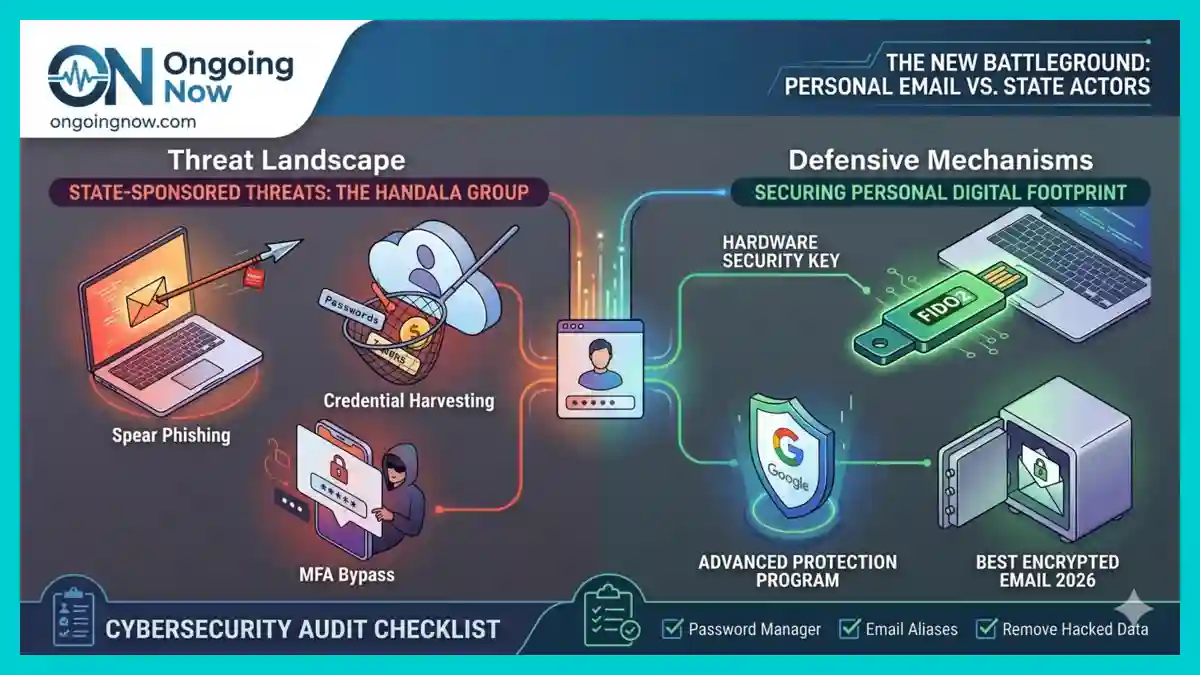
Understanding how to secure personal email from hackers now requires more than just strong passwords; it necessitates an Advanced Protection Program setup and the use of a hardware security key for Gmail. These tools are designed to prevent state sponsored cyber attacks that utilize spear phishing, credential harvesting tactics, and bypass multi factor authentication (MFA) via sophisticated Adversary-in-the-Middle (AitM) techniques. As cyber espionage explained through recent breaches shows, the goal of these “faketivist” personas is often psychological disruption and the permanent deletion of data via custom Handala malware analysis identifies as destructive “wipers.”
The Handala Group: Origin and Iranian State-Sponsored Hacking Methods
The Handala group origin dates back to late 2023, emerging as a disruptive persona that blends technical intrusion with psychological warfare. Unlike traditional ransomware groups that seek financial gain, Handala operates as a front for the Iran Ministry of Intelligence cyber operations, specifically the cluster tracked by researchers as Void Manticore (also known as Storm-0842 or Banished Kitten). Their primary objective is “disrupt, leak, and amplify,” using high-quality spear phishing to gain initial access before deploying destructive payloads.
Handala Malware Analysis and TTPs
Recent Handala malware analysis by Cyble and Unit 42 reveals a modular toolkit designed for cross-platform destruction. Their “Wiper Arsenal” includes the Handala Wiper, which overwrites the Master Boot Record (MBR), and the Hatef Wiper, which systematically deletes files while reporting progress to a command-and-control (C2) server in real-time.
| Phase | Technique (MITRE ATT&CK) | Tools Used |
| Initial Access | T1566: Spear Phishing | F5 Networks or CrowdStrike Lures |
| Credential Access | T1003: OS Credential Dumping | LSASS Memory Dumps, Mimikatz |
| Lateral Movement | T1021: Remote Services | SMB, RDP, NetBird VPN |
| Exfiltration | T1567: Exfiltration over Web API | Telegram Bot API, Storj |
| Impact | T1485: Data Destruction | Handala Wiper, BiBi Wiper |
How to Secure Personal Email from Hackers in 2026
The breach of high-ranking officials underscores that standard SMS-based MFA is no longer sufficient to prevent state sponsored cyber attacks. State actors frequently use credential harvesting tactics like “MFA Push Bombing”—sending repeated prompts until a user accidentally approves—or AitM proxies that intercept session tokens.
Implementing a Hardware Security Key for Gmail
To achieve the highest level of security, users should transition to FIDO2-compliant hardware security keys (e.g., YubiKey or Google Titan). Unlike codes, these physical tokens require a hardware-level handshake that cannot be intercepted by a remote hacker.
Purchase two keys: Always have a primary and a backup stored in a secure location.
Register the keys: Navigate to Google Account > Security > 2-Step Verification.
Remove weaker methods: Disable SMS and voice call codes, which are vulnerable to SIM swapping.
Advanced Protection Program Setup
For those at high risk, such as government employees or journalists, the Advanced Protection Program setup provides a “hardened” version of a Google account. It mandates the use of security keys, limits third-party app access to data, and adds rigorous identity verification steps for account recovery.
Secure Communications for Government Employees and High-Risk Targets
When personal cybersecurity audit checklists fail, the focus must shift to secure communications for government employees. Personal accounts are often the “weakest link” used to pivot into professional networks. Hardening personal digital footprint involves moving sensitive conversations to best encrypted email services 2026.
Best Encrypted Email Services 2026: Comparative Analysis
| Service | Jurisdiction | Encryption Model | Key Security Feature |
| Proton Mail | Switzerland | End-to-End (PGP) | Zero-access architecture |
| Tuta Mail | Germany | End-to-End (AES/RSA) | Encrypted subject lines |
| Mailfence | Belgium | OpenPGP | Integrated keystore |
| StartMail | Netherlands | Server-side PGP | Disposable “burner” aliases |
These services provide a secondary layer of defense: even if a service provider is subpoenaed or breached, the content of the emails remains encrypted with a key known only to the user.
Personal Cybersecurity Audit Checklist: Hardening Your Footprint
A personal cybersecurity audit checklist is essential for hardening personal digital footprint and ensuring that a single compromise does not lead to total identity theft.
Identity Isolation: Use unique, randomly generated passwords for every account via a password manager.
Legacy Data Removal: Learn how to delete hacked data from web by using services that scan for PII (Personally Identifiable Information) on data broker sites.
Email Aliasing: Use aliases for non-essential sign-ups to prevent your primary address from appearing in credential harvesting databases.
Device Integrity: Ensure “Remote Wipe” is enabled on all mobile devices to stop identity theft after hack.
Analysis: Why Personal Accounts are the Primary Target
Data from Push Security indicates that Iranian actors are increasingly targeting personal “Identity” rather than technical vulnerabilities. By compromising a personal Gmail or M365 account, actors gain access to password reset links for other services, tax documents, and private photos that can be used for extortion or “doxxing.” This “Identity-first” TTP (Tactic, Technique, and Procedure) allows state actors to bypass enterprise-grade firewalls by simply logging in as the user.
Human and Societal Impact: Beyond the Technical Breach
The activities of groups like Handala have profound societal implications. Their March 2026 attack on Stryker Corporation—a medical device company—reportedly wiped 200,000 devices, demonstrating that state-sponsored disruption can directly impact healthcare delivery. Furthermore, the use of stolen data to send death threats to dissidents (as documented by the FBI and DOJ) shows that cyber espionage is a tool of transnational repression.
“Iran thought they could hide behind fake websites and keyboard threats to terrorize Americans,” stated FBI Director Kash Patel during a press briefing regarding the seizure of Handala-linked domains. However, the subsequent breach of his own account illustrates the persistent nature of these threats. For the average user, the risk is less about targeted assassination and more about being collateral damage in broad spear phishing campaigns or having personal data weaponized in “hack and leak” operations.
Evidence-Based Insights for 2026
To stop identity theft after hack, victims must act within the “Golden Hour” of a breach. This includes freezing credit reports, revoking all active sessions in account settings, and auditing “forwarding rules” in email settings—a common tactic used by hackers to maintain a “silent” copy of all future correspondence.
Key Metrics: Iranian Cyber Activity (Q1 2026)
Primary Vector: 74% of successful entries began with spear phishing.
Dwell Time: Average time before a Handala wiper is triggered is 4.2 days.
Target Shift: 30% increase in attacks targeting government employees’ personal accounts compared to 2025.
By following an Advanced Protection Program setup and maintaining a rigorous personal cybersecurity audit checklist, individuals can significantly raise the “cost of entry” for state actors, moving from a target of opportunity to a hardened environment.
Stay sharp with Ongoing Now!
Source and Data Limitations: This report is based on cybersecurity advisories from the FBI, CISA, and DOJ (released March 2026), alongside technical malware analysis from Unit 42, Check Point Research, and Cyble. Data regarding the Kash Patel breach is derived from verified reports by PBS News and Reuters as of March 27, 2026. Metrics on “Handala” TTPs reflect observed patterns in the Stryker and Clalit Healthcare campaigns. Limitations include the reliance on “hack-and-leak” claims made by threat actors, which may contain exaggerated data volumes or fabricated evidence for psychological impact. Jurisdictional encryption standards for email services are current as of late 2025/early 2026.