Why Global Shortages Are Twisting the Apple Memory Chip Supply Chain
An analytical review of how escalating enterprise data demands alter production logistics and drive M5 hardware costs.
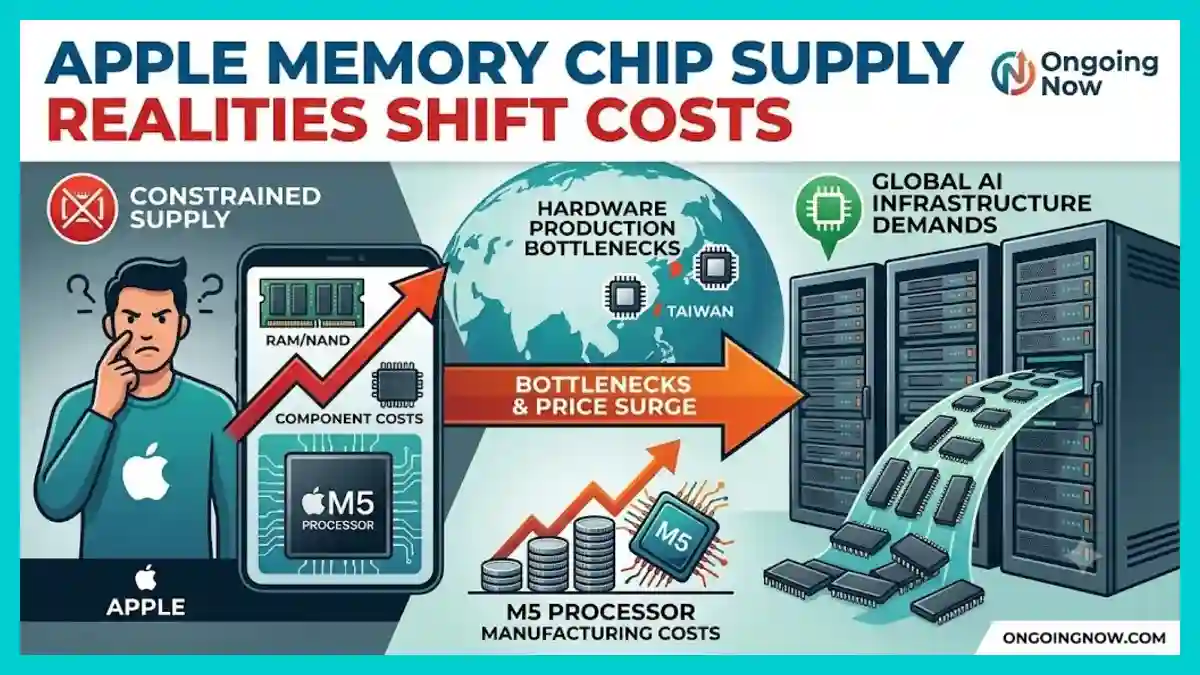
Amid intense global hardware production bottlenecks and an unexpected semiconductor chip price surge, the volatility of the Apple memory chip supply has emerged as a central challenge for consumer electronics. Driven by escalating AI server infrastructure demands, the enterprise computing sector is competing directly for critical components. For Apple Inc., this macro shift has significantly increased M5 processor manufacturing costs while disrupting advanced computing hardware logistics. To maintain system performance, engineers are adjusting RAM and storage technical logic to compensate for an ongoing Apple silicon component shortage.
The convergence of these events has reshaped the structural economics of the consumer technology industry. According to data from market research firms and statements from industry analysts at Jefferies, high-bandwidth storage and volatile memory components have entered an unprecedented pricing upcycle in the first half of 2026. Taiwan Semiconductor Manufacturing Company (TSMC), Samsung Electronics, SK Hynix, and Micron Technology have reportedly restructured their operational priorities to favor enterprise data centers. This strategic realignment directly impacts client-side consumer platforms, as commercial buyers absorb high premiums to secure production capacity.
Tracking the Volatility in Apple Memory Chip Supply
The current strain on the global market traces back to shifting resource allocations among the world’s primary memory fabricators. Data centers deploying large-scale language models require massive quantities of specialized memory, which has squeezed the volume available for consumer devices. This shift has altered the predictability of the Apple memory chip supply, forcing a re-evaluation of long-term component procurement.
To offset these disruptions, corporate logistics teams are expanding their supplier portfolios and altering delivery timelines. Industry reports indicate that standard procurement lead times for high-capacity volatile components have extended by several weeks compared to the previous fiscal year. The resulting constraints have made it difficult to forecast hardware availability across multiple product tiers, creating operational friction.
“The semiconductor industry in 2026 has officially entered a full-chain price hike cycle driven by rigid cost increases and sustained enterprise infrastructure demands,” states Zhang Xiaorong, Dean of the DeepTech Research Institute.
Macro Factors Underlying the Semiconductor Chip Price Surge
The broad semiconductor chip price surge is not isolated to a single component class or manufacturing region. Upstream raw material costs, energy price inflation, and elevated logistics expenses have collectively forced wafer foundries to adjust their baseline pricing matrices. Essential production elements, including epitaxial wafers, advanced chemical molding compounds, copper, and silver, have recorded sharp price increases since early January 2026.
Foundries and outsourced semiconductor assembly and test (OSAT) providers are transferring these cost increases down the supply chain. Market tracking data shows that contract prices for dynamic random-access memory (DRAM) and NAND flash storage have risen between 15% and 30%. Because consumer personal computers require densified memory modules, the financial impact accumulates rapidly at the assembly level.
Escalating AI Server Infrastructure Demands and Market Allocation
The rapid expansion of enterprise hyper-scalers has created a structural supply imbalance that alters how chips are allocated globally. Financial incentives offered by corporate data center operators far exceed the margins typically generated by high-volume consumer gadgets. Consequently, major storage manufacturers like Samsung and SK Hynix are prioritizing high-bandwidth memory (HBM) lines over standard low-power DDR5 allocations.
This intense competition from AI server infrastructure demands has created a domestic and international siphoning effect. Advanced fabrication facilities are operating near maximum capacity utilization, leaving minimal surplus for seasonal consumer production spikes. As a result, hardware brands must either pay uncontracted spot-market premiums or accept lower unit allocations for upcoming product assemblies.
Analyzing M5 Processor Manufacturing Costs under Market Pressure
Apple’s latest silicon architecture directly exposes the brand to these compounding economic shifts. The M5 Pro and M5 Max processors, introduced in March 2026, rely on an advanced Fusion Architecture that bonds two third-generation 3-nanometer dies into a single system-on-a-chip (SoC). This complex multi-die design requires a high-performance unified memory controller and enhanced packaging methodologies, which substantially elevates baseline production overhead.
The combination of advanced packaging yields and market premiums has pushed M5 processor manufacturing costs beyond initial projections. Because unified memory architecture requires RAM to sit directly adjacent to the processor on the substrate, any increase in component costs immediately inflates the total cost of the completed SoC. The tight integration that gives Apple silicon its performance efficiency also serves as a financial multiplier during supply contractions.
| Chip Variant | Base Memory Bandwidth | Maximum Supported Memory | Estimated Packaging Architecture |
| Apple M5 Base | 150 GB/s (Approx.) | 32 GB Unified | Single-Die Monolithic |
| Apple M5 Pro | 307 GB/s | 64 GB Unified | Dual-Die Fusion Architecture |
| Apple M5 Max | 614 GB/s | 128 GB Unified | Dual-Die Fusion Architecture |
Caveat: Bandwidth metrics are sourced from official technical specifications; actual yields and manufacturing cost allocations vary based on foundry agreement structures and defect densities.
Adjusting RAM and Storage Technical Logic for System Longevity
To mitigate the financial impact of the Apple memory chip supply squeeze, hardware engineers are modifying underlying hardware parameters. This includes a thorough revision of RAM and storage technical logic to optimize memory utilization without demanding higher physical capacities. Operating systems are incorporating aggressive memory compression algorithms and advanced swap-file management to reduce physical hardware dependencies.
An example of this architectural shift is the implementation of Memory Integrity Enforcement within the M5 family. This technology provides hardware-level memory safety and optimization, ensuring that available unified memory blocks operate at peak efficiency. By maximizing the utility of lower-capacity tiers, developers can deliver high-throughput AI prompt processing while capping physical hardware requirements.
Managing Advanced Computing Hardware Logistics and Assembly
The physical distribution of specialized components represents another layer of operational friction within the current landscape. Advanced computing hardware logistics require precise synchronization between memory foundries in South Korea, packaging facilities in Taiwan, and final assembly lines. Any delay in the transit of raw silicon or memory substrates can halt production lines, incurring substantial overhead costs.
Geopolitical complexities and tightened export controls have further complicated these transport corridors, forcing corporations to rethink their logistics frameworks. Supply-chain teams are increasingly relying on air-freight corridors and regional storage hubs to bypass localized disruptions. However, these safety measures introduce additional structural costs, which ultimately compound the price pressures affecting the final product.
Mitigating the Apple Silicon Component Shortage in Retail Lines
The consequences of the Apple silicon component shortage have begun manifesting within global retail distribution channels. While smartphone architectures use lower quantities of memory, high-end personal computers and professional tablets bear the brunt of component cost increases. Consequently, base model configurations for several computing lines have experienced mid-cycle pricing adjustments in selected international markets.
By maintaining unchanged baseline prices for smaller mobile devices, corporate planners are concentrating their margin preservation efforts on high-performance machines. Industry observers note that entry-level laptops have seen standard starting storage capacities frozen or adjusted to protect baseline profitability. This targeted allocation ensures that critical professional workflows remain supported even as component availability remains volatile.
Resolving Global Hardware Production Bottlenecks through Diversification
Long-term stabilization of the technology sector depends entirely on resolving deep-rooted global hardware production bottlenecks. Expanding existing fabrication facilities requires multi-year lead times and billions of dollars in capital expenditure, meaning relief will not be immediate. Analysts expect that structural supply constraints will persist through the remainder of 2026 and potentially into the next fiscal year.
In response, technology companies are forming closer strategic alliances with secondary and tertiary component fabricators to secure alternative supply lines. While secondary suppliers may not match the absolute density of primary market leaders, they provide a vital safety valve for non-clearing components. This gradual diversification of the Apple memory chip supply represents a permanent shift toward structural resilience over raw cost optimization.
Societal and Enterprise Impacts of Prolonged Supply Constraints
The persistence of elevated hardware costs carries broader implications for digital transformation across the enterprise and consumer sectors. Corporate IT departments are responding to these market realities by extending the operational lifecycles of their existing fleets. Rather than adhering to rigid two-year or three-year replacement cycles, businesses are utilizing device analytics to target upgrades based on performance degradation rather than hardware age.
This shift in corporate procurement slows down the adoption rate of modern computing features, anchoring organizations to legacy frameworks. For educational institutions and creative professionals, higher entry costs create distinct barriers to accessing local hardware acceleration and on-device AI tools. As computing resources become more expensive, the technology industry must balance the pursuit of architectural innovation with the practical realities of a constrained global supply chain.
Stay sharp with Ongoing Now!
Source and Data Limitations: This analysis relies on public financial reports, official hardware specifications released by Apple Inc. in March 2026, and semiconductor industry supply-chain disclosures from Q1 and Q2 2026. Price adjustment ranges and contract values are derived from market tracking reports compiled by analytical firms including Jefferies, DeepTech Research Institute, and semiconductor vendor updates (Samsung, SK Hynix, TSMC, STMicroelectronics). Quantitative cost modeling excludes confidential bilateral corporate agreements, proprietary foundry yield statistics, and localized tax or tariff adjustments that vary by geopolitical region.