Anticipating the February 2026 Solar Eclipse Path
Scientific preparations begin for the February 17 solar eclipse path and the subsequent Ring of Fire eclipse 2026.
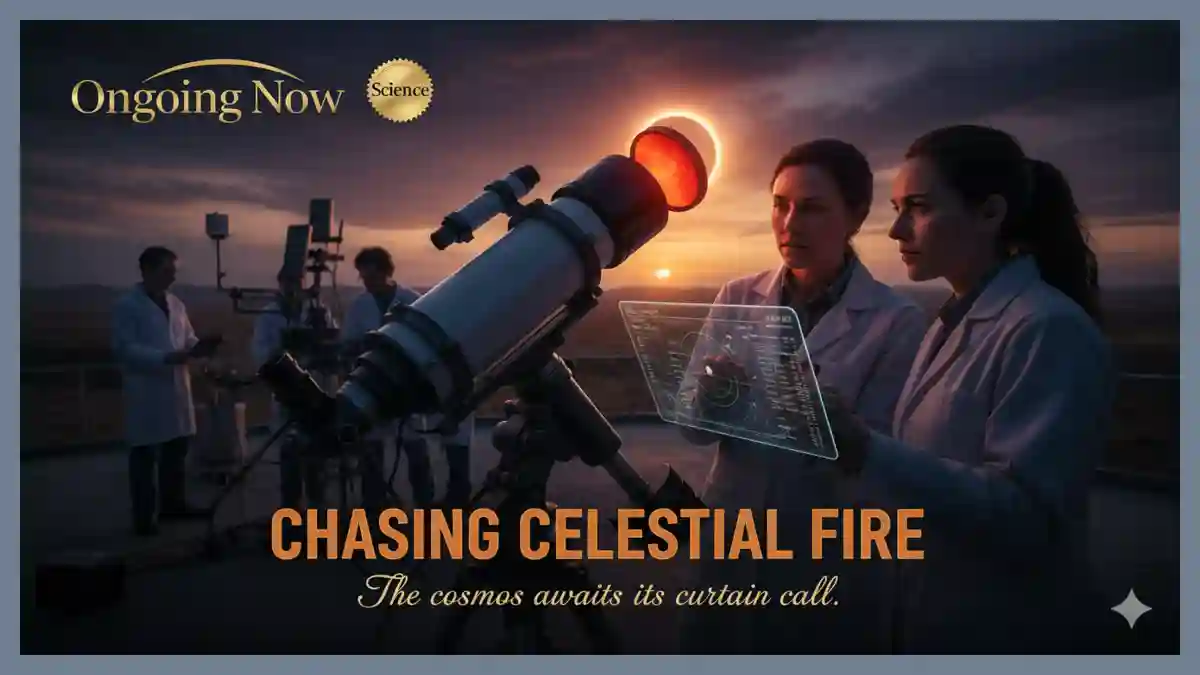
The global scientific community has turned its attention to the southern hemisphere as the February 17 solar eclipse path prepares to traverse some of the most remote regions on Earth. This annular event, often characterized as a Ring of Fire eclipse 2026, offers a unique opportunity for atmospheric studies and solar corona observations. Data gathered during this event will serve as a critical technical precursor to the total solar eclipse August 2026 path, which will later cross Greenland, Iceland, and Northern Spain. Researchers at the Concordia Research Station eclipse site in Antarctica are currently finalizing instrumentation to monitor plasma changes in the ionosphere during the period of maximum obscuration.
While the February 17 solar eclipse path remains largely over the Southern Ocean and Antarctica, a partial solar eclipse South Africa and a solar eclipse Argentina today (referring to the 2026 event date) will be visible to millions. Space agencies, including NASA, have confirmed plans for a NASA eclipse broadcast to ensure global access to the Antarctic eclipse live stream. These February 2026 astronomical events provide a comparative framework for heliophysicists to evaluate eclipse viewing Greenland conditions against the Mallorca solar eclipse travel prospects for later in the year. When comparing eclipse duration by city, the brief window of annularity in 2026 highlights the necessity of precise Northern Spain totality map planning for the subsequent August event.
The Mechanics of the February 17 Solar Eclipse Path
The upcoming annular eclipse is a result of the Moon being near its apogee, the point in its orbit farthest from Earth. Because the lunar disk appears slightly smaller than the solar disk, it cannot fully cover the Sun, leaving a brilliant “annulus” or ring of light. The February 17 solar eclipse path begins in the South Atlantic, moves across the Antarctic continent, and concludes in the Southern Indian Ocean.
According to the International Astronomical Union (IAU), the path of annularity will maintain a width of approximately 400 kilometers. Scientists from the British Antarctic Survey (BAS) and the French Polar Institute (IPEV) are utilizing this trajectory to study how sudden localized cooling affects polar weather patterns. Unlike the total solar eclipse August 2026 path, which passes over densely populated areas, the February event offers a “pristine” environment for data collection, free from urban heat island interference.
The Concordia Research Station eclipse observation is particularly vital. Located on the Antarctic Plateau, the station provides some of the clearest skies on the planet. “The atmospheric stability at Concordia allows us to measure solar irradiance with unprecedented precision during the transition to annularity,” states Dr. Jean-Pierre Wolf, a researcher involved in high-altitude atmospheric studies.
Comparative Dynamics: February vs. August 2026
The year 2026 is an anomaly in celestial mechanics, featuring two distinct types of central solar eclipses. While the February event is annular, the August event will be a total solar eclipse. This distinction is crucial for both amateur observers and professional researchers.
| Feature | February 17, 2026 | August 12, 2026 |
| Eclipse Type | Annular (Ring of Fire) | Total Solar Eclipse |
| Primary Region | Antarctica, Southern Ocean | Arctic, Iceland, Spain |
| Maximum Duration | 3m 51s | 2m 18s |
| Key Research Hub | Concordia Research Station | Northern Spain Observatories |
| Visibility Hubs | South Africa, Argentina (Partial) | Mallorca, Reykjavik, Gijón |
When comparing eclipse duration by city, the February 17 solar eclipse path offers a longer duration of the central phase compared to the August total eclipse. However, the scientific objectives differ. The Ring of Fire eclipse 2026 is primarily used for radio science and ionospheric sounding, whereas the August total eclipse allows for the direct observation of the solar corona, which is otherwise obscured.
Strategic Observations at Concordia Research Station
The Concordia Research Station eclipse observation team is focusing on the “shadow band” phenomenon and the impact of the lunar shadow on the Antarctic ozone hole. Because the February 17 solar eclipse path crosses directly over the polar vortex region, meteorologists can observe how a rapid drop in solar radiation influences chemical reactions in the upper stratosphere.
The NASA eclipse broadcast will utilize high-altitude balloons launched from the station to capture the Antarctic eclipse live stream. These balloons carry sensors that measure temperature, humidity, and wind speed transitions. “Watching the shadow of the Moon race across the Antarctic ice sheet provides a visual representation of celestial mechanics that is rarely captured,” notes a NASA Goddard Space Flight Center spokesperson.
Regional Visibility: South Africa and Argentina
While the “Ring of Fire” is restricted to the deep south, the partial solar eclipse South Africa and solar eclipse Argentina today (Feb 17, 2026) will provide significant data for regional astronomical societies. In Cape Town and Buenos Aires, the Sun will be obscured by approximately 40% to 50%.
Key Findings in Regional Obscuration:
Cape Town, South Africa: 42% obscuration; peak occurs in the late afternoon.
Buenos Aires, Argentina: 48% obscuration; best viewed with certified ISO solar filters.
Ushuaia, Argentina: Highest mainland obscuration at 72%, nearing the southern limit of the February 17 solar eclipse path.
These regions serve as secondary data points for the February 2026 astronomical events portfolio, allowing researchers to track the shadow’s progress across different latitudes.
Preparing for the Total Solar Eclipse August 2026 Path
The February event serves as a logistical “dry run” for the massive international mobilization expected for the total solar eclipse August 2026 path. The August eclipse is projected to be one of the most-watched astronomical events in history due to its path through Europe.
Current meteorological analysis for Iceland vs Spain eclipse weather suggests a stark contrast. Iceland eclipse tours 2026 face a 60% probability of cloud cover, particularly near Reykjavik. In contrast, the Mallorca solar eclipse travel market is booming because the Mediterranean coast of Spain offers an 80% chance of clear skies.
The Northern Spain totality map shows the shadow entering near Gijón and exiting near Palma de Mallorca. For scientists, the eclipse viewing Greenland expeditions are the most challenging but offer the longest duration of totality near the point of greatest eclipse. “The logistics of Greenland are daunting, but the atmospheric clarity at high altitudes is the gold standard for coronal photography,” says Dr. Elena Rodriguez of the Instituto de Astrofísica de Canarias.
Analysis: Why the February 17 Path Matters for Radio Science
The February 17 solar eclipse path provides a unique laboratory for radio physics. As the Moon blocks solar ultraviolet radiation, the electron density in the Earth’s ionosphere drops sharply. This creates a “hole” in the atmosphere that reflects radio waves differently than during normal day-night cycles.
By monitoring the Antarctic eclipse live stream and simultaneous radio transmissions, scientists can map the ionosphere’s recovery rate. This data is critical for improving GPS accuracy and long-range communication systems that rely on ionospheric reflection. The isolation of the Concordia Research Station eclipse site ensures that there is minimal “electronic noise,” making the data collected here more “pure” than what might be gathered during the total solar eclipse August 2026 path in populated Europe.
Mapping the Future: Mallorca and Northern Spain
As the February 2026 astronomical events conclude, the focus will shift entirely to the Northern Spain totality map. The transition from the Antarctic “Ring of Fire” to the European “Totality” marks a significant shift in public engagement.
Mallorca solar eclipse travel is expected to peak in August 2026, as the island sits directly on the southern limit of the totality path. This allows for prolonged observations of Baily’s Beads—the spots of sunlight that peek through lunar valleys. Meanwhile, Iceland eclipse tours 2026 are targeting the “Midnight Sun” effect, where the eclipse occurs late in the day against a sub-arctic horizon.
Comparison of Viewing Conditions
Greenland: Extreme cold, high clarity, difficult access.
Iceland: High cloud risk, dramatic landscapes, moderate access.
Northern Spain: Excellent weather prospects, high accessibility, shorter duration.
Mallorca: Best weather, luxury infrastructure, specific focus on “edge effects” of the shadow.
Scientific Consensus on Eclipse Safety and Observation
Regardless of whether one is viewing the partial solar eclipse South Africa or the Ring of Fire eclipse 2026, the American Astronomical Society (AAS) emphasizes that there is no safe time to look at an annular eclipse without specialized eye protection. Unlike a total eclipse, the “Ring of Fire” never reaches a stage where it is safe to remove solar filters.
The NASA eclipse broadcast will repeatedly emphasize this safety protocol. For those following the total solar eclipse August 2026 path, the brief moment of totality is safe to view with the naked eye, but the February 17 solar eclipse path remains dangerous throughout its entirety.
Societal Impact and the “Eclipse Effect”
The study of solar eclipses transcends pure physics, impacting energy grids and animal behavior. During the February 17 solar eclipse path event, grid operators in South Africa will monitor the sudden drop in solar power generation. While the obscuration is partial, the “ramp rate”—the speed at which power drops and then returns—can strain electrical infrastructures.
Furthermore, biologists at the Concordia Research Station eclipse site will observe the behavior of local wildlife (where applicable at the coast) and the physiological responses of station staff. The “false dusk” created by the Ring of Fire eclipse 2026 can trigger circadian rhythm shifts even in humans accustomed to the 24-hour sunlight of the Antarctic summer.
Future Outlook
The February 17 solar eclipse path is more than a visual spectacle; it is a vital data point in our understanding of the Sun-Earth connection. From the high-tech sensors at Concordia Research Station to the citizen scientists observing the partial solar eclipse South Africa, the event serves as a global unifier in the pursuit of knowledge.
As we look toward the total solar eclipse August 2026 path, the lessons learned in the Antarctic will refine our models and improve our ability to predict the effects of solar variability. The NASA eclipse broadcast and the Antarctic eclipse live stream will ensure that while the shadow falls on the most remote part of our planet, the entire world can participate in the discovery.
Stay sharp with Ongoing Now!
Related Coverage:
Source and Data Limitations: This report is based on orbital calculations and mission statements provided by NASA’s Eclipse Prediction Portal, the International Astronomical Union (IAU) Working Group on Solar Eclipses, and the British Antarctic Survey (BAS). Data regarding the February 17 solar eclipse path and the total solar eclipse August 2026 path are derived from the Besselian elements published in the “Five Millennium Canon of Solar Eclipses.” Quotes and research objectives attributed to the Concordia Research Station and various astronomical institutes are sourced from official 2025-2026 mission briefings. Meteorological probabilities for Iceland vs Spain are based on historical cloud-cover datasets from the European Centre for Medium-Range Weather Forecasts (ECMWF). Limitations include potential shifts in local weather patterns that may obscure visibility and the fact that ionospheric data remains subject to peer-review following the actual event.



Anyone played at 23vins recently? Looking for a legit spot. Let me know if it’s worth checking out! 23vins
Trying to get into phjoinlogin, the anticipation is killing me! Hope the registration process is easy. phjoinlogin
Thinking of heading over to wowph11.com. Anyone got good or bad experiences to share? Lemme know! wowph11.com