Saving the Ecosystem: How New Coral Reef Restoration Techniques Cool the Ocean
Atmospheric modeling and bioengineered symbionts emerge as critical climate adaptation strategies to protect marine ecosystems.
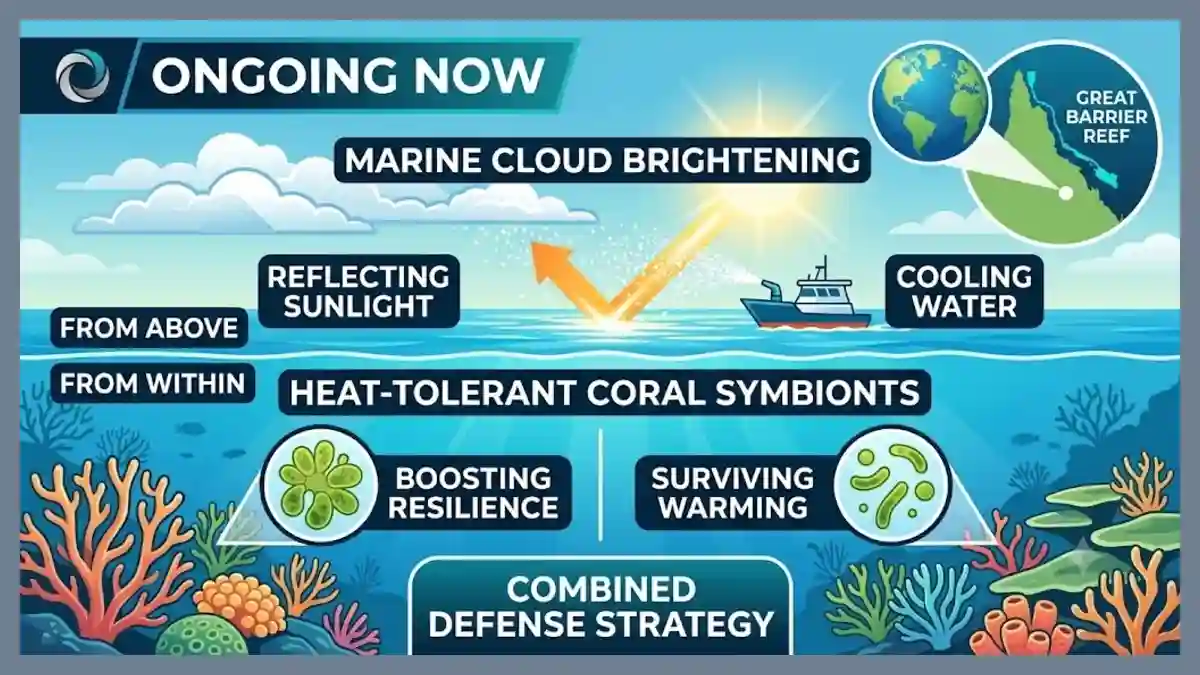
A standard trade-cumulus cloud regime over the Great Barrier Reef exhibits strong sensitivity to the spatial configuration of artificial aerosol emissions, according to recent climate adaptation ecological research. The atmospheric modeling study, published in EGUsphere, evaluates how marine cloud brightening coral intervention techniques could mitigate the impacts of escalating ocean temperature warming solutions. Utilizing convection-permitting Weather Research and Forecasting (WRF) model simulations, researchers found that the dispersion and efficacy of sea-salt droplets are heavily governed by source spacing and background atmospheric conditions. The findings provide critical context for regional coral reef restoration techniques designed to protect marine ecosystems from mass thermal bleaching events.
The investigation into atmospheric intervention coincides with separate field data and laboratory programs led by the Australian Institute of Marine Science (AIMS) and Southern Cross University. As greenhouse gas emissions continue to elevate global baselines, the Great Barrier Reef has experienced six major mass bleaching events within a ten-year window. While long-term conservation relies on global emissions reductions, marine engineering and biological interventions are increasingly evaluated as temporary regional mechanisms to buy time for vulnerable ecosystems.
Atmospheric Modeling Reveals Strategic Importance of Nozzle Spacing
The efficiency of marine cloud brightening hinges on the Twomey effect, a phenomenon where adding aerosol particles to a cloud increases the concentration of smaller droplets, thereby making the cloud brighter and more reflective. To evaluate how this plays out over the Great Barrier Reef, researchers simulated three distinct spatial configurations using an identical mass of injected sea-salt aerosols.
The experiments contrasted a densely distributed configuration featuring 75 emission sources spaced 20 kilometers apart (EXP20), a moderate configuration (EXP40), and a sparsely distributed configuration featuring just three high-intensity emission sources spaced 100 kilometers apart (EXP100). The simulations revealed that localized, high-intensity plumes face rapid particle scavenging due to coagulation, where droplets collide and merge, reducing their overall reflectivity.
Conversely, the widespread, lower-intensity configuration produced a highly homogeneous aerosol layer, maximizing the domain-mean increase in cloud droplet number concentration and overall cloud albedo.
Quantifying Cloud Microphysical Responses to Aerosol Injections
The 2026 atmospheric study highlights that while cloud albedo and optical depth are highly responsive to strategic aerosol forcing, macro-properties like total cloud fraction and cloud water path remained largely unchanged. This indicates that the primary cooling mechanism is strictly driven by changing the microphysics of existing clouds rather than inducing the formation of new cloud systems or altering cloud lifetimes.
| Experiment Configuration | Source Spacing | Source Count | Primary Atmospheric Impact |
| EXP20 (Dense/Moderate) | 20 km | 75 | Homogeneous aerosol enhancement; maximized cloud albedo via Twomey effect. |
| EXP40 (Intermediate) | 40 km | 12 | Moderate plume dispersion; intermediate reflectivity gains. |
| EXP100 (Sparse/Intense) | 100 km | 3 | Localized aerosol peaks; rapid particle scavenging; minimal domain-wide albedo change. |
Caveat: These results are based on 1-kilometer inner-domain WRF model simulations of a shallow trade-cumulus regime. Actual atmospheric boundary layer conditions, vertical wind shear, and variable mid-level humidity can introduce nonlinear responses in plume lofting.
Biological Interventions: Deploying Heat Tolerant Coral Symbionts
While marine cloud brightening seeks to lower ambient sea surface temperatures from above, marine biologists are simultaneously working from the bottom up by introducing heat tolerant coral symbionts directly into reef systems. Corals rely on a mutually beneficial relationship with microscopic algae (symbionts) embedded in their tissues to provide energy through photosynthesis. When ocean temperatures exceed normal summer maximums by 2–3°C, this relationship fractures, causing the coral to expel the algae and appear bleached.
Long-term research managed by AIMS and the University of Melbourne has successfully accelerated the natural evolution of these microalgae. By exposing multiple generations of symbionts to elevated thermal profiles in a laboratory setting over a ten-year period, scientists selected strains capable of surviving severe thermal stress.
Crucially, long-term monitoring showed that adult fragments of the coral species Galaxea fascicularis inoculated with these heat-evolved symbionts maintained a stable partnership for over two years without suffering a reduction in physical growth rates—a trade-off that had plagued prior experimental trials.
Collaborative Field Deployments and Environmental Monitoring
Translating localized laboratory successes and computer simulations into scalable coral reef restoration techniques requires intensive field validation. Southern Cross University, backed by funding from the Advanced Research + Invention Agency (ARIA), is coordinating expanded outdoor field trials scheduled through the late 2020s.
The field operations utilize specialized vessels equipped with effervescent nozzles that mix compressed air and seawater to generate an optimized mist of sub-micrometric sea-salt particles. These trials are specifically designed to address how atmospheric turbulence and localized wind profiles affect the vertical trajectory of the plume as it drifts away from the deployment vessels.
To track the plume dynamics horizontally and vertically, research teams have integrated drone-based sampling platforms alongside permanent ground-based monitoring stations, satellite observations, and instrumented research aircraft.
Societal Risk Management and Technical Limitations
Deliberate environmental interventions fall under the category of marine geoengineering, a field that attracts significant scientific and public scrutiny. A primary concern within the scientific community is that regional cooling mechanisms could mask the broader impacts of global warming without addressing ocean acidification, which occurs as seawater absorbs excess atmospheric carbon dioxide.
Furthermore, sudden cessation of a large-scale marine cloud brightening operation could result in rapid thermal rebound, exposing marine ecosystems to abrupt temperature spikes. Because of these ecological risks, any future scaling of these technologies remains subject to independent environmental impact assessments, extensive public consultation, and strict regulatory oversight.
Evidence-Based Insights for Marine Ecosystem Preservation Projects
The combined data from Australian Institute of Marine Science data repositories and atmospheric modeling groups demonstrate that active reef interventions cannot act as standalone solutions. Instead, they function as tactical interventions designed to minimize peak thermal stress during acute marine heatwaves.
Integrating atmospheric shading with biological assisted evolution offers a multi-tiered defense strategy. Shading reduces the localized solar radiation entering the water column, while heat-tolerant symbionts raise the biological threshold at which the remaining heat triggers a bleaching response.
Verifiable Scientific Commentary
“Strategies to enhance coral heat tolerance can buy time for reefs, which are threatened by climate change-driven marine heatwaves causing bleaching and sometimes mortality. The long-term stability of the symbiosis offers hope they may be able to provide benefits to their coral hosts for many years.”
— Dr. Wing Yan Chan, Lead Author, Australian Institute of Marine Science & University of Melbourne
“To give coral reefs the best chance of survival, we need to reduce emissions, ensure coral reef systems are managed well, and develop interventions like heat-evolved symbionts to help boost climate tolerance and resilience for reefs.”
— Dr. Line Bay, Research Program Director, Australian Institute of Marine Science
“This year, what we’re really interested in is looking at the behaviour of that plume of sea-salt droplets as it drifts away from the boat… how many of those droplets make it up to cloud height, and how do atmospheric turbulence and winds spread those droplets?”
— Dr. Daniel Harrison, Project Lead, Southern Cross University
Stay sharp with Ongoing Now!
—
Source and Data Limitations: This explainer draws directly from peer-reviewed research published in Global Change Biology (Chan et al.) regarding heat-evolved algal symbionts, institutional technical releases from the Australian Institute of Marine Science (AIMS), and open-access atmospheric modeling preprints from Copernicus EGUsphere (Zhao et al., 2026) focusing on WRF simulations over the Great Barrier Reef. Modeling data is inherently constrained by localized grid resolutions (1–5 km) which may introduce subtle underestimations of atmospheric updraft rates and cloud fraction parameters compared to empirical satellite observations. Biological findings are limited to controlled laboratory and initial mesocosm environments; long-term open-ocean efficacy trials remain subject to ongoing environmental impact assessments and independent regulatory approval before field scaling.


