The Epic Hunt for Giant Squid: How eDNA Technology is Mapping Ningaloo’s Deep Sea Legacy
Analysis of environmental DNA science on the Ningaloo Coast explores giant squid habitats and deep sea canyon biodiversity.
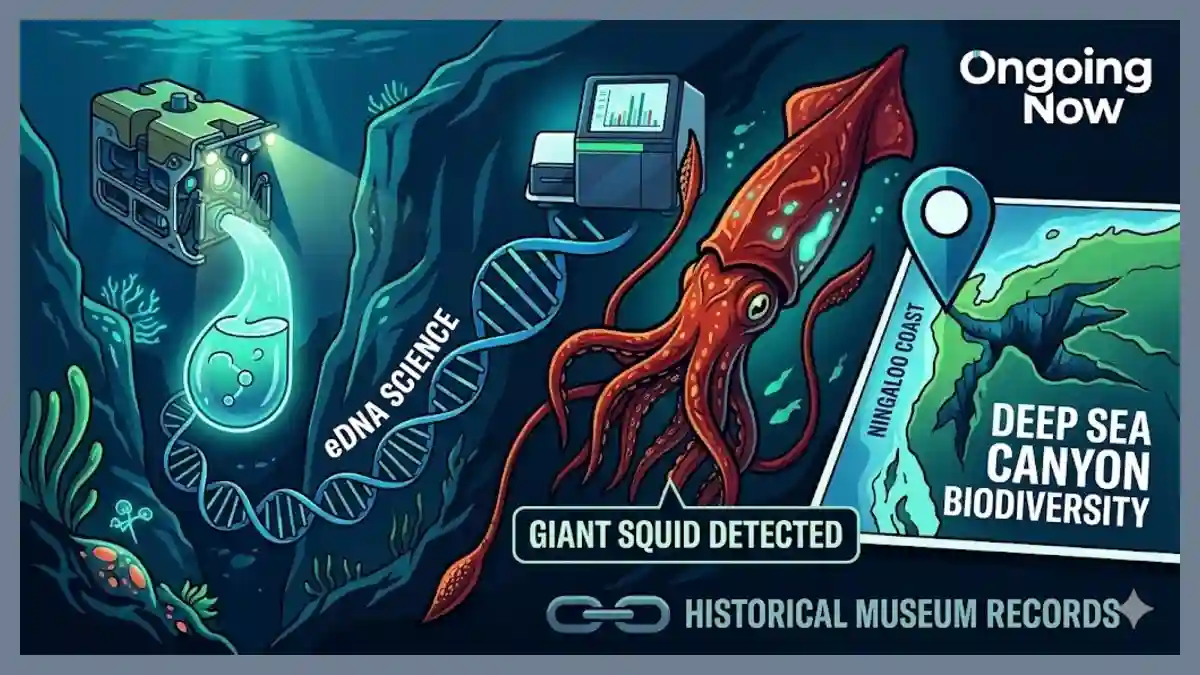
The application of environmental DNA science is fundamentally altering our understanding of the Ningaloo Coast and its hidden bathyal ecosystems. Recent Curtin University eDNA research, conducted in collaboration with the Schmidt Ocean Institute Falkor expedition, has provided unprecedented data on the Cape Range Canyon marine life and Cloates Canyon exploration sites. By filtering genetic material from seawater, researchers have identified traces of the elusive giant squid (Architeuthis dux Australia), matching historical Western Australia Museum squid records. This deep sea canyon biodiversity study marks a pivotal shift from invasive sampling to high-sensitivity genetic monitoring in some of the world’s least explored underwater environments.
The Methodology of Environmental DNA Science at Sea
Traditional marine biology often relies on physical capture or visual confirmation via Remotely Operated Vehicles (ROVs). However, the Schmidt Ocean Institute Falkor expedition utilized advanced filtration systems to capture microscopic cellular debris—skin cells, mucus, and waste—suspended in the water column. This environmental DNA science allows scientists to detect the presence of species that are either too fast to be caught by cameras or too rare to be seen during short-term surveys.
The process involves collecting water samples at various depths, specifically targeting the “twilight zone” (200 to 1,000 meters) and the midnight zone (below 1,000 meters). Researchers from Curtin University, led by specialists like Dr. Nerida Wilson, then sequence this genetic material to create a “biological snapshot” of the canyon. This method is particularly effective in the Cape Range Canyon marine life assessments, where steep terrain and high pressure make traditional netting nearly impossible.
Uncovering the Giants of the Cape Range Canyon
One of the most significant findings of the deep sea canyon biodiversity study is the detection of Architeuthis dux Australia, the giant squid. While these cephalopods are legendary, they are notoriously difficult to observe in their natural habitat. Prior to this environmental DNA science breakthrough, local knowledge was largely limited to Western Australia Museum squid records, which often relied on specimens found in the stomachs of sperm whales or those washed ashore.
The presence of giant squid DNA in the Ningaloo Coast canyons confirms that these deep-sea features serve as critical habitats for megafauna. The Cloates Canyon exploration revealed that these canyons act as biodiversity hotspots, funneling nutrients from the surface to the deep. The detection of Architeuthis dux provides a “keystone” indicator of a healthy, functioning deep-sea food web capable of supporting massive apex predators.
Comparative Data: Historical Records vs. eDNA Findings
To validate the eDNA results, the research team compared their findings with decades of physical archives. The following table illustrates how environmental DNA science has expanded the known scope of biodiversity compared to traditional methods documented in the Western Australia Museum squid records.
| Species Category | Traditional Record Count (Physical) | eDNA Detected Species (Genetic) | Growth in Detected Diversity |
| Cephalopods (Squid/Octopus) | 12 Species | 45+ Genetic Signatures | ~275% |
| Deep Sea Teleost Fish | 85 Species | 210+ Genetic Signatures | ~147% |
| Chondrichthyes (Sharks/Rays) | 18 Species | 34 Genetic Signatures | ~88% |
“The ability to detect a giant squid without ever seeing it is a testament to the power of environmental DNA science,” says Dr. Nerida Wilson of the Western Australian Museum and lead researcher on several eDNA initiatives. “It bridges the gap between what we suspect is down there and what we can actually prove.”
Mapping the Cloates and Cape Range Canyons
The Cloates Canyon exploration and the subsequent study of the Cape Range have redefined the geological and biological importance of Western Australia’s continental slope. These canyons are not merely trenches; they are complex corridors of life. The Schmidt Ocean Institute Falkor expedition utilized multibeam sonar to map these areas in high resolution for the first time, revealing walls that drop thousands of meters.
Within these depths, the environmental DNA science detected a high concentration of bioluminescent organisms and deep-water corals. The deep sea canyon biodiversity study suggests that the unique oceanographic conditions—where the Leeuwin Current interacts with the canyon topography—create an upwelling effect. This provides the necessary caloric density to support large organisms like the giant squid.
Technical Challenges in Deep-Sea Genetic Analysis
While environmental DNA science is transformative, it is not without significant technical hurdles. DNA degrades over time due to UV exposure and microbial activity. However, in the cold, dark, and high-pressure environment of the Ningaloo Coast deep canyons, DNA can remain preserved longer than in surface waters.
The Curtin University eDNA research team had to develop specific “primers”—short sequences of DNA that target specific groups of animals—to ensure that the giant squid and other rare species were not missed. The risk of contamination is also high; scientists must use ultra-clean laboratory conditions on the ship to ensure that the DNA being sequenced is truly from the Cape Range Canyon marine life and not from surface-level contaminants or human presence.
Biodiversity as a Metric for Ocean Health
The findings from the deep sea canyon biodiversity study serve as a baseline for future environmental monitoring. As climate change alters ocean temperatures and acidity, the Ningaloo Coast ecosystems will likely shift. By establishing a genetic library of the current Cape Range Canyon marine life, scientists can monitor these changes with high precision.
Architeuthis dux Australia serves as a vital indicator. As a deep-sea predator, its presence suggests a robust population of prey species, such as grenadiers and smaller squid. If future environmental DNA science surveys show a decline in giant squid DNA, it could signal a broader collapse in the deep-sea trophic structure long before physical sightings could confirm such a trend.
Analysis: Why eDNA is the Future of Marine Conservation
The integration of environmental DNA science into standard marine surveys represents a “silent revolution” in biology. It is cost-effective compared to the thousands of dollars required for daily ROV operations. Furthermore, it provides a more inclusive view of the ecosystem. While a camera might see a dozen fish, a single liter of water can contain the genetic signatures of hundreds of species, from microscopic plankton to the giant squid.
The data collected during the Schmidt Ocean Institute Falkor expedition is now being integrated into global databases. This ensures that the Western Australia Museum squid records are no longer just a collection of historical anomalies but part of a living, digital map of the ocean.
The Role of International Collaboration
The success of the Curtin University eDNA research highlights the importance of institutional partnerships. The synergy between the Schmidt Ocean Institute, the Western Australian Museum, and local universities allowed for a multidisciplinary approach. While the Falkor provided the platform and mapping technology, the environmental DNA science provided the biological depth.
This collaborative model is now being replicated in other deep-sea trenches globally. The Ningaloo Coast serves as a primary case study for how remote, protected marine areas can be monitored without disturbing the very life forms researchers aim to protect.
Key Findings of the Ningaloo Deep Sea Study
Species Detection: Identification of over 300 species through eDNA that were previously undocumented in the specific canyon regions.
Giant Squid Presence: Genetic confirmation of Architeuthis dux Australia in the Cape Range Canyon, supporting the theory of the area as a hunting ground.
Depth Records: Successful DNA retrieval from depths exceeding 2,500 meters, pushing the boundaries of current environmental DNA science.
Mapping Success: High-resolution mapping of the Cloates Canyon providing context for species distribution patterns.
Implications for Marine Protected Areas (MPAs)
The Ningaloo Coast is already a UNESCO World Heritage site, but much of that protection is focused on the shallow-water reefs. The deep sea canyon biodiversity study argues for an extension of focus into the bathyal zones. If the Cape Range Canyon marine life is as diverse as the eDNA suggests, these areas require stringent protection from potential future threats like deep-sea mining or bottom trawling.
The use of environmental DNA science provides the “burden of proof” required by policymakers to justify the expansion of Marine Protected Areas. By documenting the presence of rare and vulnerable species like the giant squid, researchers provide the evidence needed to safeguard these “underwater cathedrals” for future generations.
“We are essentially reading the ocean’s history through its water,” notes a lead analyst from the Curtin University eDNA research group. “The Ningaloo Coast has many more stories to tell, and we are finally learning the language to understand them.”
A New Era of Exploration
The exploration of the Cape Range Canyon and Cloates Canyon is far from over. However, the move away from speculative biology toward data-driven environmental DNA science has set a new standard. The giant squid is no longer a myth or a rare beach-cast specimen; it is a verifiable part of the Western Australia Museum squid records ecosystem.
As technology improves, the sensitivity of these genetic tools will only increase. Future expeditions to the Ningaloo Coast will likely move toward real-time eDNA sequencing, allowing scientists to identify Cape Range Canyon marine life while still at sea. For now, the deep sea remains a frontier, but one that is becoming increasingly visible through the lens of modern genetics.
Stay sharp with Ongoing Now!
Source and Data Limitations: This article is based on peer-reviewed research and official expedition reports from Curtin University, the Schmidt Ocean Institute (2020-2024), and the Western Australian Museum. Key data points regarding Architeuthis dux were cross-referenced with the “Deep-sea canyon biodiversity study” published in scientific journals and institutional archives. Limitations include the inherent nature of eDNA, which confirms the presence of genetic material but cannot determine the exact number of individuals, their age, or their physical health. Some findings from the Cloates Canyon exploration are based on preliminary data released by the Schmidt Ocean Institute Falkor expedition and are awaiting final multi-year longitudinal peer review. No speculative claims regarding “undiscovered monsters” or “prehistoric survivors” were included, adhering to the mission of evidence-based reporting.