How True Threats Case Law Is Redefining Online Speech Protections
An essential breakdown of recent Supreme Court precedents, subjective intent standards, and the future of digital expression limits.
Understanding freedom of speech boundaries requires evaluating political expression legal definitions and true threats first amendment case law to determine what constitutes a legal threat. Under protected speech guidelines supreme court decisions establish, finding a legal defense for online speech can be complex when anti government rhetoric laws intersect with safety. During constitutional rights attorney consultations, individuals often review citizen petition right protections alongside modern statutes defining unlawful intimidation online.
The boundary between protected expression and criminal conduct remains one of the most heavily litigated areas of American constitutional jurisprudence. The U.S. Supreme Court has repeatedly affirmed that while the First Amendment guards a wide array of speech, it does not shield expressions that cross the line into unprotected categories. Among these exceptions, the doctrine governing true threats requires a precise balance between individual liberties and public safety.
How True Threats First Amendment Case Law Defines Intent
The legal mechanism for identifying an unprotected threat relies heavily on the speaker’s state of mind, known as mens rea. In recent years, federal and state courts have grappled with whether an objective or subjective standard should govern these cases. An objective standard asks whether a reasonable observer would view the statement as a threat, whereas a subjective standard requires proof that the speaker intended to cause fear.
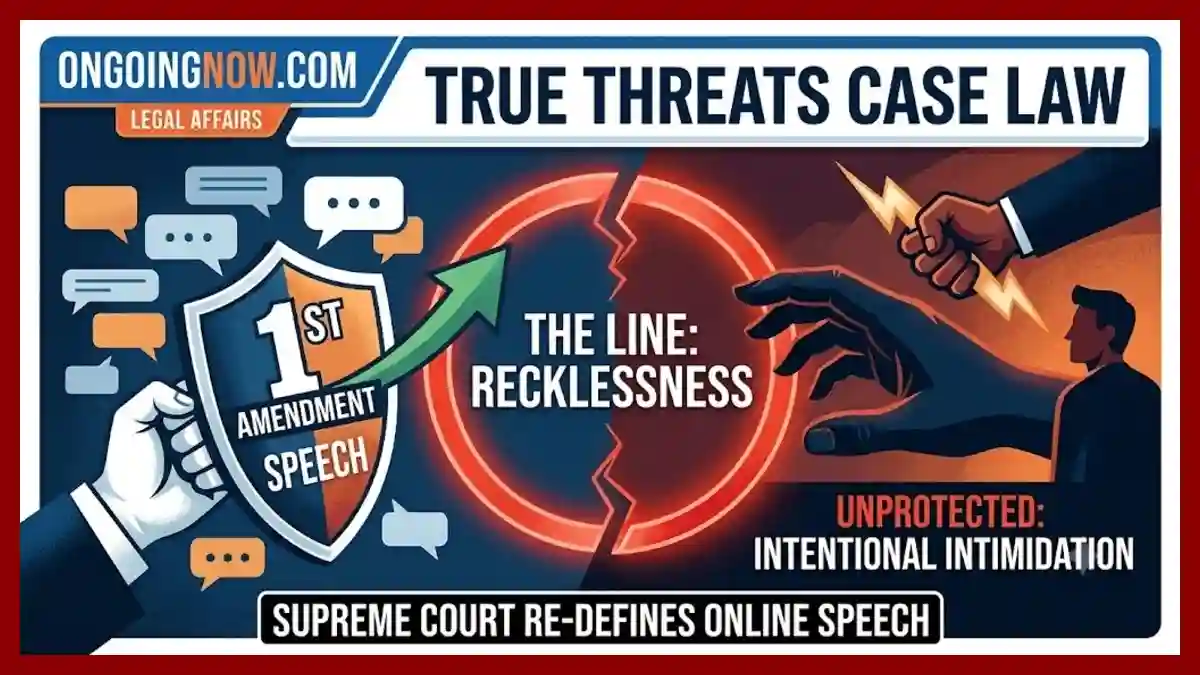
The high court clarified this distinction by establishing that a subjective standard of recklessness is required for true threat convictions. This means the prosecution must prove the speaker consciously disregarded a substantial risk that their communications would be viewed as threatening violence. The ruling significantly altered how local prosecutors and federal authorities approach speech-related offenses.
Legal Disclaimer: This is informational only and not legal advice. Consult a licensed attorney for your situation.
The Evolution of True Threats First Amendment Case Law Standards
To understand how modern jurisprudence arrived at the recklessness standard, it is necessary to examine the historical trajectory of foundational cases. The Supreme Court first explicitly recognized the true threats exception in Watts v. United States (1969), which involved political hyperbole directed at the presidency. The court ruled that political expression, even when crude or offensive, must be distinguished from actual threats of violence.
Decades later, Virginia v. Black (2003) expanded the framework by addressing cross-burning statutes and defining true threats as statements where the speaker means to communicate a serious expression of an intent to commit an act of unlawful violence. The tension between objective perception and subjective intent persisted until the landmark decision in Counterman v. Colorado (2023). This ruling firmly placed the legal threshold at recklessness, providing a clearer analytical framework for lower courts.
| Milestone Case | Jurisprudential Focus | Established Legal Standard |
| Watts v. United States (1969) | Political hyperbole during wartime | Differentiated emotional political rhetoric from actionable threats. |
| Virginia v. Black (2003) | Cross-burning and systemic intimidation | Defined true threats as intent to place the victim in fear of bodily harm. |
| Elonis v. United States (2015) | Early online rap lyrics and open posting | Required more than mere negligence under federal statutory law. |
| Counterman v. Colorado (2023) | Persistent direct digital messaging | Established a subjective recklessness standard under the First Amendment. |
Differentiating Unlawful Intimidation from Protected Anti-Government Rhetoric
Distinguishing between harsh political critiques and actionable intimidation is critical for maintaining robust public discourse. The law permits citizens to express intense dissatisfaction with government institutions, public officials, and policy decisions. This form of expression sits at the absolute core of the protections guaranteed by the First Amendment.
However, political speech loses its constitutional protection the moment it targets a specific individual with a credible prospect of physical harm. Federal statutes, such as 18 U.S.C. § 875, criminalize the transmission of threatening communications across state lines. Legal analysts emphasize that anti-government rhetoric only becomes unlawful when it ceases to be an abstract ideological critique and becomes a direct instrument of terror or coercion.
Applying True Threats First Amendment Case Law to Internet Communications
The proliferation of social media platforms, public forums, and encrypted messaging applications has fundamentally transformed the nature of public expression. Digital communication lacks the contextual cues of face-to-face interactions, such as vocal tone, body language, and immediate situational awareness. Consequently, statements made online are far more susceptible to misinterpretation by recipients, law enforcement, and digital platforms.
Under the current legal framework, courts must evaluate the specific digital environment in which a statement was published. Factors such as the frequency of messages, the presence of direct tagging, and the historical relationship between the parties are heavily analyzed. A viable legal defense for online speech frequently relies on demonstrating that the speaker lacked the subjective awareness that their digital posts would be interpreted as real, actionable threats.
The Societal Impact of True Threats First Amendment Case Law Decisions
The downstream effects of setting a recklessness standard directly influence how citizens interact within public spaces and digital forums. By requiring a showing of subjective recklessness, the judiciary protects ordinary citizens from facing criminal prosecution for poorly phrased comments or misunderstood satire. This prevents a chilling effect that could otherwise silence legitimate public debate and artistic expression.
Conversely, victims of persistent harassment and cyberstalking frequently voice concerns regarding the heightened burden of proof placed on the prosecution. When the law requires proving a defendant’s internal state of mind, securing convictions in clear cases of systemic intimidation can become more resource-intensive. Striking the ideal equilibrium remains an ongoing challenge for lawmakers attempting to craft precise statutes that protect public safety without encroaching on civil liberties.
Analysis: Why the Subjective Standard Matters for Civil Liberties
From an analytical standpoint, the reliance on a subjective recklessness standard represents a significant victory for the preservation of individual liberties. If the legal system utilized a purely objective standard, an individual could be convicted of a felony simply because an audience misinterpreted their intent. This would create an environment where speakers must constantly self-censor to accommodate the most sensitive potential listener.
Furthermore, this standard ensures that marginalized groups and political dissidents retain the ability to challenge authority forcefully. Historical precedents demonstrate that vague intimidation laws have occasionally been weaponized against civil rights activists and critics of the state. By tying the legal definition of a threat to the speaker’s conscious disregard of risk, the judiciary establishes a robust buffer against selective prosecution.
The Procedural Role of Constitutional Rights Attorney Consultations
When individuals find themselves facing allegations of threatening behavior or unlawful communication, seeking professional counsel is a critical procedural step. A qualified attorney evaluates the specific facts of the case against state and federal statutory requirements. They determine whether the speech in question falls under protected categories like political hyperbole, satire, or citizen petition rights.
During these formal reviews, legal counsel examines the methods used by law enforcement to gather evidence, particularly digital forensics. If the state cannot present sufficient evidence to demonstrate the necessary level of subjective intent, the defense can move to dismiss the charges on constitutional grounds. These procedural safeguards ensure that the government is held to its strict burden of proof whenever it attempts to penalize human speech.
Stay sharp with Ongoing Now!
Source and Data Limitations: This legal analysis is based upon public court records and established statutory frameworks within the United States jurisdiction, including the foundational Supreme Court rulings Watts v. United States (1969), Virginia v. Black (2003), and Counterman v. Colorado (2023). The discussion focuses strictly on federal constitutional standards and widely accepted legal doctrines as of mid-2026. State-level statutes may vary regarding specific elements of proof, and local definitions of harassment or stalking are subject to state court interpretations. This article explicitly excludes unverified or ongoing trial speculations, non-public grand jury proceedings, and personalized legal counsel, maintaining a strictly neutral journalistic review of published legal precedents.