Why This Small Six-Pack Triggered an Excessive Fines Clause Battle
The U.S. Supreme Court will decide if seizing a $95,000 aircraft over a minor alcohol infraction crosses the constitutional line.
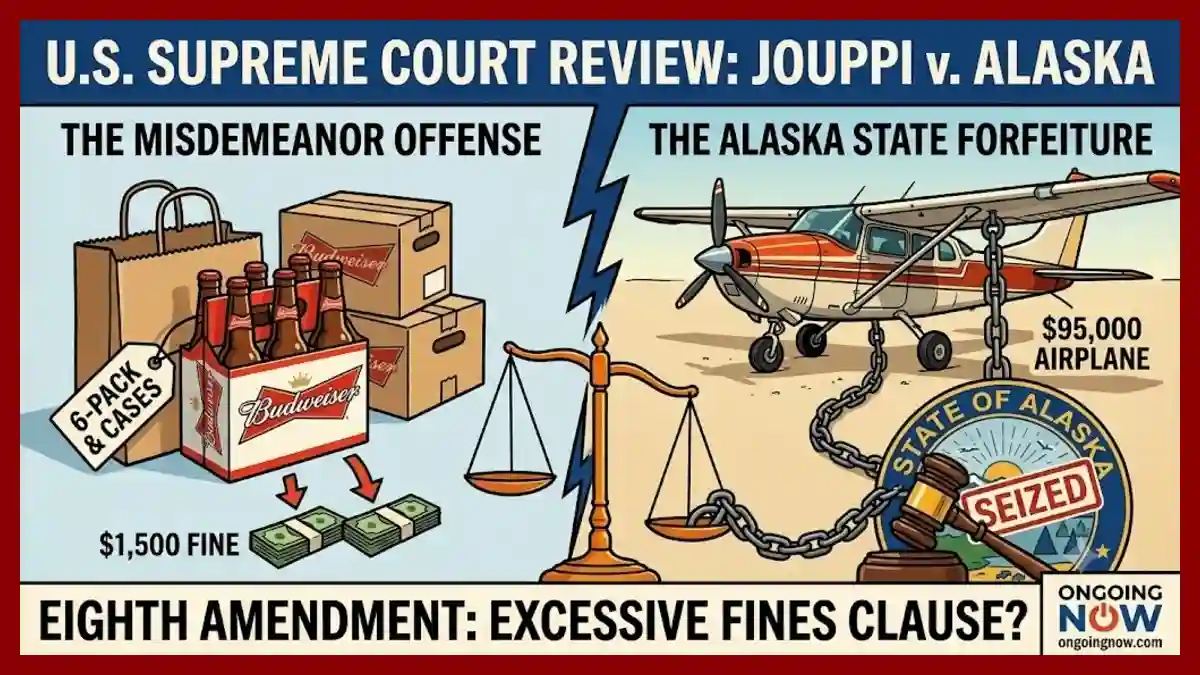
The U.S. Supreme Court has agreed to review Jouppi v. Alaska, a case that could redefine how lower courts interpret the Eighth Amendment’s Excessive Fines Clause. The legal battle centers on an 82-year-old Air Force veteran and bush pilot, Kenneth Jouppi, whose $95,000 aircraft was marked for permanent criminal forfeiture by the state of Alaska. The scheduled review has drawn intense interest from civil forfeiture defense groups and public interest organizations. They argue the case exposes major loopholes in constitutional property rights. A key focus for defense attorneys nationwide is whether a state can seize high-value property for minor misdemeanor offenses without violating the ban on unconstitutional penalties.
The dispute began 14 years ago when Jouppi prepared to pilot a charter flight from Fairbanks to Beaver, Alaska—a remote “local option” village that strictly bans the importation and possession of alcohol. State troopers inspected the aircraft before takeoff and discovered a passenger was carrying approximately nine gallons of beer. Though the cargo was boxed, troopers stated a single six-pack of Budweiser was visible in a shopping bag, establishing a basis for legal complicity. Jouppi was convicted of a misdemeanor alcohol transportation charge. He served three days in jail and paid a $1,500 fine, but the state also triggered an automatic statutory forfeiture to seize his 1969 Cessna U206D.
The 14-Year Legal Battle Over an Unflown Charter Flight
The incident occurred in April 2012. Jouppi, who operated a one-man air taxi service called KenAir, had loaded a repeat customer’s groceries and supplies. While the passenger stated the beer was a gift for her husband, the flight never actually took off because state authorities intervened on the tarmac. The passenger subsequently pleaded guilty, while Jouppi maintained he had no knowledge of the hidden alcohol and did not inspect his passengers’ closed boxes.
A jury ultimately convicted Jouppi under state laws that hold commercial operators liable if they deliberately ignore potential contraband. Along with his personal sentence, his company faced an additional $10,000 criminal fine, with $8,500 suspended. However, the primary financial blow came from the state’s parallel move to confiscate his plane under a 2004 statutory amendment. This rule mandates vehicle forfeiture for transporting illicit alcohol into dry communities.
Jouppi turned to the public-interest law firm the Institute for Justice to contest the property seizure. Over the next decade, the case cycled between state trial and appellate courts. The plane remained grounded on an Alaska tarmac, depreciating in value while the legal bills mounted. The central question quickly shifted from local compliance to federal constitutional boundaries.
The Alaska Supreme Court Favors Legislative Deference
In April 2025, the Supreme Court of Alaska issued a unanimous ruling upholding the state’s right to take the aircraft. The state justices recognized that forcing a citizen to give up their property is a punitive action that counts as a “fine” under the Eighth Amendment. However, they concluded that the $95,000 penalty did not cross the line into “gross disproportionality” when measured against the broader impact of illegal alcohol in rural regions.
The court’s rationale rested on broad legislative deference. The justices pointed to state studies showing that illegal alcohol imports cause severe social, economic, and medical harm to isolated villages. They ruled that lawmakers were within their rights to use mandatory aircraft forfeitures as a harsh deterrent.
“The illegal importation of even a six-pack of beer causes grave societal harm.” — Supreme Court of Alaska (Jouppi v. State)
Jouppi’s legal counsel countered that the state court looked at the offense at a “stratospheric level of abstraction”. By focusing on the total societal damage of the entire illegal alcohol trade, the court ignored the specific facts of the case. The defense argued this abstract approach sets a dangerous standard, essentially allowing states to seize expensive commercial tools for minor, first-time infractions.
By the Numbers: The Financial Disparity of the Penalty
To evaluate whether a penalty is unconstitutionally excessive, courts typically balance the value of the seized property against the statutory caps and the real-world scale of the infraction. The figures in Jouppi’s case reveal a stark gap between the criminal sentence and the property loss:
Estimated Value of the Seized Cessna Aircraft: $95,000
Contraband Volume Discovered: 9 gallons total (including a single visible six-pack)
Personal Criminal Fine Imposed: $1,500
Maximum Allowable Statutory Fine for the Misdemeanor: $10,000
Ratio of Property Value to Actual Imposed Fine: 63 to 1
This dramatic financial imbalance formed the basis of the initial trial court decisions, which twice ruled that losing the plane was an excessive and unconstitutional punishment.
National Disparity in Property Forfeiture Protections
The U.S. Supreme Court’s decision to grant review highlights an ongoing division among state and federal courts regarding the United States v. Bajakajian standard. This standard dictates that a forfeiture cannot be grossly disproportional to the gravity of the crime. Yet, without a unified formula from the nation’s highest court, individual states have built wildly conflicting rules.
For instance, the Indiana Supreme Court recently struck down the forfeiture of a $40,000 Land Rover owned by Tyson Timbs, ruling it excessive because the vehicle’s value was four times the maximum criminal fine for his low-level drug offense. In contrast, the Alaska standard allows a $95,000 aircraft to be permanently taken for a misdemeanor, creating a legal environment where citizen protections depend entirely on geographic state lines.
Furthermore, several federal circuits explicitly evaluate whether a forfeiture strips a citizen of their economic livelihood. The Alaska high court did not give weight to the fact that losing the plane effectively ended Jouppi’s decades-long career as an independent commercial pilot. The upcoming Supreme Court review will directly address whether an individual’s financial survival must be factored into the constitutional balancing test.
Constitutional Implications for the Future of Asset Forfeiture
The core constitutional question before the justices is direct: Must a court evaluate an excessive fines challenge based on the specific actions of the individual defendant, or can it point to generalized societal harms to justify a massive financial penalty?
Public interest groups point out that state and municipal agencies face a structural conflict of interest, as the proceeds from criminal and civil forfeitures often flow directly back into law enforcement budgets. If the Supreme Court rules in favor of Alaska, it could give states a green light to draft highly punitive laws that automate property seizures for low-level regulatory offenses.
[Forfeiture Triggered by Contraband Detection]
                      │
                      ▼
       [Judicial Excessiveness Review]
                      │
         ┌────────────┴────────────┐
         ▼                         ▼
[Abstract Scale Standard]   [Fact-Specific Standard]
   Focuses on collective       Focuses on individual
    societal harms.             conduct and record.
         │                         │
         ▼                         ▼
 [Forfeiture Justified]     [Penalty Calibrated]
Conversely, a ruling for the pilot would establish a firm constitutional boundary, forcing states to evaluate each seizure on its specific facts rather than using generalized legislative intent to protect aggressive property seizures from judicial review.
Practical Ramifications for Transportation and Trade
A final decision from Washington will carry major operational consequences for independent commercial operators, logistics companies, and charter transport services. If strict liability and automatic forfeitures are upheld, small businesses operating in heavily regulated sectors will face immense financial risk every time they transport third-party cargo or passengers.
For everyday citizens, the case highlights the broad power of state statutory enforcement and the long, difficult road required to contest government property seizures. Oral arguments are scheduled for the Supreme Court’s upcoming fall term, with a definitive ruling expected by the first half of 2027.
This is informational only and not legal advice. Consult a licensed attorney for your situation.
Stay sharp with Ongoing Now!
—
Source and Data Limitations: The data and analysis in this article are sourced directly from official public records, including the petition for a writ of certiorari filed in the U.S. Supreme Court (Jouppi v. Alaska, Docket No. 25-246), the published opinion of the Supreme Court of the State of Alaska (Jouppi v. State, 566 P.3d 943), and case briefs prepared by the Institute for Justice and the Cato Institute. This explainer strictly excludes speculative media commentary regarding potential justice voting outcomes or unverified assertions about the parties involved. All statutory figures and ratios are based on verified court documents accurate as of July 2026.