How Section 4 Works: The 25th Amendment Legal Requirements
A comprehensive analysis of how Section 4 works in the involuntary removal of president process under U.S. law
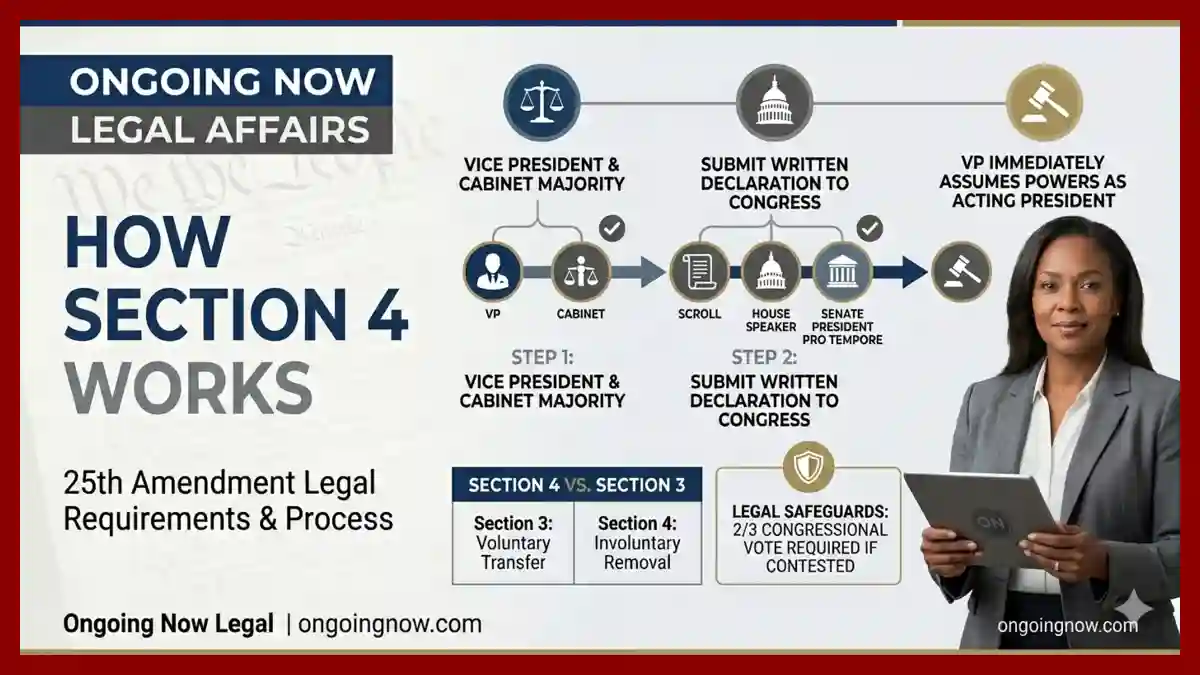
The 25th Amendment remains a cornerstone of American constitutional continuity, specifically defining the involuntary removal of president process when a commander-in-chief is unable to discharge their duties. Understanding how Section 4 works requires an analysis of the 25th amendment legal requirements, which mandate a cabinet majority 25th amendment vote alongside the Vice President. Unlike the section 4 vs section 3 differences—where Section 3 involves a voluntary transfer of power—Section 4 addresses a contested or involuntary constitutional definition of presidential inability. The role of vice president in section 4 is pivotal as the initiating authority, while the 25th amendment executive departments definition clarifies which officials constitute the “Principal Officers.” Rooted in 25th amendment history and ratification following the Kennedy assassination, the provision lacks extensive presidential disability legal precedents, making its text the primary guide for constitutional governance.
The Constitutional Mechanism: How Section 4 Works
The Fourth Section of the 25th Amendment is unique in American law because it provides the only constitutional method for the temporary or permanent transfer of power without the president’s consent, outside of impeachment. How Section 4 works is a multi-step legal procedure that begins with a written declaration sent to the President pro tempore of the Senate and the Speaker of the House of Representatives. This declaration must assert that the President is “unable to discharge the powers and duties of his office.”
The initiation of this process rests solely with the Vice President and a majority of the “principal officers of the executive departments.” If the Vice President does not agree to the removal, Section 4 cannot be invoked, regardless of the Cabinet’s consensus. Once the declaration is delivered, the Vice President immediately assumes the powers and duties of the office as Acting President. This immediate transfer ensures that the executive branch remains functional during a leadership crisis.
The legal complexity of how Section 4 works increases if the President subsequently issues a counter-declaration. If the President notifies Congress that no inability exists, they resume their duties unless the Vice President and the Cabinet majority submit a second declaration within four days. This “check and balance” mechanism ensures that the involuntary removal process is not used as a political tool but as a response to a genuine medical or mental disability.
The Involuntary Removal of President Process
The involuntary removal of president process is designed to be difficult to complete, requiring significant consensus across two branches of government. While the Vice President takes power immediately upon the first declaration, the permanent or long-term displacement of a sitting president requires a supermajority vote in Congress if the President contests the claim of inability.
Procedural Timeline of Section 4
| Stage | Action Required | Legal Effect |
| Initiation | VP + Cabinet Majority sign declaration | VP immediately becomes Acting President |
| Resumption | President sends declaration of fitness | President resumes power after 4 days (unless contested) |
| Contestation | VP + Cabinet Majority send second declaration | VP remains Acting President; Congress must decide |
| Congressional Vote | 2/3 vote in both House and Senate | VP remains Acting President for duration of term |
The involuntary removal of president process serves as a safeguard against a “disabled” but “conscious” president who refuses to step aside. Historical debates during the 25th amendment history and ratification suggest that the framers of the amendment intended for this to cover both physical illnesses, such as a stroke, and mental incapacities where the president might not recognize their own condition.
25th Amendment Legal Requirements and Definitions
The 25th amendment legal requirements are strictly procedural. The text does not provide a specific medical or psychological checklist for “inability.” Instead, the constitutional definition of presidential inability is left to the political and medical judgment of the Vice President and the Cabinet. This lack of a clinical definition was intentional, allowing the executive branch flexibility to respond to unforeseen types of impairment.
A critical component of these requirements is the 25th amendment executive departments definition. The law refers to the “principal officers of the executive departments,” which generally corresponds to the 15 Senate-confirmed heads of the federal executive departments (e.g., State, Treasury, Defense, Justice). Acting secretaries who have not been confirmed by the Senate are a subject of ongoing legal debate, as the amendment does not explicitly clarify whether they count toward the required majority.
Furthermore, the 25th amendment legal requirements allow Congress to designate a different body to replace the Cabinet in this process. By law, Congress could appoint a “disability review body” composed of medical experts or elder statesmen, though it has never chosen to do so. Until such a body is created, the “Cabinet majority” remains the only group capable of acting alongside the Vice President.
Section 4 vs Section 3 Differences: Voluntary vs Involuntary
Understanding the section 4 vs section 3 differences is essential for distinguishing between routine medical procedures and constitutional crises. Section 3 is a voluntary mechanism used when a president anticipates an inability, such as undergoing surgery under general anesthesia. In these cases, the President signs a letter, the Vice President becomes Acting President, and the President resumes power immediately upon signing a second letter.
In contrast, how Section 4 works is adversarial in nature. While Section 3 has been invoked multiple times—such as by President Ronald Reagan in 1985 and President George W. Bush in 2002 and 2007—Section 4 has never been formally triggered. The section 4 vs section 3 differences highlight the amendment’s dual purpose: providing a smooth transition for temporary health issues and a rigorous, high-threshold path for removing a president who cannot or will not recognize their own disability.
The evidentiary burden in Section 4 is significantly higher. Because it involves the involuntary removal of president process, the Vice President must be prepared to defend the decision before Congress. If the President contests the removal, the burden of proof falls on the Vice President and the Cabinet to convince two-thirds of both chambers that the President is truly unable to serve.
The Role of Vice President in Section 4
The role of vice president in section 4 is that of a “constitutional gatekeeper.” No other individual or group can initiate an involuntary removal without the Vice President’s signature. This ensures that the person who stands to gain the most—the successor—must also take the greatest political and legal risk by publicly declaring the President unfit.
Critics often note that the role of vice president in section 4 creates a potential conflict of interest. However, the requirement for a cabinet majority 25th amendment vote serves as a check. The Cabinet members are appointed by the President, and their loyalty is traditionally to the person who selected them. Therefore, a consensus between the Vice President and the President’s own appointees is viewed as a high bar that prevents “palace coups.”
The role of vice president in section 4 also extends to the period of Congressional deliberation. While Congress debates the issue (a period limited to 21 days), the Vice President remains the Acting President. This prevents a “power vacuum” where the nation is unsure who holds the nuclear codes or the authority to command the military.
25th Amendment History and Ratification
The 25th amendment history and ratification began in the shadow of the 1963 assassination of John F. Kennedy. While the Constitution originally stated that the Vice President would assume the “powers and duties” of the office, it was unclear if they became the President or merely an acting official. More importantly, there was no mechanism for filling a vacancy in the Vice Presidency or for handling a president who was alive but incapacitated.
The amendment was proposed by Congress in 1965 and ratified by the required three-fourths of the states by February 10, 1967. Senator Birch Bayh, often called the “father of the 25th Amendment,” emphasized that the constitutional definition of presidential inability was left vague to ensure it would cover everything from a kidnapping to a “mental breakdown” or a “comatose state.”
Since its ratification, the 25th amendment history and ratification records show that the primary focus was on the stability of the executive branch. The Cold War context required a system where the “finger on the button” was always clearly identified and legally authorized.
Analysis: The High Threshold of Presidential Disability
From a legal perspective, the 25th amendment legal requirements under Section 4 are designed to be almost impossible to meet for purely political reasons. The requirement for a two-thirds vote in both houses of Congress to sustain a removal is a higher threshold than the “majority” required for impeachment or the “two-thirds” of the Senate required for conviction.
“The 25th Amendment was not intended to facilitate the removal of an unpopular president, but to protect the office when a president is incapacitated. Its procedures are a shield, not a sword.” — Legal Analysis, Congressional Research Service.
This high threshold explains the lack of presidential disability legal precedents for Section 4. While there have been periods where a president’s health was questioned—such as following the attempted assassination of Ronald Reagan in 1981—officials have historically hesitated to use Section 4 due to the potential for legal and social instability.
Why This Matters: Public Interest and Societal Impact
The clarity of how Section 4 works is vital for national security and public trust. In a modern democracy, the legal certainty of who holds executive power affects everything from global financial markets to international treaties. The involuntary removal of president process provides a legal “release valve” that allows the government to function even when its leader cannot.
For the public, the 25th Amendment ensures that “disability” does not lead to “discontinuity.” By formalizing the role of vice president in section 4, the Constitution provides a clear line of succession that is predictable and transparent. This transparency is a key element of the rule of law, ensuring that power is exercised by those who are constitutionally authorized to do so.
This is informational only and not legal advice. Consult a licensed attorney for your situation.
By the Numbers: Section 4 Thresholds
1: Number of Vice Presidents required to sign the declaration.
8: Minimum number of Cabinet heads (out of 15) required for a majority.
4: Days the Vice President and Cabinet have to respond if the President claims they are fit.
21: Days Congress has to vote on the issue if the President contests the removal.
2/3: The majority required in both the House and Senate to keep the Vice President as Acting President.
Comparative Context: Section 4 vs. Impeachment
While both Section 4 and impeachment can result in a president losing power, they are legally distinct. Impeachment is a punishment for “High Crimes and Misdemeanors” and requires an act of wrongdoing. Section 4 is a non-punitive, “no-fault” mechanism focused entirely on the constitutional definition of presidential inability. A president removed under Section 4 retains their title but loses their “powers and duties,” whereas a convicted and removed president loses both.
The 25th amendment legal requirements focus on the functional capacity of the executive, not the legality of their actions. This distinction is critical for maintaining the separation between political disagreement and constitutional necessity.
Conclusion: The Stability of the 25th Amendment
The 25th amendment history and ratification created a robust, if daunting, framework for handling the most sensitive of constitutional crises. By understanding how Section 4 works, legal scholars and the public can appreciate the balance between the need for decisive leadership and the protection of the democratic mandate. Though presidential disability legal precedents are few, the strict 25th amendment legal requirements ensure that any involuntary removal of president process remains a measure of last resort, grounded in the cabinet majority 25th amendment process and the role of vice president in section 4.
Stay sharp with Ongoing Now!
Source and Data Limitations: This article is based on the text of the 25th Amendment to the U.S. Constitution, ratified in 1967. Analysis relies on official records from the Congressional Research Service (CRS), the National Archives, and historical records of the 89th Congress. The definition of “executive departments” is based on 5 U.S.C. § 101. As Section 4 has never been invoked, there are no judicial “case law” precedents or court rulings regarding its application. All interpretations of “inability” are based on the legislative intent documented during the amendment’s ratification. This report excludes speculative theories or political opinions regarding current or past officials, focusing strictly on the legal framework as established by verified public records up to April 2026.