14th Amendment Citizenship Clause: Legal History
Legal analysis of the 14th Amendment citizenship clause, its history, and its impact on birthright citizenship in America.
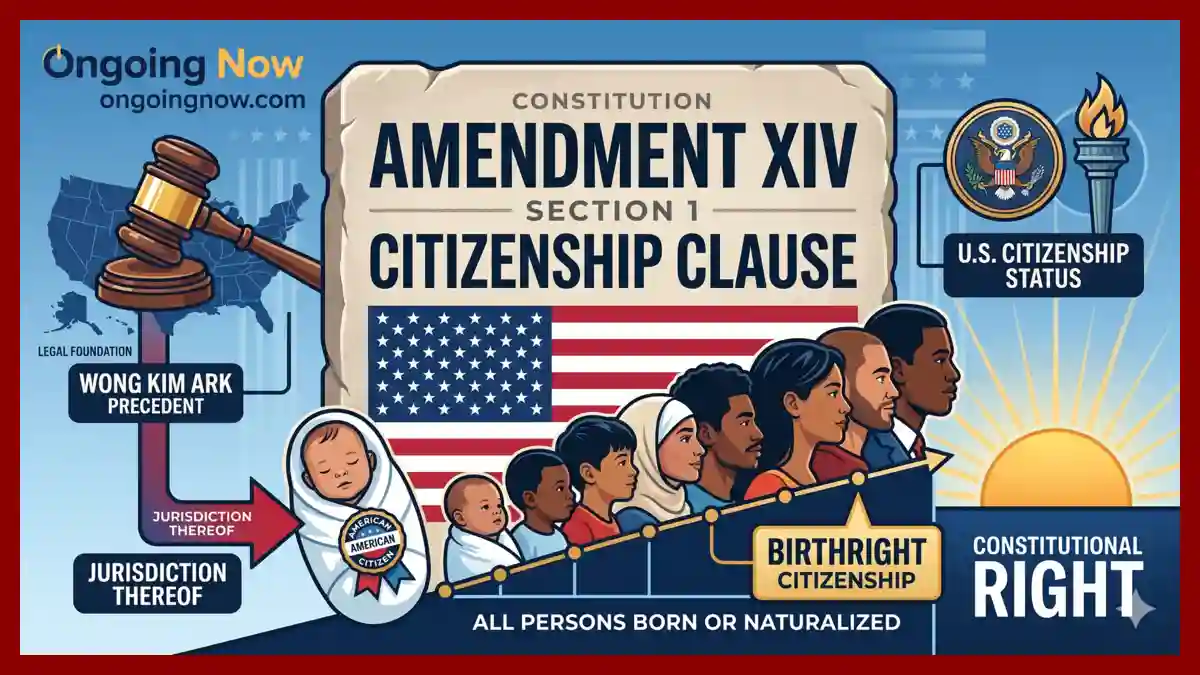
The 14th Amendment citizenship clause serves as the definitive legal foundation for birthright citizenship in the United States, establishing that all persons born or naturalized in the country are citizens. This constitutional basis for citizenship was designed to override the Dred Scott decision and ensure a uniform national standard. The Wong Kim Ark precedent further solidified this by confirming that the jurisdiction thereof meaning applies to nearly all children born on U.S. soil, regardless of parental status. Consequently, Amendment 14 Section 1 remains the cornerstone of birthright citizenship legal history, providing a technical definition of U.S. jurisdiction that limits government discretion in granting nationality. This legal interpretation of citizenship continues to shape modern constitutional law explainers and federal policy.
The Constitutional Basis for Citizenship
The 14th Amendment citizenship clause was ratified in 1868, primarily to guarantee that formerly enslaved people were recognized as full citizens. Before this addition, the Constitution did not explicitly define the criteria for citizenship, leaving the matter to conflicting state laws and judicial opinions. The clause states: “All persons born or naturalized in the United States, and subject to the jurisdiction thereof, are citizens of the United States and of the State wherein they reside.”
This single sentence fundamentally altered the American legal landscape by creating a national citizenship that takes precedence over state citizenship. The U.S. Supreme Court has consistently held that this language creates a self-executing right. This means the right to citizenship at birth does not require additional acts of Congress to be valid or enforceable.
Modern legal analysis of the 14th Amendment citizenship clause emphasizes its role in preventing the creation of a permanent underclass. By tethering citizenship to the objective fact of birth on soil, the framers sought to remove the power of political majorities to deny membership in the polity to specific groups.
Analyzing the Jurisdiction Thereof Meaning
The phrase “subject to the jurisdiction thereof” is the most scrutinized portion of the amendment in contemporary legal debates. In a technical sense, the jurisdiction thereof meaning refers to the requirement that an individual owes direct allegiance to the United States and is subject to its laws. Historically, this excluded the children of foreign diplomats and members of Native American tribes, who were then considered sovereign nations.
The technical definition of U.S. jurisdiction does not imply a requirement of legal parental status, but rather a geographical and legal presence. If a person is within U.S. territory and can be prosecuted under U.S. law, they are generally considered to be under its jurisdiction. This interpretation has been upheld for over a century, ensuring that the clause applies broadly to almost everyone born within the fifty states and incorporated territories.
Legal scholars often note that if “jurisdiction” were interpreted as “political loyalty” or “consensual membership,” the clause would become discretionary. Such a shift would allow the government to decide who is “loyal enough” for citizenship, a concept that contradicts the established 14th Amendment legal analysis found in major Supreme Court rulings.
The Wong Kim Ark Precedent and Its Legacy
The landmark case of United States v. Wong Kim Ark (1898) remains the definitive judicial authority on the constitutional basis for citizenship. Wong Kim Ark was born in San Francisco to Chinese parents who were subjects of the Emperor of China but were legally residing in the U.S. When the government attempted to deny him re-entry after a trip abroad, claiming he was not a citizen, the Supreme Court intervened.
The Court ruled that the 14th Amendment citizenship clause applied to Wong Kim Ark because his birth occurred on U.S. soil while his parents were not acting in a diplomatic capacity for a foreign power. This ruling established that the Wong Kim Ark precedent covers the children of non-citizens, including those who are not eligible for naturalization themselves.
| Key Aspect | Legal Determination in Wong Kim Ark |
| Birth Location | San Francisco, California (U.S. Soil) |
| Parental Status | Foreign nationals, permanently residing in U.S. |
| Court Ruling | Birth on soil grants citizenship regardless of parentage. |
| Exception | Children of diplomats or invading alien enemies. |
Disclaimer: This is informational only and not legal advice. Consult a licensed attorney for your situation.
Birthright Citizenship Legal History and Evolution
The evolution of birthright citizenship legal history is marked by a transition from British common law principles to a distinct American constitutional mandate. The doctrine of jus soli (right of the soil) was inherited from English law, where anyone born within the “king’s peace” was a subject. The 14th Amendment constitutionalized this principle to ensure it could not be easily repealed by statute.
Following the Civil War, the Civil Rights Act of 1866 served as a precursor to the amendment. However, lawmakers feared that a future Congress might repeal the Act, leading them to entrench the legal interpretation of citizenship within the Constitution itself. This history demonstrates an intentional move toward an objective, birth-based standard rather than a subjective, ancestry-based one.
In the decades following ratification, the federal government occasionally attempted to narrow the scope of the clause, particularly during eras of high anti-immigrant sentiment. However, the judiciary has remained a consistent guardian of the broad interpretation, citing the original intent of the Reconstruction-era framers to create a predictable and inclusive national identity.
Technical Definition of U.S. Jurisdiction
To understand the technical definition of U.S. jurisdiction, one must look at how courts distinguish between “territorial jurisdiction” and “political jurisdiction.” For the purposes of Amendment 14 Section 1, being under U.S. jurisdiction means being subject to the power of U.S. courts and the reach of U.S. statutes. This distinguishes residents from those who have “diplomatic immunity,” who are physically present but legally outside the reach of domestic law.
Territorial Presence: Physical birth within the boundaries of the United States.
Legal Subjection: The obligation to follow U.S. laws and the eligibility to be tried in U.S. courts.
Excluded Categories: Children of foreign heads of state, children of diplomats on official assignment, and children born on foreign public vessels in U.S. waters.
This framework ensures that the 14th Amendment legal analysis remains grounded in the physical reality of birth. By maintaining a strict geographical standard, the law avoids the complexities of determining the intent or the legal status of the parents at the exact moment of birth, which would create significant administrative and legal hurdles.
Analysis: Why the Citizenship Clause Matters Today
The 14th Amendment citizenship clause is more than a historical artifact; it is the legal engine that drives American demographic stability. By providing a clear, bright-line rule for citizenship, it eliminates the “statelessness” that plagues many other nations. In many parts of the world, children born to non-citizens remain non-citizens for generations, leading to social fragmentation.
In the United States, the legal interpretation of citizenship acts as a tool for integration. Because the Wong Kim Ark precedent ensures that the second generation is fully American by law, the legal system facilitates a faster transition from immigrant status to full civic participation. This has profound implications for social stability, as it grants every child born on soil an equal stake in the nation’s future.
Furthermore, any attempt to alter this standard via executive order or statute would likely face immediate constitutional challenges. Because the right is enshrined in the 14th Amendment, most legal experts agree that only a subsequent constitutional amendment—requiring a two-thirds vote in both houses of Congress and ratification by three-fourths of the states—could legally change the birthright standard.
Societal Impact and Public Interest
The public interest in maintaining a stable constitutional law explainer regarding citizenship cannot be overstated. For millions of families, the 14th Amendment provides the security of knowing that their children’s legal status is not subject to the shifting winds of political discourse. It provides a foundation for the “American Dream” by ensuring that legal identity is an inherent right rather than a government-granted privilege.
From a regulatory perspective, the 14th Amendment citizenship clause simplifies the work of agencies like the Social Security Administration and the Department of State. When a birth certificate is issued by a U.S. hospital, it serves as prima facie evidence of citizenship. This efficiency reduces the burden on the federal government to investigate the lineage or residency history of every newborn.
“The Fourteenth Amendment affirms the ancient and fundamental rule of citizenship by birth within the territory, in the allegiance and under the protection of the country.” — United States v. Wong Kim Ark (1898)
This quote summarizes the judicial consensus that has held firm for over 125 years. The amendment’s primary function is to protect the individual from the state, ensuring that the right to belong to the national community is protected by the highest law in the land.
Conclusion and Broader Significance
The 14th Amendment citizenship clause remains one of the most significant provisions in the U.S. Constitution. Through the Wong Kim Ark precedent and a consistent technical definition of U.S. jurisdiction, the American legal system has maintained a transparent and inclusive standard for nationality. As legal discussions continue to evolve, the constitutional basis for citizenship stands as a testament to the country’s commitment to equal protection and the rule of law.
By understanding the birthright citizenship legal history and the specific jurisdiction thereof meaning, citizens and policymakers alike can better appreciate the stability this clause provides. While debates may arise regarding immigration policy, the legal bedrock of the 14th Amendment ensures that the status of those born on American soil remains a matter of constitutional right, not political whim.
Stay sharp with Ongoing Now!
Source and Data Limitations: This article is based on the text of the United States Constitution (Amendment XIV), the landmark Supreme Court decision in United States v. Wong Kim Ark (1898), and established precedents in American constitutional law. Data regarding the historical intent of the 14th Amendment is drawn from the Congressional Globe and records of the 39th Congress. Analysis regarding “jurisdiction” reflects the consensus of U.S. federal courts as of April 2026. This report excludes speculative interpretations regarding future executive orders or unfiled litigation. All legal terms are used in accordance with their definitions in the United States Code and Supreme Court syllabus. This is informational only and not legal advice. Consult a licensed attorney for your situation.