Explosive Diarrhea Traced to Greens: Cyclospora Cayetanensis Infection Signs Expand
Federal investigators track contaminated shredded lettuce as thousands report parasitic gastrointestinal illness across the U.S.
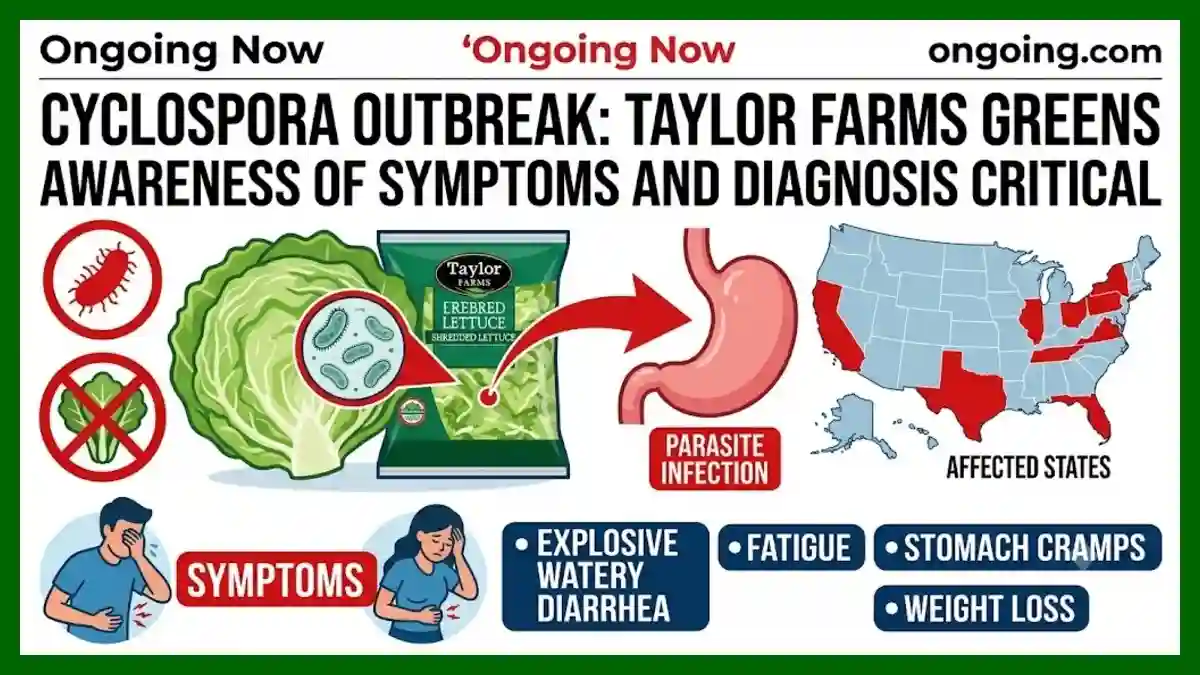
A significant surge in gastrointestinal illnesses across the United States has focused public health attention on foodborne pathogens. Epidemiological data compiled by the Centers for Disease Control and Prevention (CDC) reveals that thousands of individuals are suspected to be infected with a microscopic parasite. The U.S. Food and Drug Administration (FDA) alongside local health departments have initiated intensive traceback efforts to pinpoint the exact agricultural points of contamination.
Understanding cyclospora cayetanensis infection signs is critical for both clinicians and consumers during this seasonal peak. Unlike typical viral gastroenteritis, this parasitic condition can persist for weeks if misdiagnosed. As federal agencies issue updated guidance, identifying the distinct clinical presentation and diagnostic paths remains essential for public safety.
The Clinical Timeline of Cyclospora Cayetanensis Infection Signs
The presentation of cyclosporiasis is highly distinct from standard bacterial food poisoning. The contaminated lettuce symptoms timeline typically begins roughly one week after ingesting infective oocysts, though the incubation range spans from 2 days to more than 2 weeks. Because the parasite requires a prolonged incubation period inside the host’s small intestine, individuals rarely connect their symptoms to a specific meal consumed days prior.
[Exposure] ---> [Incubation: 2–14 Days] ---> [Onset of Severe Watery Diarrhea] ---> [Relapsing Cycles]
Once the incubation phase concludes, the primary manifestation is the sudden onset of severe watery diarrhea causes. This symptom is frequently accompanied by a cluster of secondary gastrointestinal and systemic complications:
Significant abdominal cramping, severe bloating, and increased gas.
Anorexia (loss of appetite) and subsequent unintended weight loss.
Persistent nausea, low-grade fever, and flu-like body aches.
Profound, lingering fatigue that often outlasts the active digestive symptoms.
Tracking the U.S. Outbreak and Epidemiological Metrics
The cdc foodborne outbreak updates indicate a substantial shift in parasitic transmission metrics compared to previous fiscal years. Public health surveillance highlights that the current case trajectory is uniquely elevated.
Epidemic Curve and Case Distribution
According to official reports, federal agencies have documented over 1,600 laboratory-confirmed domestic infections across 34 states, with thousands of additional cases undergoing active validation. A notable geographic cluster has emerged in the Midwest—specifically impacting Michigan, Ohio, Indiana, Kentucky, and West Virginia. In response, the FDA’s Coordinated Outbreak Response and Evaluation (CORE) Network has focused traceback investigations on imported shredded iceberg lettuce and fresh herbs served in commercial establishments.
Comparative Outbreak Metrics (Current Season vs. Prior Year)
| Public Health Metric | 2025 Surveillance Period | 2026 Active Surveillance Period |
| Confirmed U.S. Cases | 249 domestically acquired cases | 1,645 laboratory-confirmed cases |
| Suspected / Pending Cases | Minimal reporting lag | Over 5,100 cases under analysis |
| Hospitalization Rate | Under 5% historically | Approximately 9% of confirmed cases |
| Primary Vectors Investigated | Isolated produce imports | Packaged salads, shredded lettuce, cilantro |
Statistical Caveat: The data presented above represents a subset of overall gastrointestinal illnesses. Due to a standard six-week reporting lag between initial symptom onset and final laboratory confirmation, federal agencies anticipate total figures will continue to rise significantly through the end of the seasonal period.
How Long Does Cyclospora Last Without Medical Intervention?
A primary concern for public health officials is the prolonged lettuce food poisoning duration associated with parasites. While viral pathogens typically resolve within 48 to 72 hours, an untreated Cyclospora infection operates on a much longer timeline.
When considering how long does cyclospora last, clinical data shows symptoms can persist from several weeks to months. The illness is notorious for a remitting-relapsing pattern. Patients may experience an apparent recovery where diarrhea subsides, only to experience a severe return of gastrointestinal distress a few days later. This cyclical nature stresses the immune system and can deplete essential fat-soluble nutrients due to chronic malabsorption in the bowel.
Overcoming Obstacles in Commercial Food Poisoning Diagnosis
Obtaining an accurate commercial food poisoning diagnosis represents a significant hurdle in controlling community outbreaks. Standard stool cultures routinely ordered for acute diarrhea check for bacterial agents like Salmonella or E. coli, but they completely omit testing for protozoan parasites.
Advanced Parasite Infection Testing Options
To accurately identify Cyclospora cayetanensis, specific diagnostic protocols must be initiated by a physician:
Oocyst Examination: A specialized stool examination requiring acid-fast staining or UV fluorescence microscopy. Because the parasite is shed intermittently, patients may need to submit multiple samples collected over several days.
Molecular Gastrointestinal Panels: A highly sensitive Polymerase Chain Reaction (PCR) assay capable of detecting parasitic DNA directly from a single specimen.
Public health departments urge clinicians to explicitly request these targeted parasite infection testing options when evaluating patients presenting with prolonged, watery, or cyclical diarrheal illness during the spring and summer months.
Clinical Protocols for Foodborne Parasite Medical Treatment
When a case is confirmed, traditional parasitic stomach illness remedies such as over-the-counter anti-motility agents are insufficient as primary therapy. While these medications can offer temporary symptomatic reduction, they do not clear the underlying pathogen from the microvilli of the small intestine.
The established foodborne parasite medical treatment of choice is a targeted course of antibiotics. The standard regimen consists of oral trimethoprim-sulfamethoxazole (commonly known as Bactrim or Septra) administered twice daily for 7 to 10 days.
For individuals with confirmed sulfa allergies, alternative therapeutic strategies are more limited. Clinicians may evaluate secondary options such as ciprofloxacin or nitazoxanide, though clinical data suggests their efficacy against Cyclospora is substantially lower than the standard sulfa-based approach. Consequently, close medical supervision and aggressive oral or intravenous rehydration are essential components of management for vulnerable or allergic populations.
Societal and Preventive Frameworks for Agricultural Safety
The broader societal impact of large-scale parasitic contamination extends beyond individual medical distress. It places a significant strain on emergency medical services, impacts commercial productivity due to workforce absenteeism, and damages consumer trust in the fresh produce supply chain.
Because Cyclospora oocysts are highly resistant to chemical sanitizers and standard chlorine washes, simply rinsing contaminated lettuce at home or in commercial kitchens is often ineffective at eliminating the risk. The parasite originates in human feces and requires one to two weeks in the environment to mature into an infective state, meaning direct person-to-person transmission is extremely rare. Prevention ultimately depends on strict agricultural sanitation, regular testing of irrigation water, and ensuring global agricultural partners adhere to rigorous Good Agricultural Practices (GAP) to block contamination at the farm level.
Stay sharp with Ongoing Now!
Source and Data Limitations: Information within this public health report is derived directly from official epidemiological briefs issued by the Centers for Disease Control and Prevention (CDC) and the U.S. Food and Drug Administration (FDA) as of July 2026. Clinical testing and treatment methodologies reflect current medical consensus outlined by the Cleveland Clinic and peer-reviewed protocols. Because traceback investigations within commercial supply chains are ongoing, specific product origins, secondary distribution nodes, and final case counts remain subject to updates as further genetic sequencing and state-level laboratory data are finalized. This article is intended solely for general public health education and does not constitute individual medical advice.