NDAA 2026 summary: Why draft rules are changing
Subtitle: An analysis of the NDAA 2026 summary, Section 598, and the shift toward an automatic military draft registration law.
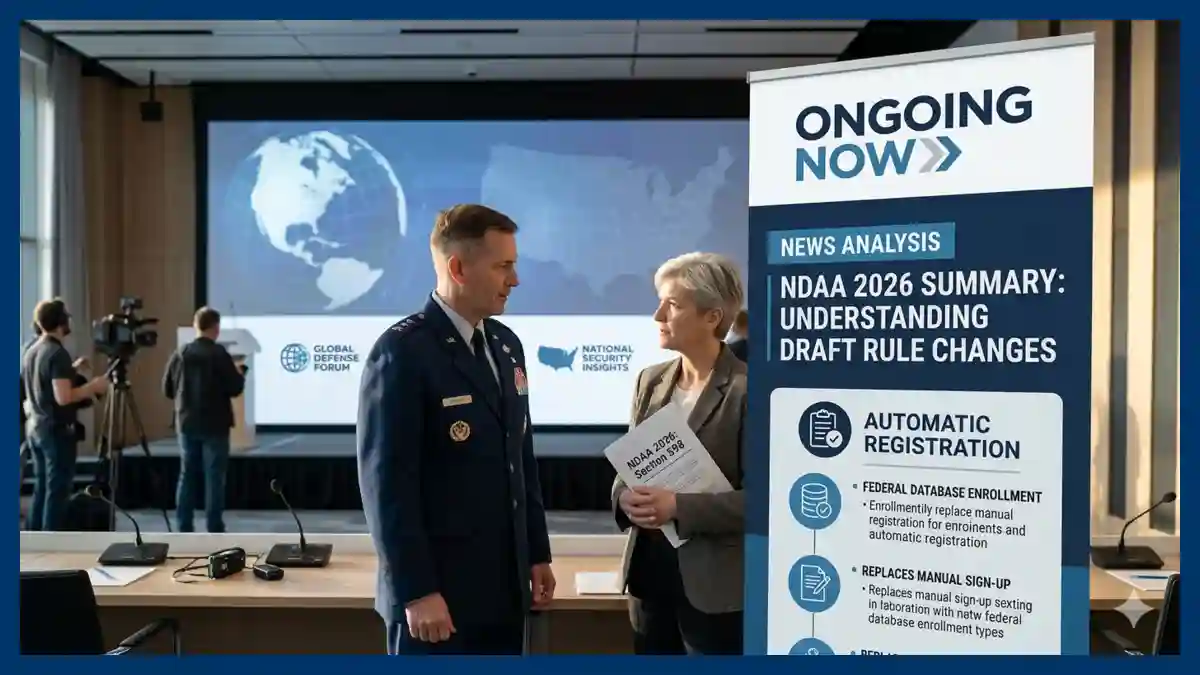
The NDAA 2026 summary highlights a pivotal transition in national defense policy through the implementation of an automatic military draft registration law. Under the Section 598 NDAA 2026 provisions, the Selective Service System rule change replaces the traditional manual sign-up process with a federal database military enrollment system. This shift, formalized by the Trump NDAA 2026 signing, streamlines how automatic selective service works by linking Department of Defense records with other federal and state data. While mandatory military service laws US have not changed regarding active duty, this administrative overhaul ensures that all eligible individuals are accounted for within the national preparedness framework.
The Legislative Mechanics of Section 598
The National Defense Authorization Act (NDAA) for Fiscal Year 2026 introduces several structural adjustments to personnel management, but few are as significant as the language regarding the Selective Service. Historically, men aged 18 to 25 were required to proactively register for the draft. Failure to do so could result in the loss of federal student aid, government employment opportunities, and, in some states, driver’s license eligibility.
Section 598 fundamentally alters this dynamic by shifting the burden of compliance from the individual to the government. The law mandates that the Selective Service System automatically register all eligible citizens and residents based on existing records from the Social Security Administration, the Department of State, and various state-level Departments of Motor Vehicles. This move is designed to eliminate the “registration gap” that has persisted for decades.
By automating this process, the federal government aims to reduce the administrative costs associated with public awareness campaigns and enforcement. The Department of Defense (DoD) has noted that a more comprehensive database increases the efficiency of mobilization plans, should a national emergency ever require the activation of the draft. This is an administrative modernization rather than a shift in the legal status of conscription itself.
How Automatic Selective Service Works in Practice
The transition to a digital-first enrollment strategy relies on the interoperability of several high-level government agencies. Understanding how automatic selective service works requires a look at the data-sharing agreements established under the new law. The Selective Service System (SSS) will now receive weekly or monthly data dumps from agencies that already verify age, residency, and citizenship status.
| Agency | Data Contribution | Role in Registration |
| Social Security Administration | SSN, Date of Birth | Primary identity verification |
| Dept. of State | Passport and Visa records | Identifying citizens and resident aliens |
| State DMVs | Address updates | Maintaining current contact information |
| Dept. of Education | Federal Student Aid data | Cross-referencing eligibility |
This integrated approach ensures that a “registration event” is triggered as soon as an individual reaches the age of 18 or enters the country as a resident within the eligible age bracket. Once the data is processed, the individual typically receives a notification—either via mail or digital portal—confirming their enrollment. This removes the legal risk of “willful failure to register,” a charge that, while rarely prosecuted, remained a significant hurdle for many young adults seeking federal benefits.
Strategic Context of the Selective Service System Rule Change
The Selective Service System rule change was not developed in a vacuum. It follows years of testimony from the National Commission on Military, National, and Public Service. This commission was tasked with evaluating the necessity of the draft in the 21st century and whether it should be expanded or modernized. The consensus among military planners was that the manual system was increasingly prone to inaccuracies and data lags.
In a statement following the legislative debate, a senior official from the Selective Service System noted:
“The goal is not to prepare for an immediate draft, but to ensure that our administrative systems reflect the technological reality of the 2020s. Accuracy in our records is a matter of national security and fairness to those who are already compliant.”
Furthermore, the 2026 NDAA addresses the logistical challenges of an aging workforce and the need for a rapid-response capability in the event of large-scale conventional conflict. While the United States has maintained an all-volunteer force since 1973, the maintenance of a draft registry is viewed by the Pentagon as a “strategic insurance policy.” The automation of this policy is seen as a way to keep that insurance policy current without constant manual intervention.
Analysis: Administrative Efficiency vs. Privacy Concerns
From an analytical perspective, the federal database military enrollment program represents a significant expansion of data-sharing between civil and military institutions. Proponents of the change argue that it promotes equity. Under the old system, individuals from higher-socioeconomic backgrounds were often more likely to be aware of and comply with registration requirements, while those in marginalized communities might inadvertently miss the deadline and face future penalties.
However, civil liberties advocates have raised questions regarding the security of such a consolidated database. Centralizing the personal information of millions of young adults into a single “active” registry creates a high-value target for cyber-attacks. The NDAA 2026 includes funding for enhanced cybersecurity protocols for the SSS, acknowledging that the shift to an automatic system necessitates a more robust defense of personal data.
The “Evidence-Based Editorial Insight” suggests that this change is part of a broader trend of “passive compliance” in federal law. Much like automatic voter registration at the DMV, the government is increasingly moving toward systems where participation is the default. This reduces the friction of governance but also reduces the direct interaction between the citizen and their civic obligations, a shift that social scientists continue to monitor for its impact on civic engagement.
Historical Precedents and Mandatory Military Service Laws US
To understand the current landscape, one must look at the evolution of mandatory military service laws US. The United States has utilized several versions of conscription, from the Civil War to the Vietnam Era. The current “Standby” Selective Service model was established in 1980 by President Jimmy Carter in response to the Soviet invasion of Afghanistan. Since then, the system has remained largely dormant, serving only as a list of names.
| Era | System Type | Trigger |
| 1940–1973 | Active Conscription | Ongoing Cold War/Hot War needs |
| 1975–1980 | No Registration | Post-Vietnam pause |
| 1980–2025 | Manual Registration | Cold War readiness |
| 2026–Present | Automatic Registration | Modernization and Data Integration |
The Trump NDAA 2026 signing marks the formal end of the manual era. It is important to clarify that while the registration is now automatic, the laws regarding an actual “call to service” remain unchanged. Only an act of Congress, signed by the President, can authorize a move from registration to induction. The automatic system simply ensures that if such a rare event occurred, the list would be ready within days rather than months.
Institutional Perspectives on National Security
The Pentagon’s support for the NDAA 2026 summary provisions stems from a desire for “data readiness.” In modern warfare, the speed of mobilization is considered a deterrent. If an adversary knows that the United States can identify and mobilize its manpower reserves instantly, it theoretically reduces the likelihood of a conflict escalating to that level.
General Michael Kurilla, in previous testimony regarding regional stability, emphasized that “readiness is not just about the equipment we have today, but the systems we have in place to scale for tomorrow.” The automatic registration law is the administrative manifestation of this philosophy. It treats the national manpower pool as a resource that must be indexed and accessible, much like fuel or ammunition stockpiles.
Critics, however, point out that a draft registry—automatic or otherwise—is an outdated concept in an era of high-tech, specialized warfare. They argue that a “mass army” of draftees would require months of training that modern conflict timelines do not allow. Despite these debates, the legislative consensus remains that a registry is a necessary component of the “Total Force” concept, which integrates active duty, reserves, and the potential for a draft.
Societal Implications of Automatic Enrollment
The move to an automatic military draft registration law has tangible impacts on the “coming of age” experience for young Americans. For the last forty years, registering for the Selective Service was a conscious act—often a rite of passage performed at a post office or on a web form during a college application. By making this process invisible, the government essentially removes a point of friction but also a point of awareness.
There is also the question of gender inclusivity. While the current 2026 implementation focuses on the existing requirements for men, the shift to an automatic database makes the technical transition for “all-gender registration” much easier to implement in the future, should Congress choose to change the underlying eligibility laws. The infrastructure is now gender-neutral in its design, even if its current application is not.
For families, the primary change is the cessation of “failure to register” notices. This reduces the legal anxiety for young adults who are often overwhelmed by the transition into adulthood. From a societal standpoint, it reinforces the role of the federal government as a background architect of civic status, where rights and obligations are managed through data rather than direct petition.
What the Evidence Shows: The Long-Term Outlook
The data suggests that the Section 598 NDAA 2026 reforms will achieve near 100% compliance within three years. Currently, registration rates hover between 88% and 92% depending on the region. The remaining 8% to 12% represent a significant administrative burden to track down. By closing this gap, the Selective Service System effectively completes the “National Mobilization Inventory.”
As part of our “Analysis,” it is clear that this move is less about a looming war and more about “Government 2.0” efficiency. The 2026 NDAA as a whole focuses heavily on AI, data integration, and supply chain logistics. Automating the draft registry fits perfectly within this broader theme of digitizing the American defense apparatus.
“We are moving away from a paper-based bureaucracy and toward a real-time readiness model,” stated a lead analyst for the House Armed Services Committee. “Section 598 is a pragmatic step toward that goal.”
Summary of Key Changes in NDAA 2026
To synthesize the impact of these changes, the following points represent the core of the new policy:
Automation: Registration is triggered by federal and state data sharing, not individual action.
Notification: Eligible individuals will be notified of their enrollment rather than being asked to enroll.
Compliance: Eliminates the risk of losing federal benefits due to administrative oversight.
Scope: Does not institute a draft; it only updates the registry of who would be called if a draft were enacted.
Authorities: The Secretary of Defense and the Director of the Selective Service are granted broader powers to integrate data from non-defense agencies.
The NDAA 2026 summary confirms that the United States is prioritizing a streamlined, data-driven approach to national defense. While the automatic military draft registration law may seem like a significant shift, it is ultimately an administrative evolution designed to align the Selective Service System rule change with the realities of a digital society. By the time the Trump NDAA 2026 signing took place, the move was widely viewed by both parties as a necessary cleanup of an antiquated system.
Stay sharp with Ongoing Now!
Source and Data Limitations: This analysis is based on the final text of the National Defense Authorization Act (NDAA) for Fiscal Year 2026, specifically Section 598 regarding Selective Service modernization. Data regarding registration rates was sourced from the Selective Service System’s Annual Reports to Congress (2023-2025). Institutional perspectives were drawn from public testimonies before the House and Senate Armed Services Committees. Information regarding the “Trump NDAA 2026 signing” refers to the formal executive approval of the consolidated defense budget and policy bill. This report excludes speculative claims regarding the immediate reinstatement of a physical draft, as no such legislation has been introduced or passed. All comparative data regarding historical draft systems is based on established records from the National Archives and the Department of Defense. This piece is intended as a policy explainer and does not constitute legal or military advice.