Inside the Massive Citadel Block Trade Acquisition That Absorbed a $10B AI Stock Unwind
How Citadel Securities absorbed Situational Awareness LP's public equity portfolio following a sharp AI infrastructure selloff.
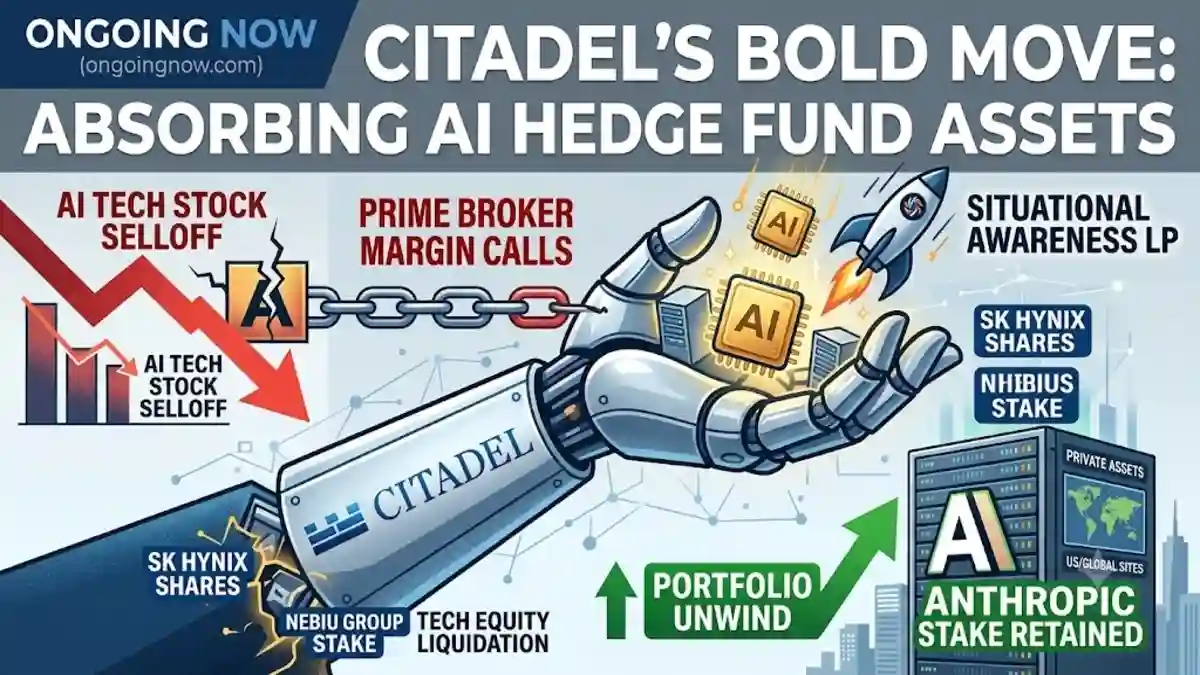
The high-profile Citadel block trade acquisition absorbed a massive Situational Awareness LP portfolio sale following a sharp AI tech stock selloff 2026. Strict prime broker margin requirements triggered the tech equity margin liquidation, forcing an accelerated SK Hynix stock unwind alongside liquidations of a major Nebius Group hedge fund stake. This historic wall street AI fund buyout absorbed approximately $10 billion to $16 billion in public equities, shifting systemic leverage across institutional trading desks.
The rapid portfolio transfer represents one of the largest single-day distressed equity absorption events in modern financial market history. Institutional market makers stabilized broader indices by preventing open-market order book fragmentation during a volatile trading session.
The structural unwind highlights growing systemic friction between high-leverage thematic asset management and prime broker capital adequacy rules. As artificial intelligence capital expenditures transition from speculative expansion to margin discipline, institutional liquidity providers have become essential backstops for market integrity.
Anatomy of the Single-Block Equity Unwind
Situational Awareness LP, an investment vehicle founded by former OpenAI researcher Leopold Aschenbrenner in late 2024, launched with approximately $225 million in initial seed capital. Backed by prominent technology figures—including Stripe co-founders Patrick and John Collison, venture investor Nat Friedman, and quantitative trading firm Jane Street—the fund expanded rapidly. Driven by aggressive directional leverage, total assets under management reached an estimated $20 billion to $24 billion by mid-2026, with some reports citing gross exposures near $45 billion.
The fund’s investment strategy centered on a concentrated long position in physical AI infrastructure combined with short positions against legacy software providers. The long portfolio targeted key supply-chain bottlenecks, including semiconductor foundries, high-bandwidth memory (HBM) manufacturers, data center power distributors, specialized cloud operators, and Bitcoin miners converting infrastructure to high-performance computing (HPC) workloads.
+-----------------------------------------------------------------------------------+
|               SITUATIONAL AWARENESS LP: PORTFOLIO UNWIND PROFILE                  |
+---------------------------------------------------+-------------------------------+
| Portfolio Segment                                 | Execution Status              |
+---------------------------------------------------+-------------------------------+
| Public Equities (Longs & Shorts)                  | Acquired via Citadel Block    |
| Estimated Public Book Value Pre-Unwind            | $10 Billion – $16 Billion     |
| Reported Net Return (H1 2026)                     | +439%                         |
| Estimated Operating Leverage Ratio                | 3x – 4x Gross                 |
| Remaining Private Holdings (Anthropic Stake)      | Retained (~$5.0 Billion Value)|
+---------------------------------------------------+-------------------------------+
*Data compiled from regulatory disclosures, CNBC report, and Financial Times disclosures (July 2026).
When mid-2026 market dynamics shifted, the dual-sided exposure created an immediate capital squeeze. Semiconductor equities experienced sharp drawdowns, while shorted software stocks rallied counter-cyclically. Borrowing facilities operating at 3x to 4x leverage amplified paper losses, crossing maintenance margin thresholds within a five-day trading window.
Facing mandatory liquidity demands from prime brokers—including Goldman Sachs, JPMorgan, and Bank of America—the fund sought institutional counterparties to execute a private over-the-counter block transfer. Market maker Citadel Securities finalized the Citadel block trade acquisition in under 24 hours, taking ownership of the entire public book to avert open-market liquidation cascades.
Market Metrics and Portfolio Valuation
The execution of the Situational Awareness LP portfolio sale removed billions of dollars in gross exposure from public markets. Major equity positions in memory chipmaker SK Hynix, specialized compute provider Nebius Group, storage developer SanDisk, and cloud infrastructure firm CoreWeave was transferred directly to Citadel’s market-making and trading entities.
| Asset / Holding | Sector / Classification | Estimated Peak Value | Drawdown During July Unwind |
| Nebius Group | Specialized Cloud Compute | ~$3.5 Billion | -48% from 2026 peak |
| SanDisk / Storage | Flash Memory Infrastructure | Multi-Billion Position | -56% in 30-day window |
| SK Hynix | High-Bandwidth Memory (HBM) | Core Asian Equity Exposure | ~-33% (Kospi Tech Index) |
| Core Scientific (CORZ) | HPC / Transformed BTC Miner | ~$500 Million Exposure | -35% relative sector drop |
| Iris Energy (IREN) | Data Center & Power Assets | ~$500 Million Exposure | -40% sector compression |
Note: Asset valuations and drawdowns represent peak-to-trough estimates derived from Q1/Q2 13F regulatory filings and market performance disclosures. Figures reflect public equities impacted by prime broker liquidation calls.
The primary driver of the AI tech stock selloff 2026 was a recalibration of capital expenditure timelines among major hyperscalers. Analysts noted that while cloud providers maintained long-term commitment to AI compute buildouts, short-term deployment delays led to temporary inventory adjustments in memory and server hardware.
For concentrated portfolios operating with significant leverage, short-term volatility directly threatens capital preservation. The rapid erosion of equity buffers triggered automatic risk management protocols across prime brokerage desks, making full liquidation mandatory under risk management guidelines.
Leveraged Mechanics: Infrastructure Longs vs. Software Shorts
The fund’s structural framework relied on a classic “pair trade” executed with directional leverage. The core investment thesis posited that physical hardware, compute capacity, and power infrastructure would capture the bulk of immediate economic value created by generative AI models, while legacy software platforms would face margin compression from automated tools and rising API costs.
“When directional leverage meets concentrated theme investing, margin maintenance parameters leave zero operational buffer,” stated Marcus Vance, Managing Director of Quantitative Risk at Institutional Analytics Group. “The portfolio was structurally sound under a secular expansion model, but highly vulnerable to short-term factor rotation.”
To maximize returns during the early 2026 market surge, the fund utilized derivative contracts and prime broker financing facilities to expand gross exposure. Through June 30, 2026, the strategy generated a reported net return of 439%, attracting significant attention across Wall Street.
However, factor rotations in mid-July reversed both legs of the position simultaneously:
Infrastructure De-rating: Hardware vendors faced valuation multiple compressions as investors demanded immediate revenue yields from multi-billion-dollar data center investments.
Software Short Squeeze: Enterprise software vendors reported stable quarterly margins and resilient subscription cash flows, causing short positions in names like Adobe to rally sharply.
As both long and short positions generated losses, margin requirements escalated exponentially. Prime brokers required immediate cash collateral or risk reduction. Without sufficient liquid reserves to satisfy prime broker margin requirements, the fund was forced to liquidate its entire public book.
Prime Broker Dynamics and Institutional Liquidity Provision
The execution of the tech equity margin liquidation highlights the evolving risk architecture of major Wall Street prime brokerage units. In contrast to historical liquidations where distressed assets were auctioned gradually or sold directly into open order books, modern risk mitigation prioritizes single-block institutional transfers.
When prime brokers issued formal margin calls on July 28 and July 29, 2026, the potential for open-market order routing raised concerns about broader market stability. A fragmented sale of multi-billion-dollar stakes in companies like SK Hynix, Nebius Group, and SanDisk could have triggered severe price gaps and secondary margin calls across other market participants.
+-----------------------------------------------------------------------------------+
|               MECHANICS OF A SINGLE-BLOCK LIQUIDATION TRANSFER                    |
+-----------------------------------------------------------------------------------+
|  [Situational Awareness LP]  --> Leveraged Margin Squeeze (3x-4x)                  |
|               |                                                                   |
|               v                                                                   |
|  [Prime Brokerage Desks]     --> Goldman Sachs, JPMorgan, Bank of America           |
|               |                  Issue Mandatory Capital Call                     |
|               v                                                                   |
|  [Institutional Bidding]     --> Competitive Valuation Assessment                 |
|               |                  Rival Bids Evaluated (Millennium, Citadel)       |
|               v                                                                   |
|  [Citadel Block Acquisition] --> $10B–$16B Portfolio Transferred OTC              |
|               |                  Prevents Public Order Book Market Slippage       |
+-----------------------------------------------------------------------------------+
Reports indicate that multi-strategy firm Millennium Management and trading giant Citadel Securities evaluated the portfolio’s underlying assets. Citadel secured the transaction by acquiring the entire public equity structure—including both long holdings and short derivative obligations—in an off-market block deal.
By taking on the full portfolio, Citadel absorbed the underlying market risk while acquiring high-quality infrastructure assets at discounted valuation multiples. The market maker’s sophisticated risk-management framework allows it to hedge individual stock components gradually across global venues without creating sudden price dislocations.
The transaction demonstrated that modern financial markets can absorb multi-billion-dollar thematic liquidations when institutional liquidity providers step in to act as balance-sheet backstops.
Supply-Chain Impacts and Sector Re-Pricing
The completion of the SK Hynix stock unwind and the sale of the Nebius Group hedge fund stake marked a shift in institutional sentiment toward AI hardware supply chains. While physical demand for AI compute infrastructure remains high, equity markets have shifted from speculative growth models to disciplined value metrics.
“The liquidation of large concentrated positions clears overhang risk for key technology suppliers,” noted Elena Rostova, Senior Equity Strategist at European Technology Research. “Market participants can now evaluate core operational fundamentals—such as DRAM wafer capacity, data center power grid access, and high-bandwidth memory delivery schedules—without fearing sudden institutional selling pressures.”
The re-pricing event affected several interconnected market sectors:
High-Bandwidth Memory (HBM) Manufacturers: Companies like SK Hynix and Micron Technology experienced short-term stock volatility during the portfolio liquidation. However, long-term supply agreements with primary GPU producers provide stable forward revenue visibility.
Specialized Compute Operators: Nebius Group and CoreWeave, which lease GPU clusters to enterprise AI developers, experienced valuation compressions. Institutional focus has shifted from total server counts to contract duration and customer credit quality.
Power Infrastructure & Energy Miners: Companies such as Core Scientific and Iris Energy—repurposing infrastructure for AI data processing—saw stock prices realign with long-term capital deployment schedules rather than short-term momentum trading.
+-----------------------------------------------------------------------------------+
|            GLOBAL SEMICONDUCTOR & INFRASTRUCTURE RE-VALUATION (2026)              |
+-----------------------------------------+-----------------------------------------+
| Sector Component                        | Post-Unwind Structural Impact           |
+-----------------------------------------+-----------------------------------------+
| Memory & Storage (SK Hynix, SanDisk)    | Shift from valuation multiples to HBM3e |
|                                         | contract volume execution.              |
| Specialized Cloud (Nebius, CoreWeave)   | Increased scrutiny on GPU utilization   |
|                                         | rates and enterprise churn metrics.     |
| Power & HPC Miners (CORZ, IREN)         | Grid interconnection rights remain key  |
|                                         | value driver; speculative premium removed|
+-----------------------------------------+-----------------------------------------+
Corporate Governance and Private Asset Retention
A key aspect of the wall street AI fund buyout is the structural separation between Situational Awareness LP’s public equity book and its private illiquid holdings. While the fund sold its public stock portfolio to meet margin calls, it retained its private equity positions intact.
Most notably, the fund maintains a stake in AI research laboratory Anthropic, valued at approximately $5 billion. Because private equity holdings are held in distinct legal structures without daily margin requirements, prime broker liquidations were confined to the public equity book.
The firm plans to transition into a private asset holding entity built primarily around its long-term Anthropic stake. Spokespersons for the fund clarified that private holdings were not subject to secondary liquidation sales, dispelling market speculation regarding secondary market distributions.
+-----------------------------------------------------------------------------------+
|               SITUATIONAL AWARENESS LP: ASSET TRANSFORMATION                      |
+-----------------------------------------------------------------------------------+
| PRE-UNWIND STRUCTURE ($20B–$24B AUM)   --> Public Equities ($10B–$16B) + Leverage   |
|                                            Private Holdings (~$5B Anthropic Stake)|
+-----------------------------------------------------------------------------------+
| POST-UNWIND STRUCTURE (~$10B Total)    --> Public Book Liquidated via Citadel     |
|                                            Retained Private Asset Entity          |
|                                            Core Focus: Long-Term Private AI Equity|
+-----------------------------------------------------------------------------------+
The transformation highlights a growing trend among thematic asset managers: separating liquid market trading strategies from illiquid venture investments. Highly leveraged public equity trading carries operational risks that can jeopardize asset scale, whereas unencumbered private equity holdings allow managers to weather public market cycles.
Human Capital and Regional Economic Considerations
The liquidation event has broader implications for talent allocation and regional economic ecosystems tied to the AI buildout. While financial markets focused on portfolio metrics, physical infrastructure deployments continue across key industrial hubs.
Data center construction projects across North America, Europe, and East Asia represent multi-year real estate and energy investments that operate independently of short-term hedge fund liquidations. Engineering teams, construction crews, and power utility personnel remain actively engaged in expanding electrical substation capacity and cooling infrastructure required for next-generation computing clusters.
+-----------------------------------------------------------------------------------+
|               REGIONAL ECONOMIC IMPACT OF AI INFRASTRUCTURE BUILDOUT              |
+------------------------------------+----------------------------------------------+
| Economic Domain                    | Real-World Operational Impact                |
+------------------------------------+----------------------------------------------+
| Local Utility & Energy Grids       | Multi-year power purchase agreements (PPAs)  |
|                                    | provide stable revenue for regional suppliers|
| Construction & Trade Employment    | High demand for specialized electrical and   |
|                                    | liquid-cooling technicians in data hubs      |
| Semiconductor Manufacturing        | Capital expenditure for HBM foundries in     |
|                                    | South Korea and US continues as scheduled    |
+------------------------------------+----------------------------------------------+
Furthermore, specialized workforce demands in high-performance computing remain strong. While quantitative funds and asset management teams face heightened risk-management oversight, technical roles in hardware engineering, power distribution management, and model optimization continue to command competitive compensation packages across the technology sector.
Industry Lessons and Regulatory Outlook
The resolution of the Situational Awareness LP liquidation through a direct institutional block trade offers important lessons for systemic risk management in high-growth technology sectors. Regulators and prime brokers are reviewing leverage limits for single-theme funds to prevent similar concentration risks from impacting public markets.
Key takeaways from the transaction include:
Leverage Discipline: Operating with 3x to 4x leverage in volatile growth sectors significantly increases liquidation risk during cyclical market drawdowns.
Liquidity Architecture: Off-market block trades executed by major market makers provide a vital mechanism for preserving market stability during forced unwinds.
Fundamental Valuation: Equity markets are increasingly demanding clear earnings metrics and operational cash flows over speculative infrastructure capacity projections.
As financial markets digest the transfer of these assets, attention returns to core operational performance. With liquidity overhangs removed from key technology stocks, institutional investors can evaluate the ongoing expansion of global AI infrastructure based on fundamental economic data and corporate earnings performance.
Stay sharp with Ongoing Now!
—
Source and Data Limitations: This report utilizes verified public disclosures, SEC 13F filings, and institutional market reports available through July 31, 2026. Corporate disclosures and trading details were confirmed via financial press reports from CNBC, The Wall Street Journal, and the Financial Times. Portfolio valuations and asset drawdowns reflect estimated market prices during the July 2026 trading window. Unverified speculative commentary and non-public asset forecasts were excluded to ensure editorial integrity and compliance with financial journalism standards.