US Navy Intercepts Iranian Drone in Arabian Sea
The USS Abraham Lincoln carrier strike group maintains regional stability following a maritime security alert and defensive action.

The United States Navy confirmed today that a carrier-based fighter jet intercepted and destroyed an Iranian unmanned aerial vehicle (UAV) in the Arabian Sea. According to a CENTCOM official statement today, a sophisticated Shahed-139 drone was downed after it ignored repeated warnings and maneuvered aggressively toward the USS Abraham Lincoln.
This Arabian Sea naval incident occurs amid a broader US Iran military escalation 2026, where maritime security has become a focal point for international observers. The engagement reflects the heightened readiness of aircraft carrier defense systems as Washington and Tehran navigate a period of intense diplomatic and military friction.
The USS Abraham Lincoln current location is approximately 500 miles off Iran’s southern coast, where it serves as the centerpiece of a significant American naval presence. This latest F-35C drone interception highlights the persistent risks to maritime security alerts and the critical role of the US Navy Middle East presence in protecting global shipping lanes.
Analysis of the Arabian Sea Naval Incident
The interception took place early Tuesday morning as the carrier strike group was transiting international waters. U.S. Central Command (CENTCOM) reported that the Iranian-made Shahed-139 drone, a platform known for long-endurance surveillance, was detected on a high-speed flight path toward the nuclear-powered supercarrier.
Despite multiple attempts by the strike group to communicate via established de-escalatory channels, the aircraft maintained its intercept course. A 5th-generation F-35C Lightning II stealth fighter, launched from the Lincoln, ultimately neutralized the threat.
“The Iranian drone continued to fly toward the ship despite de-escalatory measures taken by U.S. forces operating in international waters,” stated Captain Tim Hawkins, a spokesperson for CENTCOM.
The decision to engage was characterized as a necessary act of self-defense to ensure the safety of the approximately 3,000 personnel currently stationed aboard the flagship. No American casualties or equipment damage were reported following the encounter.
Maritime Security Alerts in the Strait of Hormuz
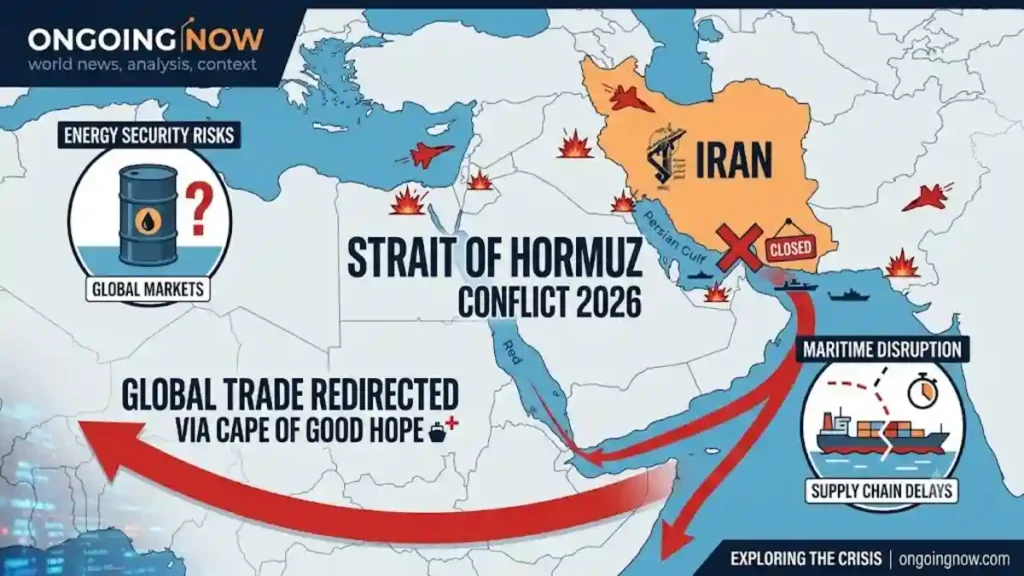
Hours after the aerial engagement, a second maritime event was reported in the strategically vital Strait of Hormuz. The British maritime security firm Vanguard Tech and the United Kingdom Maritime Trade Operations (UKMTO) issued alerts after armed Iranian boats reportedly approached a U.S.-flagged commercial vessel.
The M/V Stena Imperative, an oil tanker with American crew members, was reportedly hailed by two Islamic Revolutionary Guard Corps (IRGC) fast-attack craft and a Mohajer drone. The vessels allegedly ordered the tanker to stop its engines and prepare for boarding, a request the vessel’s captain ignored while maintaining speed in the Traffic Separation Scheme.
The guided-missile destroyer USS McFaul responded to the scene, providing an escort that effectively de-escalated the situation. These twin developments have placed regional maritime authorities on high alert, as the Strait remains the world’s most critical energy transit point.
Comparative Regional Maritime Incidents
| Date | Location | Incident Type | Primary Assets Involved |
| June 2025 | Persian Gulf | Nuclear Site Strikes | US Air Force / Israeli Defense Forces |
| January 2026 | Strait of Hormuz | Live-Fire Drill Warning | IRGC Navy / US 5th Fleet |
| Feb 3, 2026 | Arabian Sea | F-35C drone interception | USS Abraham Lincoln / Shahed-139 |
| Feb 3, 2026 | Strait of Hormuz | Tanker Harassment | M/V Stena Imperative / USS McFaul |
Technical Evaluation of Aircraft Carrier Defense Systems
The successful F-35C drone interception serves as a field demonstration of the integrated defense architecture utilized by modern carrier strike groups. The USS Abraham Lincoln utilizes a multi-layered sensor net, including the E-2D Advanced Hawkeye for early warning and the Aegis Combat System for missile and air defense.
Military analysts suggest that the Shahed-139’s approach may have been a “stress test” of these systems. By using an unmanned platform, the IRGC can gather data on U.S. radar signatures and response times without risking human pilots.
The use of an F-35C from the Marine Fighter Attack Squadron (VMFA) 314 underscores the versatility of the carrier air wing. These stealth assets are designed not only for deep-strike missions but also for precision air-to-air engagements in contested environments where electronic warfare may be present.
Geopolitical Context of US Iran Military Escalation 2026
The current military posture is intrinsically linked to a series of domestic and international shifts. Following a violent crackdown on anti-government protests within Iran last month, President Donald Trump has increased military pressure, describing the current deployment as a “massive armada.”
The US Navy Middle East presence currently includes at least ten warships, including guided-missile destroyers and air defense assets. This buildup is intended to provide leverage ahead of planned diplomatic talks in Istanbul, Türkiye, scheduled for Friday.
While Iranian President Masoud Pezeshkian has instructed his diplomats to pursue “fair and equitable negotiations,” hardline elements within the IRGC appear to be maintaining a posture of defiance. This “dual-track” dynamic—kinetic military friction alongside active diplomacy—creates a volatile environment where miscalculation remains a primary concern for international observers.
Impact on Global Energy Markets and Shipping
The Arabian Sea naval incident and the harassment of the Stena Imperative have immediate implications for the global economy. Approximately 20% of the world’s oil supply passes through the Strait of Hormuz daily.
Market volatility often follows such encounters. While Brent crude prices had eased to approximately $66 per barrel earlier this week, the resumption of maritime friction typically adds a “risk premium” to energy futures.
For the commercial shipping industry, these events necessitate increased insurance premiums and the adoption of more rigorous security protocols. The International Chamber of Shipping and various NGOs have emphasized the need for “freedom of navigation” to remain a non-negotiable standard in international waters.
Analysis: Why the USS Abraham Lincoln Matters Now
The presence of the USS Abraham Lincoln in the Arabian Sea is a strategic signal to both regional allies and adversaries. After a 20-day “carrier gap” in January 2026—the first since late 2023—the arrival of the Lincoln re-establishes a permanent U.S. aviation platform in the CENTCOM area of responsibility.
Unlike land-based assets, a carrier strike group provides a sovereign, mobile airfield that can operate without the political complexities of host-nation sensitivities. In the context of the US Iran military escalation 2026, the Lincoln serves as both a deterrent and a primary response mechanism for any disruption to maritime trade.
The F-35C drone interception demonstrates that the U.S. military is prepared to enforce “red lines” regarding the proximity of foreign assets to its naval formations. For Tehran, these encounters serve as a reminder of the technological disparity between 5th-generation stealth assets and current-generation UAV platforms.
Human and Community Impact of Regional Tensions
While the headlines focus on stealth jets and drones, the human impact of the US Navy Middle East presence is felt most acutely by the merchant mariners and local coastal communities. Thousands of sailors from various nations operate in these waters daily, often finding themselves at the center of geopolitical maneuvering.
Verified reports from maritime unions highlight the psychological strain on crews aboard commercial tankers when approached by armed vessels. The “shadow war” at sea often places unarmed civilians in high-risk environments, requiring constant coordination with naval authorities.
Additionally, the regional buildup has consequences for humanitarian corridors. Aid organizations monitoring the situation in the Middle East have expressed concern that a further escalation could disrupt the delivery of essential supplies to vulnerable populations in Yemen and other conflict-affected areas. Maintaining a “calm and professional” maritime environment is essential for the dignity and safety of those whose livelihoods depend on the sea.
Future Outlook: Diplomacy vs. Deterrence
The next 72 hours are critical for regional stability. As diplomats prepare for the Friday summit in Istanbul, the USS Abraham Lincoln will likely remain in its current position to provide security and political weight.
The CENTCOM official statement today reiterated that while the U.S. does not seek conflict, it will not tolerate “unsafe and unprofessional behavior.” The international community, including mediators from Qatar, Oman, and Turkiye, continues to advocate for a framework that reduces the frequency of these high-stakes maritime encounters.
The outcome of the upcoming talks will determine if the US Iran military escalation 2026 can be transitioned into a stable diplomatic process or if the cycle of interceptions and maritime alerts will continue to define the Arabian Sea.
Stay sharp with Ongoing Now!
More News: The Syrian Butcher White House Gambit to Revive Syria
Source and Data Limitations: This report is based on official statements from U.S. Central Command (CENTCOM), verified maritime alerts from UKMTO and Vanguard Tech, and regional reporting from the Associated Press, Al Jazeera, and Reuters. Iranian perspectives were drawn from the semi-official Tasnim and Fars news agencies. While the drone interception is confirmed, some details regarding the specific intent of the Shahed-139 remain subject to military classification. Maritime tracking data for the USS Abraham Lincoln is periodically delayed for operational security. Claims regarding “secret” diplomatic backchannels have been excluded in favor of publicly acknowledged diplomatic efforts in Türkiye.