Home Bargains Investment News 2026: Why Growth Rises
Home Bargains investment news 2026 highlights a £6 million Ledbury expansion, signaling robust growth in the UK discount sector.
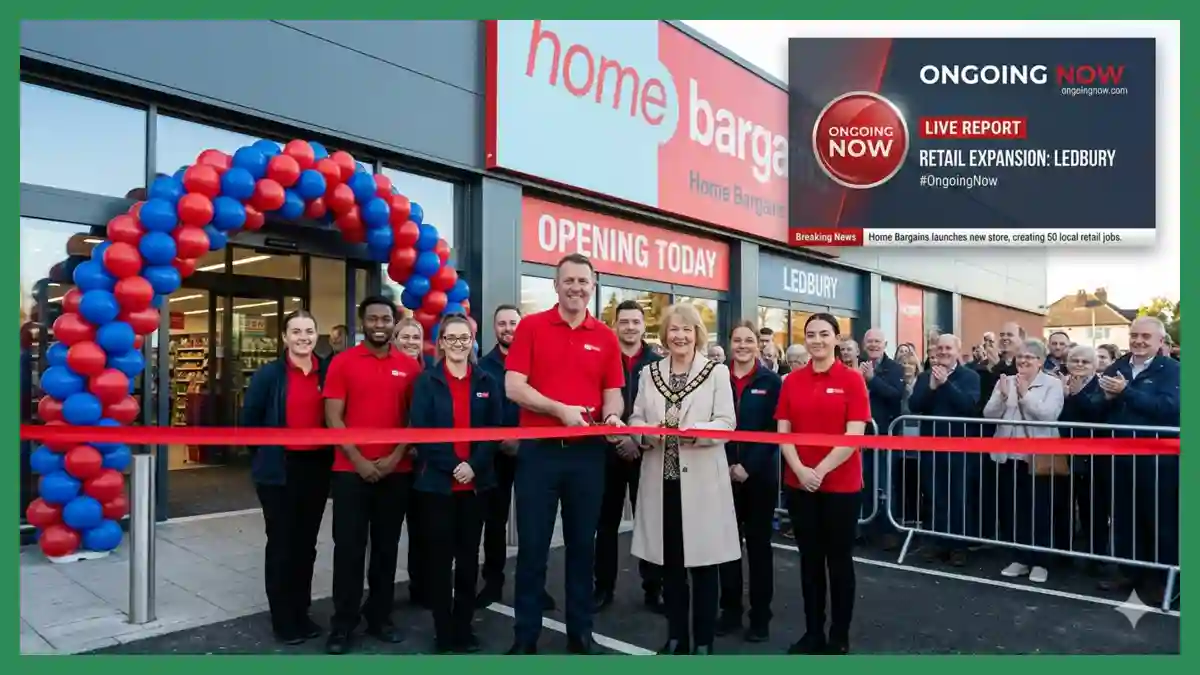
The regional retail landscape in Herefordshire underwent a significant structural shift on April 3, 2026, as TJ Morris, the parent company of Home Bargains, officially inaugurated its latest expansion. This Home Bargains investment centers on a £6 million capital deployment into a new 17,965 sq. ft facility in Ledbury, marking a strategic move to capture market share in mid-sized market towns. The Ledbury store launch serves as a microcosm of the company’s broader national strategy, which includes a target of 50 Home Bargains new openings 2026 to counteract broader stagnation in the UK brick-and-mortar sector. By integrating a specialized garden center and in-store bakery, the retailer is diversifying its value proposition to compete directly with traditional supermarkets and hardware chains.
Verified financial data for the fiscal year ending June 30, 2025, underscores the stability behind this expansion, with Home Bargains reporting a 7.9% increase in revenue to £4.5 billion. The retail jobs Ledbury created by this launch—totaling 50 positions—reflect a 13.3% surge in operating profit to £492 million, providing the liquid capital necessary for such high-velocity physical growth. On the morning of the ribbon cutting ceremony, local stakeholders noted that the store location map places the outlet at the New Mills Industrial Estate on Leadon Way, a high-traffic corridor intended to maximize regional logistical efficiency. While grand opening offers drew immediate consumer interest, the local economic impact is projected to be long-term, driven by 45 entirely new hires and a stabilized supply chain connection to the company’s recently completed Doncaster Distribution Centre.
Strategic Capital Allocation in the 2026 Retail Landscape
The launch of the Ledbury site is not an isolated event but a key component of TJ Morris’s “new wave” of 2026 expansions. Following a year where 18 net new stores were added, the company has accelerated its pace to nearly one opening per week. This aggressive physical footprint expansion is supported by a robust balance sheet and a pivot toward “destination” discount shopping. Unlike traditional discount models that rely on high-street footfall, the Ledbury model utilizes a larger footprint to accommodate a wider variety of SKU categories, including fresh and frozen food.
Industry analysts suggest that the £6 million investment per site is a calculated risk aimed at securing long-term dominance in the “variety discounter” segment. With operating profits approaching half a billion pounds, Home Bargains is currently outperforming many FTSE 100 retail counterparts in terms of margin resilience. The inclusion of a garden center in the Ledbury branch further suggests a strategy to mitigate the seasonality of traditional discount retail, providing a revenue hedge during the spring and summer months.
Market Snapshot: TJ Morris (Home Bargains) Financial Performance
| Metric | FY 2025 (Ending June 30) | FY 2024 (Ending June 30) | Year-on-Year Change |
| Total Revenue | £4.54 Billion | £4.21 Billion | +7.9% |
| Operating Profit | £492 Million | £434 Million | +13.3% |
| Store Count | 632 | 614 | +18 Net New |
| Expansion Target | 800–1,000 Stores | N/A | Long-term Goal |
Note: Financial data is sourced from TJ Morris Ltd. statutory filings. Operating profit growth outpaced revenue growth, indicating successful cost-control measures and supply chain optimization.
Analysis: The “Bucking the Trend” Phenomenon
While many UK retailers have moved toward “digital-first” strategies or downsized their physical estates, Home Bargains is doubling down on massive physical infrastructure. This strategy, often referred to by analysts as “fortress retail,” relies on owning or holding long-term leases on large-format stores in accessible, car-dependent locations. The Home Bargains investment news 2026 reflects a belief that the discount consumer prioritizes immediate physical availability and price transparency over the convenience of delivery.
The firm’s investment in technology also plays a role in its 2026 stability. In early 2026, the company partnered with Evolve Business Group to implement a managed network solution across its 650+ stores. This infrastructure provides dual connectivity and automatic failover for payment systems, ensuring that high-volume “basket” transactions are never interrupted by technical outages. This focus on operational resilience is a critical, though often overlooked, driver of the company’s ability to maintain high margins in a low-price environment.
Human Capital and Local Economic Impact
The local economic impact of the Ledbury launch extends beyond the 50 retail jobs Ledbury residents have filled. For a town of Ledbury’s size, the introduction of a major national employer provides a localized “employment multiplier.” Of the 50 roles, 45 represent new job creation rather than internal transfers, a significant injection into the local labor market.
Spencer Harling, the newly appointed Ledbury Store Manager, emphasized the community-centric nature of the launch during the opening remarks.
“Creating jobs locally and becoming part of such a strong community is a privilege. We are welcoming around 50 new colleagues who will be joining our team, 45 of whom are new to the business.” — Spencer Harling, Store Manager, Home Bargains Ledbury.
Furthermore, the company recently announced a 4% pay increase for shopfloor workers in March 2026, positioning itself as a competitive employer in the discount sector. This move is designed to reduce staff turnover, which remains a primary cost-driver for high-volume retailers. By offering better-than-average wages, Home Bargains aims to secure the service quality required to maintain its reported five million weekly customer visits.
Supply Chain and Infrastructure Synergy
The timing of the Home Bargains new openings 2026 is closely linked to the operationalization of the Doncaster Distribution Centre. Described by the company as one of the most “technologically advanced centers in Europe,” this facility allows for the rapid replenishment of fresh and frozen goods—a category that now comprises a larger percentage of the Ledbury store’s floor plan.
By centralizing logistics, Home Bargains can maintain its “top brands at bottom prices” mantra even as global supply chain costs fluctuate. The store’s 17,965 sq. ft size is optimized for this logistical flow, allowing for large-scale pallet deliveries that reduce the “cost-per-unit” of stocking shelves. This efficiency is what enables the firm to invest £6 million into a single location while maintaining low consumer prices.
Evidence-Based Business Insights
From a corporate strategy perspective, the Ledbury launch highlights three critical trends for 2026:
Diversified Discounting: The transition from selling only “dry” goods to offering fresh food and garden center services creates a “one-stop-shop” environment that threatens mid-market supermarkets like Morrisons or Sainsbury’s.
Strategic Real Estate: By targeting market towns with less competition than major urban centers, Home Bargains secures a dominant position in local catchment areas.
Vertical Integration: The synergy between the new automated distribution centers and the store-level network upgrades suggests a retailer that is behaving more like a tech-logistics firm than a traditional discounter.
The ribbon cutting ceremony in Ledbury may appear to be a local event, but it is the physical manifestation of a data-driven expansion strategy. TJ Morris’s ability to grow its operating profit by double digits while simultaneously increasing its capital expenditure on new builds suggests a business model that has successfully navigated the inflationary pressures of the mid-2020s.
The Role of ESG and Future-Proofing
A final component of the Home Bargains investment news 2026 is the integration of Electric Vehicle (EV) infrastructure. Through a partnership with Zest, TJ Morris is rolling out fast and ultra-rapid charging points across its new and existing locations. While the Ledbury store location map emphasizes traditional vehicle access, the inclusion of EV charging at new sites is a strategic move to increase “dwell time.”
Shoppers who stop to charge their vehicles are statistically more likely to spend more time—and money—inside the store. This fusion of retail and utility infrastructure is a growing trend among “big-box” retailers seeking to future-proof their physical assets against the shifting automotive landscape.
A Benchmark for 2026 Retail
The Ledbury launch serves as a benchmark for how private retailers can leverage high liquidity to capture market share during periods of economic transition. With a clear path toward 1,000 stores nationwide and a proven ability to scale revenue and profit simultaneously, Home Bargains remains a primary force in the UK’s economic recovery. The £6 million invested in Ledbury is not just a gamble on a local town; it is a signal of confidence in the enduring power of the physical discount model.
Stay sharp with Ongoing Now!
Source and Data Limitations: This report is based on verified news releases from Home Bargains (TJ Morris Ltd) dated April 2–3, 2026, and statutory financial filings for the period ending June 30, 2025. Data regarding revenue growth (7.9%) and operating profit (13.3%) was sourced from the company’s latest annual report. Information regarding the Ledbury store size (17,965 sq. ft) and job creation (50 roles) was verified via local Hereford and retail industry press. Excluded from this report are speculative retail forecasts not supported by official guidance or third-party financial audits. EV infrastructure details were confirmed through official partnership announcements between Zest and TJ Morris. All quotes are attributed to official company representatives as documented in April 2026 press releases.