F-15E Strike Eagle Downed Over Iran as Epic Fury Escalates
US Central Command initiates search and rescue operation for two-person crew as Operation Epic Fury enters fifth week of kinetic activity.
The downing of a United States F-15E Strike Eagle over Iranian territory on April 3, 2026, marks a significant shift in the five-week-old conflict known as Operation Epic Fury. US Central Command (CENTCOM) confirmed that a high-stakes search and rescue operation is currently underway in southwestern Iran to locate the two-person crew. This incident represents the first confirmed loss of an American crewed aircraft to hostile fire since the onset of joint US-Israeli operations on February 28. The event has immediate geopolitical implications, impacting diplomatic backchannels and causing Crude Oil WTI Futures to surge over $110 per barrel. Beyond the military loss, the wreckage has become a focal point of Tehran military claims, with the Islamic Revolutionary Guard Corps (IRGC) asserting the effectiveness of newly developed Iran air defense systems.
Identifying the F-15E Strike Eagle Wreckage
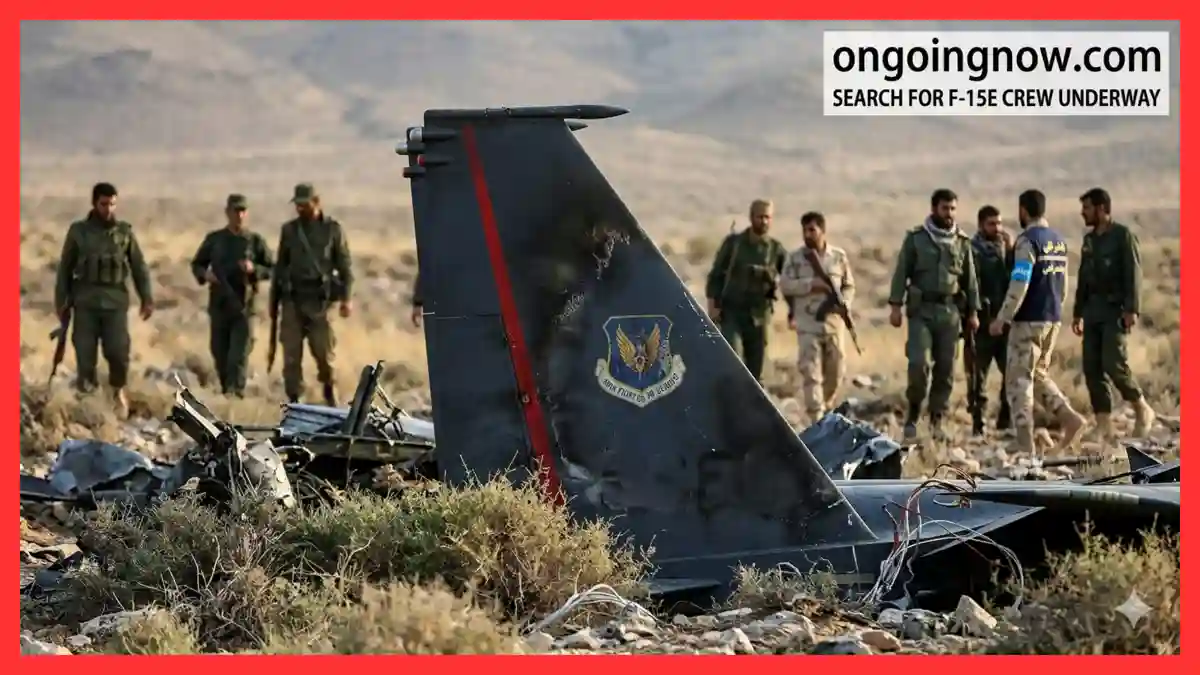
Initial reports from Iranian state media, including Fars News and Tasnim, originally claimed the downing of an F-35 stealth fighter. However, aviation experts and Open Source Intelligence (OSINT) analysts quickly corrected the identification based on visual evidence circulating on military aviation social media. Wreckage photos clearly displayed a red vertical stabilizer stripe and the US Air Forces in Europe (USAFE) shield, markings iconic to the 48th Fighter Wing’s 494th Fighter Squadron, which operates F-15E Strike Eagle aircraft.
The F-15E Strike Eagle wreckage was geolocated to Khuzestan Province, approximately 470 kilometers south of Tehran. Images showing a distinct tail fin and an ACES II ejection seat provided evidence of a controlled departure from the aircraft, though the condition of the crew remains unconfirmed. While Tehran has utilized the crash site for propaganda purposes, aviation specialists note that the presence of the ejection seat confirms at least one crew member successfully initiated the emergency sequence before impact.
Search and Rescue Operation Efforts
Immediately following the loss of radar contact, US forces launched a Combat Search and Rescue (CSAR) mission. Local reports and Telegram war updates provided sightings of US C-130 tankers and HH-60 Pave Hawk helicopters flying at low altitudes within contested airspace. These specialized assets are designed for the high-risk extraction of personnel behind enemy lines.
The search and rescue operation is complicated by the presence of active Iran air defense systems and the IRGC’s call for local civilians to assist in the capture of “foreign paratroopers.” Iranian state television has offered rewards for information leading to the apprehension of the crew, heightening the humanitarian stakes for the missing pilots. Pentagon officials, speaking on the condition of anonymity, emphasized that “operational security is the primary concern” as teams navigate the rugged terrain of southwestern Iran.
Performance of Iran Air Defense Systems
The IRGC has attributed the successful engagement to “newly developed and advanced air defenses” that have been integrated into their national security apparatus. Throughout Operation Epic Fury updates, the performance of these systems has been a point of contention. While CENTCOM had previously dismissed several Iranian claims as disinformation, this verified loss suggests a maturing threat environment for coalition aviation.
Military analysts suggest that Iran may be utilizing a combination of indigenous “Khordad-15” systems and modernized mobile batteries to create “bubbles” of denied airspace. The following table outlines the reported engagement metrics as of April 3, 2026:
Operation Epic Fury: Aviation and Defense Metrics
| Category | Data/Status | Source |
| Confirmed US Aircraft Losses | 1 (F-15E Strike Eagle) | US Officials / IRGC |
| Reported Crew Status | 2 Personnel (Missing in Action) | CENTCOM / CNN |
| Total Combat Flights | 13,000+ (Since Feb 28) | US Dept. of War |
| Iranian Targets Struck | 12,300+ | Operation Epic Fury Fact Sheet |
| Oil Market Impact | $110+ per barrel | WTI Futures (Apr 3) |
Regional Reactions and Gulf War Escalation 2026
The incident has triggered a wave of spectator reactions to jet crash footage across the Middle East. On platforms like X and Telegram, videos geolocated to bridges over the Karoon River show the low-flying rescue formations, drawing both support and condemnation from regional observers. This visibility has turned a tactical loss into a broader psychological engagement in the Gulf war escalation 2026.
In Washington, the US Central Command statement remained measured, avoiding the rhetoric used by political leadership. Secretary of War Pete Hegseth previously described the mission as “laser-focused” on dismantling Iranian offensive capabilities, but the loss of a crewed jet brings the human cost of the campaign into sharper focus. International humanitarian organizations, including the International Federation of Red Cross and Red Crescent Societies, have noted that the escalation is driving an exponential rise in medical needs across the region.
Broader Geopolitical Context and Analysis
Analysis: Why the F-15E Loss Matters
The loss of the F-15E Strike Eagle is more than a technical setback; it is a test of the US military’s CSAR capabilities in a near-peer environment. Unlike previous conflicts where air superiority was absolute, the Gulf war escalation 2026 features a highly contested electromagnetic spectrum and advanced integrated defenses. If the crew is captured, the conflict moves into a high-stakes hostage negotiation phase, potentially derailing any behind-the-scenes ceasefire discussions.
The Resilience of Integrated Defenses
Evidence from the crash site suggests that despite 13,000+ combat sorties by coalition forces, the Iranian “Khatam al-Anbiya” air defense headquarters maintains functional command and control. This resilience forces a re-evaluation of the “SEAD” (Suppression of Enemy Air Defenses) campaign, which was intended to be completed in the first ten days of the operation.
Human Impact and Community Perspective
The conflict’s expansion into Khuzestan and Yazd provinces has significantly impacted civilian life. Beyond the immediate danger of military debris, the mobilization of local militias to search for the downed crew has created an atmosphere of extreme tension. Verified reports indicate that bridges and electrical power plants have become primary targets, leading to widespread utility failures for the local population.
The human-centric focus of international observers remains on the dignity of the missing crew and the safety of non-combatants caught in the crossfire. “The safety of all individuals, including the aircrew and the civilians on the ground, must be the priority,” stated a representative from a prominent European NGO. As the search and rescue operation continues, the international community watches for signs of further escalation or a potential pivot toward a mediated pause in hostilities.
Stay sharp with Ongoing Now!
Source and Data Limitations: This report is based on verified metrics provided by US Central Command, the US Department of War’s April 1 Fact Sheet, and geolocated visual evidence from independent OSINT analysts. Conflicting claims from the Islamic Revolutionary Guard Corps (IRGC) regarding the aircraft type (F-35 vs. F-15E) were reconciled using photographic evidence of aircraft markings. Information regarding the crew’s survival is currently limited to the sighting of an ejection seat; no official confirmation of custody or status has been released by the Pentagon as of April 3, 2026. Delays in communication are expected due to the ongoing nature of the search and rescue mission.