Strait of Hormuz Status: Navigating the New Maritime Reality
International shipping faces a complex landscape as the Strait of Hormuz remains under strict Iranian naval management while a targeted U.S. blockade continues to impact Iranian-bound cargo.

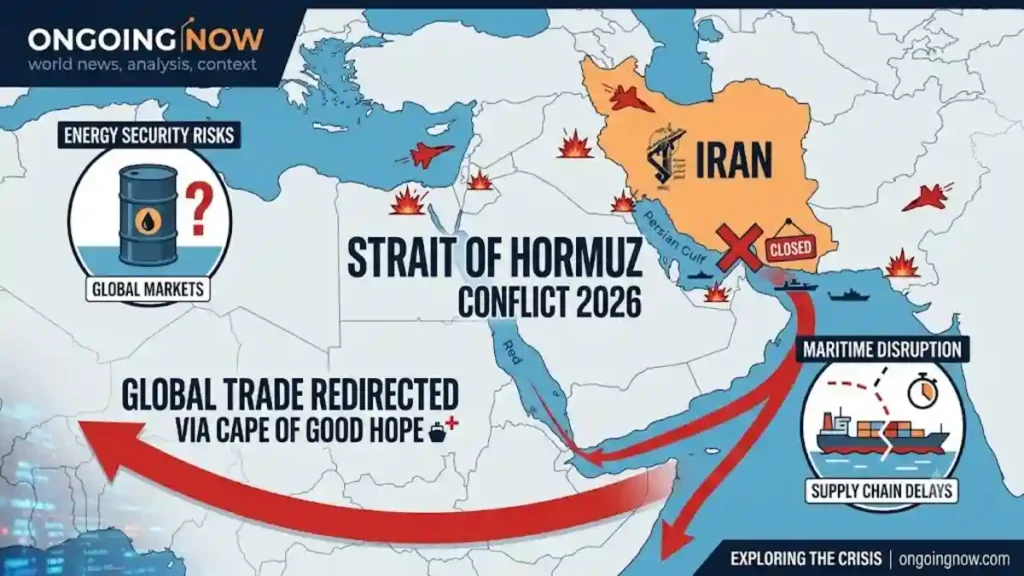
The Strait of Hormuz has emerged as a focal point of global maritime tension following an IRGC naval command announcement that it will maintain “strict management” over the strategic waterway. Despite a brief diplomatic opening on April 17, 2026, the current status of the channel is characterized by a high-stakes standoff: Iran has asserted control over commercial shipping lanes, while the United States maintains an active Iran US naval blockade targeting vessels bound for Iranian ports. This development carries profound geopolitical significance, as it directly impacts the flow of roughly 20% of the world’s crude oil and liquefied natural gas, prompting immediate international responses from major economies and global energy markets.
Within this volatile environment, several key entities are actively shaping the narrative. The United States Central Command (CENTCOM), led by Admiral Brad Cooper, is overseeing the enforcement of the blockade, which reportedly involves over 10,000 personnel and a dozen warships. Concurrently, the Islamic Revolutionary Guard Corps (IRGC) has deployed gunboats to enforce its own transit rules, leading to recent maritime security incidents reported by the UK Maritime Trade Operations (UKMTO). Diplomatic efforts, though strained, continue through mediators such as Pakistan, while European leaders, including French President Emmanuel Macron and British Prime Minister Keir Starmer, recently met in Paris to discuss securing freedom of navigation for the broader international community.
Current Status of Maritime Operations
The operational environment within the Strait of Hormuz is currently bifurcated. On one hand, the Iranian government, via Foreign Minister Abbas Araghchi, initially declared the strait “completely open” for commercial traffic on Friday, April 17, following a ceasefire in Lebanon. However, this was quickly countered by the IRGC, which asserted that strict control would remain in place as long as the U.S. blockade of Iranian ports persists. This internal friction within Tehran has created a state of uncertainty for international shippers.
As of April 18, 2026, the IRGC has reportedly fired upon at least one tanker, signaling a move back toward the “previous state” of restrictive transit. While some non-military vessels have been permitted to pass through designated routes—specifically those unaffiliated with “hostile countries” and following pre-coordinated Iranian paths—the broader freedom of navigation remains contested. The U.S. Navy continues to patrol the region, with destroyers such as the USS Frank E. Peterson and USS Michael Murphy operating in the Gulf of Oman to monitor the situation.
Analysis: The Impact of Synchronized Blockades
The current situation represents a unique and dangerous “dual-blockade” scenario. The U.S. blockade is surgical, focused exclusively on preventing cargo from reaching or leaving Iranian territory, whereas the Iranian response involves a more generalized “management” of the entire strait. This creates a friction point that disrupts the standard “freedom of the seas” doctrine.
Financial Toll: The blockade is estimated to cost the Iranian economy approximately $400 million to $435 million per day in lost revenue.
Energy Security: Since the onset of the conflict on February 28, 2026, global energy markets have remained on edge, with approximately 230 loaded oil vessels reported to be waiting for safe passage as of mid-April.
Supply Chain Resilience: Shippers are increasingly rerouting Very Large Crude Carriers (VLCCs) to loading ports outside the Persian Gulf to avoid the choke point, though this adds significant time and cost to global logistics.
Comparative Perspective: 2026 vs. Past Crises
| Feature | 2026 Hormuz Crisis | 1980s “Tanker War” |
| Primary Actor | IRGC / US CENTCOM | Iran / Iraq |
| Blockade Type | Targeted / Electronic Monitoring | Indiscriminate Missile Attacks |
| Key Tech | Drones & High-Precision Tracking | Sea Mines & Unguided Rockets |
| Diplomatic Hub | Islamabad, Pakistan | United Nations (New York) |
Human and Community Impact
The maritime standoff extends far beyond geopolitical chess; it has immediate consequences for the civilian populations and maritime workers in the region. Seafarers on commercial vessels find themselves in the crosshairs of military maneuvers. The UKMTO has recorded reports from captains describing approaches by IRGC gunboats as close as 23 miles northeast of Oman, creating a high-stress environment for crews who are often caught between conflicting international mandates.
Furthermore, the regional economy in the Persian Gulf is feeling the strain. Major aviation hubs from Doha to Dubai have reported a significant drop in traffic, and local fishing communities—such as those on Qeshm Island—have seen their livelihoods disrupted by strikes on infrastructure. The humanitarian impact is also visible in the rising costs of basic goods in countries dependent on Gulf imports, as insurance premiums for shipping have surged to historic levels.
Key Metrics and Timeline of Recent Events
The following table outlines the critical developments leading to the current state of the Strait of Hormuz.
| Date | Event | Outcome |
| Feb 28, 2026 | Outbreak of hostilities | Iran effectively closes the strait to international traffic. |
| Apr 8, 2026 | Temporary Ceasefire | US and Iran agree to terms; hope for reopening grows. |
| Apr 13, 2026 | US Naval Blockade Begins | CENTCOM enforces blockade on all ships bound for Iran. |
| Apr 17, 2026 | Conflicting Declarations | Iran FM says “Open”; IRGC maintains “Strict Control.” |
| Apr 18, 2026 | Security Incident | IRGC gunboats fire on a tanker; route remains contested. |
“The status of the Strait of Hormuz will remain under strict control until the United States restores freedom of navigation for all vessels bound for Iran.” — Statement from Iranian Central Military Command, April 18, 2026.
International and Institutional Responses
Global powers are attempting to de-escalate the situation while preparing for a prolonged disruption. In Paris, European leaders emphasized a “strictly defensive” mission to protect commercial shipping, which may include military escorts and mine-clearing operations. British Prime Minister Keir Starmer noted that the reopening of the strait is a “global responsibility,” underscoring the economic fallout that threatens international markets.
Meanwhile, U.N. Secretary-General António Guterres has welcomed the temporary ceasefires in neighboring Lebanon, urging all parties to use the pause as a springboard for a broader regional de-escalation. Despite these efforts, the U.S. administration, through President Donald Trump, has stated that the blockade will remain in “full force and effect” until negotiations are finalized.
Evidence-Based Implications
The current data suggests that the Strait of Hormuz will not return to “business as usual” in the immediate future. The Middle East conflict update indicates that while commercial vessels not bound for Iran are technically permitted passage, the risk of miscalculation remains high.
Maritime Insurance: Rates for transiting the Gulf of Oman have reached levels not seen in decades, forcing some companies to avoid the route entirely.
Strategic Stockpiles: Analysts indicate that Iran has limited oil storage capacity (estimated at 13 days), which may force a shutdown of domestic oil fields if the blockade persists, potentially causing long-term damage to their production infrastructure.
Geopolitical Alignment: The crisis has solidified a divide, with some nations like China and Russia reportedly seeking “toll” agreements or special coordination with Tehran to ensure the passage of their vessels.
The IRGC’s naval command announcement serves as a reminder that control of this narrow choke point remains one of the most potent levers in regional diplomacy. As long as the Iran US naval blockade remains in place, the “strict management” of the strait is likely to continue, leaving the global economy to navigate a volatile and unpredictable maritime corridor.
Stay sharp with Ongoing Now!
Source and Data Limitations: This report is based on verified briefings from the U.S. Department of Defense (CENTCOM), statements from the Iranian Foreign Ministry and the IRGC via state-affiliated media (IRIB, Tasnim), and maritime security alerts from the UK Maritime Trade Operations (UKMTO). Financial impact data is based on estimates from regional economic analysts. Readers should be aware that in active conflict zones, operational status can change within hours, and conflicting statements from different branches of the Iranian government (the Foreign Ministry vs. the IRGC) reflect ongoing internal policy debates. Reports of maritime incidents are verified through secondary shipping data where possible, but “strict management” protocols may lead to delays in public reporting of vessel interceptions.