Strait of Hormuz 48 Hour Warning Deadline: Why it Matters
Subtitle: Strategic implications as the April 6 Strait of Hormuz deadline approaches following a 48-hour warning from Washington.

The international community is closely monitoring the escalating situation in the Persian Gulf as the April 6 Strait of Hormuz deadline 2026 approaches. This critical juncture follows a 48-hour warning issued by President Trump, who stated that “all Hell will reign down” if the strategic waterway is not reopened. The current standoff involves several high-stakes factors: the potential for “Operation Hell Reign,” the recent history of US-Israel joint strikes near Tehran, and a significant global oil price spike.
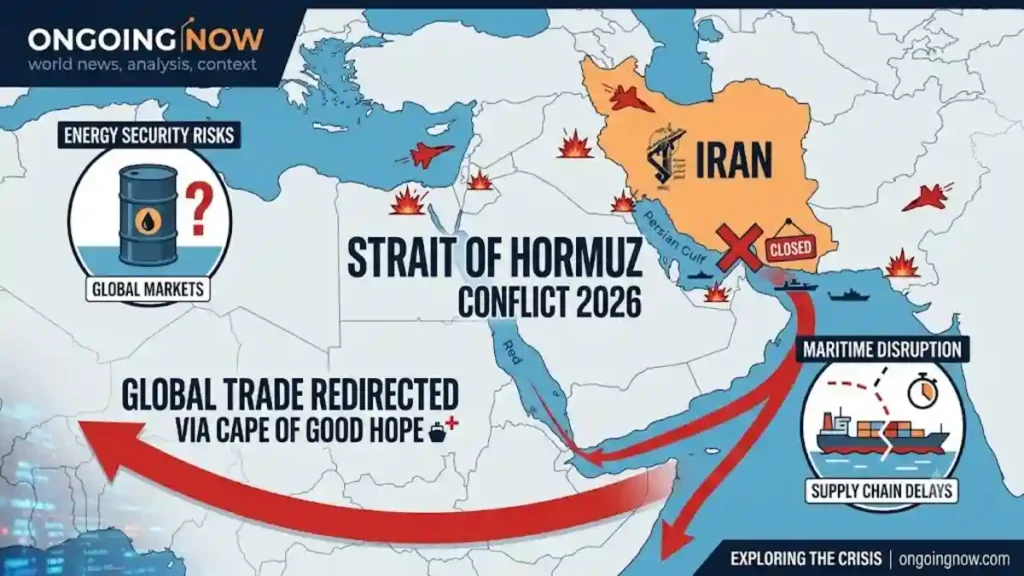
As of April 5, 2026, the Strait of Hormuz—which typically handles 20% of the world’s energy supply—remains largely restricted following the conflict that began on February 28. The 48-hour countdown has triggered diplomatic ripples across Tier 1 economies and increased military readiness in West Asia. This explainer analyzes the verified metrics of the shipping lane status, the economic consequences of the current blockade, and the diplomatic efforts led by regional intermediaries.
The 48-Hour Ultimatum and “Operation Hell Reign“
On Saturday, April 4, 2026, President Trump utilized social media to reiterate a final timeline for Iranian authorities to reopen the Strait of Hormuz. The message reminded Tehran of a previous 10-day window to reach a deal, which is now set to expire on April 6. The administration has signaled that failure to comply could lead to intensified military actions, colloquially referred to in public discourse as “Operation Hell Reign.”
The rhetoric from Washington emphasizes that Iranian infrastructure, including power plants and desalination facilities, could be targeted if the blockade persists. This follows a month of high-intensity operations where US and Israeli forces conducted precision strikes against various military assets. Conversely, Iran’s Khatam al-Anbiya Central Headquarters has dismissed the ultimatum as “unbalanced,” with Gen. Ali Abdollahi Aliabadi warning that any further strikes would meet a “devastating” response.
Strategic Status of the Strait of Hormuz Shipping Lane
Maritime analytics indicate a profound shift in the usage of the world’s most vital energy chokepoint. While the lane is not entirely vacant, its utility for international commerce has been severely diminished since the initial Feb. 28 engagement. Data from Kpler suggests that the majority of current transits are limited to vessels either originating from or bound for Iran, often destined for Chinese ports.
The International Energy Agency (IEA) has characterized this disruption as the largest in the history of the global oil market. Non-Iranian tankers have largely avoided the route due to prohibitive insurance premiums and the high risk of kinetic engagement. This “stranglehold” has not only affected petroleum but has also disrupted the flow of liquefied natural gas (LNG), methanol, and agricultural commodities like soybean and corn.
Economic Analysis: The Global Oil Price Spike
The uncertainty surrounding the April 6 deadline has directly influenced energy markets. Brent crude prices, which fluctuated near $65 per barrel earlier in the year, have surged to between $100 and $120 per barrel in early April 2026. This “war premium” reflects the market’s fear of a long-term closure and the potential destruction of production facilities.
By the Numbers: Energy and Military Metrics
| Metric | Verified Value (as of April 5, 2026) |
| Brent Crude Price | $100 – $120 per barrel |
| Global Energy Supply via Hormuz | ~20% (Pre-war levels) |
| US Service Member Injuries | 365 (since Feb. 28) |
| US Hostile Deaths | 7 (confirmed by Pentagon) |
| Iranian Drone Capacity | ~50% remaining (US Intel estimate) |
While the market is currently in a state of high volatility, analysts note that the impact is particularly acute for import-dependent regions in Asia. China, India, and Japan face rising inflationary pressures as shipping costs for alternative routes—if available—continue to climb.
Humanitarian and Community Impact in the Region
Beyond the geopolitical maneuvers, the conflict has had a documented impact on regional civilian infrastructure. On April 2, a strike on a major bridge outside Tehran resulted in at least eight fatalities and nearly 100 injuries. Additionally, a projectile strike near the Bushehr nuclear power plant killed a security worker on Saturday, raising concerns regarding environmental safety and nuclear stability in the region.
The humanitarian focus remains on the preservation of essential services. Iranian state media and international observers have noted disruptions to local power grids following previous rounds of strikes. The dignity and resilience of affected communities are highlighted by local efforts to maintain food supply chains despite the maritime blockade affecting agricultural imports.
Comparative Context: Previous Maritime Crises
The current Strait of Hormuz crisis draws comparisons to the “Tanker War” of the 1980s, though the scale of modern precision weaponry and the speed of market reaction in 2026 represent a significantly different operational environment. During the 1980s, the disruption lasted years with lower immediate price spikes; in 2026, the global economy’s “just-in-time” nature has caused an almost instantaneous reaction to the blockade.
The current conflict is also distinct due to the integration of unmanned aerial vehicles (UAVs). US intelligence assessments suggest that despite five weeks of strikes, approximately half of Iran’s drone arsenal remains intact. This capability allows for continued “asymmetric” pressure on shipping, regardless of the status of conventional naval assets.
International and Institutional Responses
Global powers are currently divided on the path forward. While the US and Israel maintain a posture of military pressure to force the reopening of the lane, other international actors are seeking a diplomatic off-ramp.
Pakistan: Islamabad has served as a primary intermediary, hosting high-level delegations from Saudi Arabia, Turkey, and Egypt to discuss de-escalation.
Russia: Officials from Rosatom have warned of rising “nuclear risks” following strikes near Bushehr, urging a cessation of hostilities near sensitive sites.
France: President Emmanuel Macron has expressed skepticism regarding the feasibility of “forcibly seizing” the Strait, calling such options unrealistic for long-term stability.
A 15-point peace proposal was reportedly delivered to Tehran via Pakistani channels. However, the Iranian Foreign Ministry characterized the demands as “excessive,” and a consensus on the terms for reopening the waterway has yet to be reached as the 48-hour window closes.
What the Data Shows: Future Implications
The primary evidence suggests that the next 48 hours will determine the trajectory of global energy security for the remainder of 2026. If the deadline passes without a diplomatic breakthrough or a reopening of the lane, the transition from aerial and naval skirmishes to “Operation Hell Reign”—targeting land-based economic infrastructure—becomes a statistical probability based on current administration directives.
Investors and policymakers are bracing for a potential supply deficit. While OPEC+ countries have the capacity to increase production, the physical inability to move that product through the Persian Gulf remains the primary bottleneck. The April 6 deadline stands as the most significant test of international maritime law and global economic resilience in recent decades.
Stay sharp with Ongoing Now!
Source and Data Limitations: This report is based on verified news dispatches from April 3–5, 2026, including reports from Xinhua, CBS News, AFP, and The Media Line. Data regarding military casualties and equipment losses (e.g., F-15 and A-10 aircraft) is based on official Pentagon updates and verified local reports. There is a natural delay in confirming strike damage within Iranian territory due to restricted access. Speculative social media claims regarding specific “Operation Hell Reign” targets have been excluded in favor of official statements. Economic projections are subject to change based on real-time market volatility.