Global Security Impact: Why Middle East Ceasefire Matters
A two-week truce and conditional Strait of Hormuz reopening offer a temporary reprieve for global energy markets and international diplomacy.

The United States and Iran have entered a two-week conditional ceasefire as of April 8, 2026, marking the first significant pause in hostilities following weeks of direct military engagement. This agreement, brokered largely through Pakistani mediation, centers on the reopening of the Strait of Hormuz to “regulated passage” under the coordination of the Iranian Armed Forces. While the truce has immediately influenced global oil prices and security assessments, both Washington and Tehran maintain high-alert military postures, with Iran’s Supreme National Security Council describing the period as a window for negotiation rather than a definitive termination of conflict.
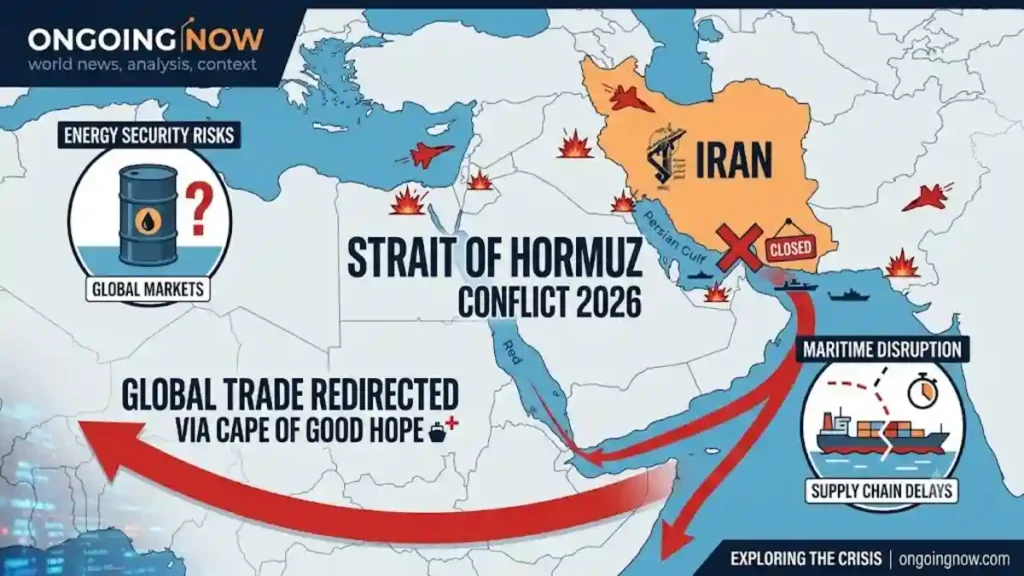
The regional conflict update reveals a fragile transition from active combat to structured diplomacy. Key stakeholders, including the United Nations, Japan, and Pakistan, have welcomed the de-escalation while emphasizing the necessity of a permanent resolution. The global security impact remains centered on the stability of the Strait of Hormuz, where nearly 20% of the world’s oil supply transits. Under the current ceasefire terms, safe passage is contingent upon Iranian military management, a condition that continues to weigh on long-term geopolitical risk assessments.
De-escalation Terms and the Role of International Mediation
The current Middle East ceasefire terms were formalized following intense diplomatic outreach led by Pakistani Prime Minister Shehbaz Sharif. The agreement establishes a 14-day window for high-level delegations to meet in Islamabad starting April 10, 2026. This diplomatic track aims to finalize a “10-point proposal” submitted by Tehran, which reportedly includes requests for the release of frozen assets and a halt to military operations against allied regional groups.
U.S. President Donald Trump indicated that the decision to pause strikes, previously aimed at Iranian infrastructure and leadership sites, followed discussions with Pakistani officials and General Asim Munir. The White House has characterized the current status as having “met and exceeded” initial military objectives under “Operation Epic Fury,” providing a strategic opening for a long-term peace agreement. However, the U.S. administration maintains that the full resumption of strikes remains an option if the terms of the Strait of Hormuz reopening are violated or if Iranian forces commit what Tehran’s leadership calls “the slightest error.”
The Strategic Importance of the Strait of Hormuz Reopening
The conditional Strait of Hormuz reopening serves as the primary mechanism for immediate economic relief. Prior to this agreement, the waterway’s closure had driven Brent crude prices to $119 per barrel. Following the announcement of the ceasefire, prices dropped by approximately 15.9%, settling near $92 per barrel.
Iranian Management: Passage is currently designated as “regulated” by the Iranian Navy and Revolutionary Guard.
Technical Limitations: Tehran has cited unspecified “technical limitations” that may affect the volume of daily traffic compared to pre-war levels of 100 ships per day.
Security Coordination: All commercial vessels must coordinate transit with Iranian authorities, a shift from the previous international traffic separation schemes.
By the Numbers: Global Energy and Security Shifts
| Metric | Pre-Conflict (Jan 2026) | Peak Conflict (Mar 2026) | Ceasefire (Apr 8, 2026) |
| Brent Crude Price | $70/barrel | $119/barrel | $92/barrel |
| Hormuz Traffic | ~100 ships/day | Near zero | Resuming (Regulated) |
| Global Food Security | 318M (Insecure) | 363M (Projected) | Stabilizing |
Geopolitical Risk Assessment and Regional Responses
The geopolitical risk assessment for the second quarter of 2026 remains “Elevated” despite the truce. Analysts point to the rapid reconstitution of Iranian ballistic missile sites and the continued presence of U.S. combat forces in the region as primary friction points. The ceasefire has elicited varied responses from regional powers:
Pakistan: Serves as the primary host for the Islamabad talks, positioning itself as a neutral arbiter capable of bridging the gap between Washington and Tehran.
Israel: While a White House official stated Israel has agreed to the pause, the Israeli government has not issued a formal public comment, focusing instead on the “systematic degradation” of security threats.
Gulf Arab States: There is reported concern among some capitals regarding the “regulated” status of the Strait, fearing it grants Tehran permanent leverage over maritime trade.
United Nations: Secretary-General António Guterres has called for UN ceasefire monitoring to ensure the protection of civilian infrastructure, particularly in light of recent strikes on the South Pars natural gas field.
Human Impact: Tehran Protest Reactions and Civilian Resilience
Domestic stability within Iran remains a critical factor in the negotiation process. Tehran protest reactions following the ceasefire announcement have been characterized by public gatherings and a mix of relief and continued economic demand. Earlier in 2026, the country faced significant civil unrest triggered by subsidy reforms and inflation, which led to widespread internet shutdowns.
The ceasefire provides a necessary pause for humanitarian corridors. The World Food Programme (WFP) previously warned that a continued conflict could push 45 million more people into acute food insecurity due to rising energy costs. In Tehran and other major cities, the cessation of airstrikes has allowed for the partial restoration of civilian services, though internet access and foreign media restrictions remain largely in place. The resilience of local communities is currently tested by a “subsistence economy” heavily impacted by the prior weeks of military engagement and international sanctions.
Analysis: The Framework for Global Security Impact
The global security impact of this ceasefire extends beyond the immediate cessation of fire. It represents a pivot toward “deterrence through negotiation.” By accepting the 10-point proposal as a basis for talks, the U.S. administration is testing a diplomatic off-ramp for “Operation Epic Fury.”
“This does not signify the termination of the war. Our hands remain upon the trigger.”
— Statement from Iran’s Supreme National Security Council, April 8, 2026.
The success of the upcoming Islamabad talks hinges on whether the Middle East ceasefire terms can be transitioned into a binding UN Security Council resolution. Historically, short-term truces in the region have struggled when “regulated passage” in international waters is used as a bargaining chip for sanctions relief. The current situation mirrors the “Maximum Pressure 2.0” posture of 2025, but with the added complexity of direct kinetic strikes having already occurred.
Evidence-Based Implications for the Coming Weeks
As the April 10 negotiations approach, the international community is monitoring three primary indicators of stability. First is the actual volume of oil exiting the Persian Gulf; any “technical” delays in the Strait of Hormuz will likely trigger a price rebound. Second is the presence of UN ceasefire monitoring or similar third-party verification to prevent accidental escalations during the 14-day window. Finally, the internal political climate in both Washington and Tehran will dictate whether the “Golden Age” predicted by some officials is a realistic goal or a tactical delay.
The geopolitical risk assessment suggests that without a formal agreement on nuclear enrichment and regional proxy activity, the structural causes of the conflict remain unresolved. The two-week period serves as a high-stakes stress test for modern diplomacy in an era of direct interstate conventional warfare.
Stay sharp with Ongoing Now!
Source and Data Limitations: This report is based on verified briefings from the United Nations (March 17, 2026), official statements from the Iranian Supreme National Security Council (April 8, 2026), and reported diplomatic correspondence from the Pakistani Prime Minister’s office. Data regarding oil prices is sourced from global spot trading reports as of April 8. Note that information from inside Iran remains subject to verification due to ongoing internet restrictions and limited foreign media access. Military objectives for “Operation Epic Fury” are based on White House press releases and have not been independently audited by international observers. Updates from Israel remain pending official government statements.