Brent Crude Oil Price Forecast: Why Risk Persists
Global energy markets are balancing a complex dichotomy as escalating West Asia tensions and potential Strait of Hormuz shipping disruptions collide with a projected 2026 crude oil surplus.

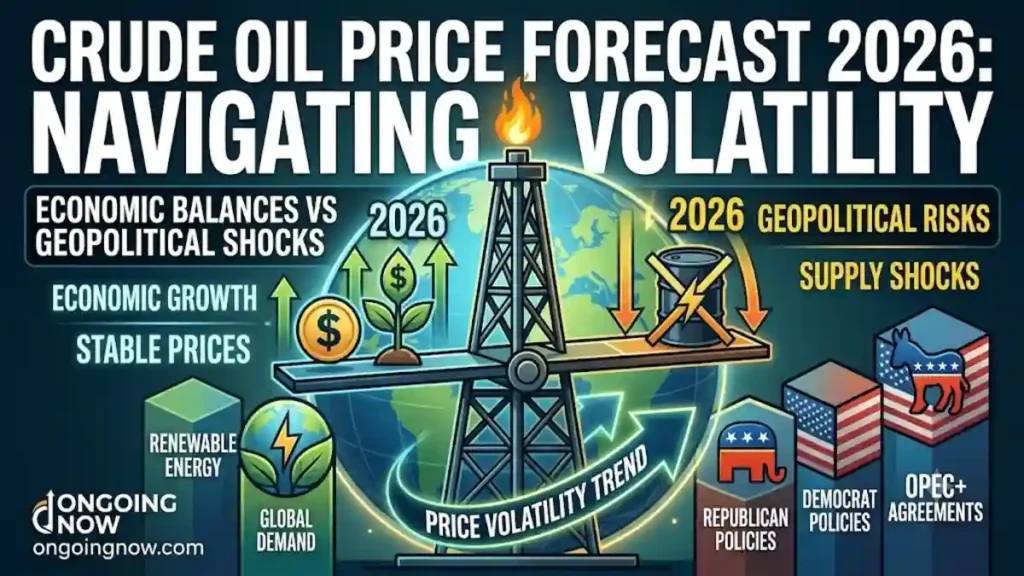
The Brent crude oil price forecast for 2026 remains a focal point for global markets as the energy sector navigates a volatile intersection of geopolitical instability and structural oversupply. While North Sea Dated crude surged by $10 per barrel in January to trade above **$73 per barrel**, primarily driven by Strait of Hormuz shipping disruptions and renewed Iran oil export sanctions 2026, international agencies maintain a cautious outlook. The International Energy Agency (IEA) and the World Bank both indicate that while a “war premium” has returned to the market, a substantial supply surplus of approximately 3.7 million barrels per day (mb/d) continues to cap long-term price ceilings.
The current market environment is shaped by three distinct factors: the increasing global energy supply chain risks emanating from the Persian Gulf, the tightening of U.S. sanctions on Tehran’s “shadow fleet,” and the resilience of non-OPEC+ production from the United States, Brazil, and Guyana. Consequently, the impact of Middle East conflict on stocks has been measured, with traders weighing immediate supply threats against the backdrop of an “extraordinary” 477-million-barrel global inventory build recorded in 2025.
Geopolitical Premiums Meet Structural Surplus
The oil price spike explanation for early 2026 is rooted in the increased military activity near the Strait of Hormuz, where nearly 21% of global petroleum liquids transit daily. In February 2026, Iran’s Islamic Revolutionary Guard Corps (IRGC) conducted naval drills that led to temporary maritime restrictions, forcing vessels to adjust routes and pushing Brent futures up by 5% in a single week.
However, analysts from BloombergNEF and J.P. Morgan Research note that this “war premium” is currently estimated at a modest $4 to $8 per barrel. Unless a full maritime blockade occurs—a scenario that would halt 13 million barrels of crude daily—the structural surplus is expected to drive prices lower toward the end of the year.
2026 Price Projections: A Diverging Outlook
Financial institutions have provided a range of forecasts based on varying risk scenarios for the Brent crude oil price forecast:
| Institution | Base Case 2026 Forecast | Risk Scenario (Disruption) |
| World Bank | $60 / bbl | Higher if sanctions intensify |
| J.P. Morgan | $58 / bbl | $75+ if trade tensions escalate |
| BloombergNEF | $55 / bbl | $91 / bbl (Full Iran Disruption) |
| IEA (Current) | ~$71 / bbl | Volatile based on Gulf security |
“The crude market is amply supplied in the near-term. The market should be able to withstand oil flow interruptions to some extent, depending on the size of the disruption,” noted Yiwen Yin, Oil Markets Analyst at BloombergNEF.
Strait of Hormuz: The Focal Point of Supply Chain Risks
The Strait of Hormuz shipping disruptions represent the single largest “tail risk” for the global energy supply chain risks in 2026. Because the waterway is only 24 miles wide at its narrowest point, even partial closures during military exercises have immediate effects on insurance premiums and transit times.
In February 2026, vessel berthing delays at Bandar Abbas Port exceeded three days, while major regional hubs like Jebel Ali in the UAE and Fujairah saw increased congestion as tankers sought alternative berths. For global logistics, these disruptions ripple beyond energy, affecting the delivery of petrochemical feedstocks and industrial components.
Shipping Rerouting: Vessels avoiding the Strait must circumnavigate Africa, adding 2–3 weeks to transit times.
Operational Efficiency: Major export terminals, including Saudi Arabia’s Ras Tanura, have reported cautious vessel movement, leading to longer loading cycles.
Cost Multipliers: Higher insurance premiums for “war risk” zones are currently being passed on to consumers in Asian markets, which are most dependent on Gulf exports.
Analysis: The Impact of Iran Oil Export Sanctions 2026
A critical driver of the current market tension is the enforcement of Iran oil export sanctions 2026. On February 6, 2026, the U.S. Department of State sanctioned 15 entities and 14 “shadow fleet” vessels involved in the transport of Iranian petroleum. This move is part of a broader strategy by the administration to restrict Tehran’s primary revenue source.
What the Numbers Show
Data from Kpler indicates that Iranian crude loadings fell to below 1.39 mb/d in January 2026, a 26% year-on-year decline. The strain on Tehran’s economy is evident, with the Central Bank of Iran (CBI) reporting a 10% drop in nominal oil export value to $30.7 billion for the first half of the current fiscal year.
Discounted Sales: To maintain flows to China, Iran is offering significant price discounts, with analysts estimating that 20% of revenue is consumed by transport and storage costs.
Stranded Assets: Unsold Iranian crude stored on tankers has nearly tripled over the past year to over 170 million barrels.
Capital Outflow: Despite a reported trade surplus, nearly $15 billion in capital left Iran in the first six months of the fiscal year, signaling domestic economic uncertainty.
Market Performance: Impact of Middle East Conflict on Stocks
The impact of Middle East conflict on stocks has remained relatively contained as of late February 2026. While the S&P 500 and global indices have seen minor dips of 0.2% to 0.5% following escalations, broader market focus remains on U.S. economic data, including GDP growth and the Personal Consumption Expenditures (PCE) index.
Energy sector equities have shown mixed performance. Integrated majors are benefiting from strong refining margins, whereas high-cost producers, such as certain U.S. shale players, face margin compression as Brent remains near the $70 mark.
“Geopolitical stories are notoriously difficult to price,” Marija Veitmane, head of equity research at State Street Global Markets, told Bloomberg TV. “Right now it’s almost impossible to assign probabilities to any outcome, given how quickly those narratives change.”
Energy Sector Investment Tips and Future Trends
For institutional participants, energy sector investment tips for 2026 emphasize a “hybrid energy reality.” While traditional oil remains volatile, investment is increasingly flowing into grid resilience and battery storage to offset the risk of fossil fuel price shocks.
Key Investment Themes for 2026:
Refining Resilience: OPEC+ nations have expanded domestic refinery capacity, allowing them to capture value even if crude prices soften.
Storage Innovation: With global inventories at a five-year high, companies specializing in Battery Energy Storage Systems (BESS) are emerging as winners in a market prone to power price fluctuations.
Upstream M&A: Rystad Energy projects $150 billion in upstream opportunities, as players with “deep pockets” use the period of depressed primary energy prices to acquire frontier blocks.
Data Center Demand: The expansion of AI and digital infrastructure in Asia and the Americas is creating a new, stable floor for energy demand, regardless of geopolitical flares.
West Asia Geopolitical Risk Analysis: A Human Perspective
The West Asia geopolitical risk analysis extends beyond market tickers to real-world impacts on regional and global consumers. For developing economies, the combination of high energy prices and currency volatility creates a “cost-of-living” squeeze.
Consumer Impact: In Asian economies like South Korea and Japan, which rely heavily on Hormuz for energy imports, the rise in “war risk” premiums directly translates to higher utility costs.
Labor Markets: While the energy sector remains a robust employer, the shift toward automated and decentralized energy systems is beginning to reshape the workforce in traditional oil-producing hubs.
Global Inflation: The World Bank warns that while falling energy prices generally help ease inflation, any sustained conflict that removes Iranian barrels or blockades the Strait could reverse the disinflationary trend of the last two years.
Why This Matters
The current situation demonstrates that global markets are no longer purely reactive to Middle Eastern tensions. The rise of non-OPEC+ supply has provided a buffer that did not exist in previous decades. However, the concentration of maritime risk in the Strait of Hormuz remains the “Achilles’ heel” of the global energy architecture. For businesses, the lesson of 2026 is the necessity of supply chain diversification and the integration of geopolitical risk into long-term capital planning.
Stay sharp with Ongoing Now!
Source and Data Limitations: This article is based on market reports from the International Energy Agency (IEA) February 2026 Oil Market Report, World Bank Commodity Markets Outlook (October 2025 and February 2026 updates), and financial data from J.P. Morgan Research and BloombergNEF. Shipping and tanker tracking data were provided by Kpler and Achilles Chem as of February 20, 2026. Sanctions information is sourced from the U.S. Department of State (February 6, 2026). This analysis excludes speculative social media reports and unverified military claims. All forecasts are subject to change based on actual OPEC+ production decisions and the outcome of ongoing diplomatic negotiations.