Supreme Court Oral Arguments Focus on Birthright Citizenship
Executive Order reinterpretation of the 14th Amendment faces a major constitutional test as the Supreme Court weighs the definition of jurisdiction.
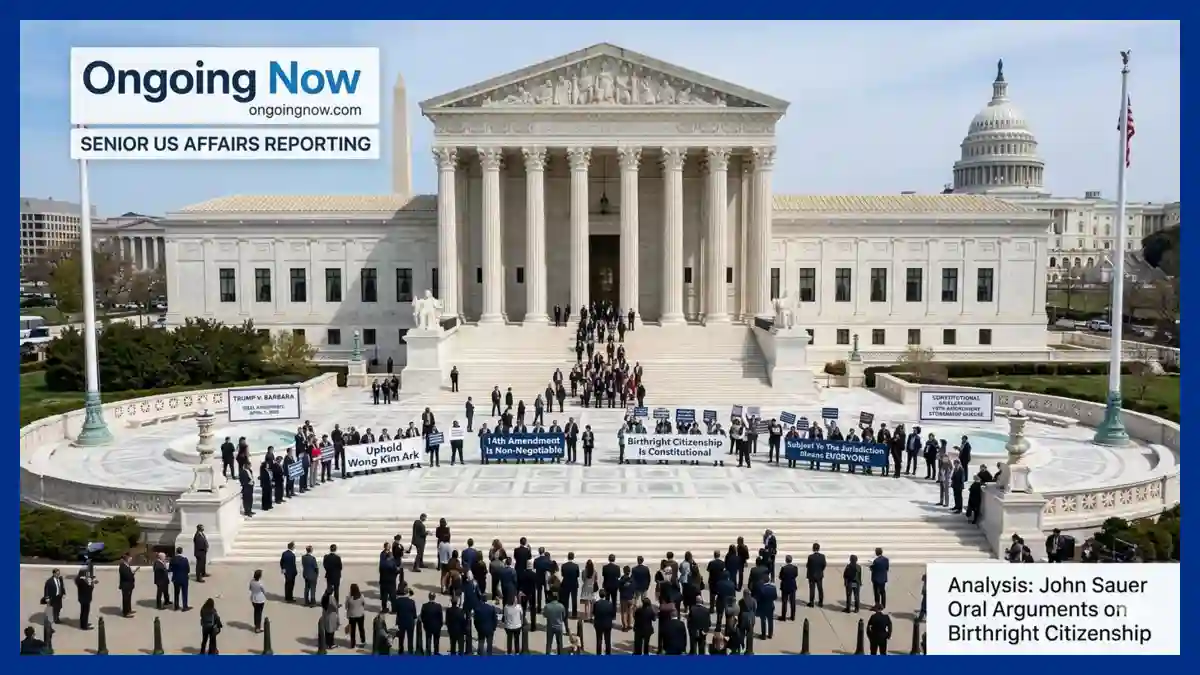
The U.S. Supreme Court heard oral arguments on April 1, 2026, in the landmark case Trump v. Barbara, evaluating the constitutionality of an executive order seeking to end birthright citizenship for children of undocumented immigrants and temporary residents. The central legal dispute hinges on the “Citizenship Clause” of the 14th Amendment, specifically whether such children are “subject to the jurisdiction” of the United States. President Donald Trump made a historic appearance by attending the session in person, marking the first time a sitting president has attended oral arguments in modern history. U.S. Solicitor General D. John Sauer defended the administration’s position, arguing that the amendment was originally intended to cover only those with “direct and immediate allegiance” to the country.
Within the first 300 words of the proceedings, the Supreme Court became the focal point of a clash involving the Executive Branch, the Department of Justice, and various state attorneys general who have challenged the order. The American Civil Liberties Union (ACLU) represented the respondents, including “Barbara,” a Honduran citizen whose child’s status is at stake. The Solicitor General faced pointed questions from Chief Justice John Roberts and other justices regarding the tension between the new executive policy and over 125 years of legal precedent established by the 1898 ruling in United States v. Wong Kim Ark.
Examining the 14th Amendment and the Jurisdiction Debate
The core of the administration’s legal brief, presented by John Sauer, argues for a narrow interpretation of the 14th Amendment’s “subject to the jurisdiction” phrasing. According to the government’s theory, jurisdiction requires more than mere physical presence; it necessitates a political allegiance that undocumented individuals and temporary visitors allegedly do not possess. This argument seeks to distinguish current migration patterns from the Reconstruction Era context in which the amendment was drafted.
Lawyers for the respondents and constitutional law experts counter that the phrase was intended to be geographic, encompassing everyone within U.S. territory except for the children of foreign diplomats or enemy occupiers. They argue that the “original intent” of the Reconstruction-era framers was to create a broad, objective rule that avoided the “permanent subclass” of residents that the Dred Scott decision had previously facilitated.
The Historic Significance of John Sauer Oral Arguments
During the oral arguments, Solicitor General John Sauer emphasized that the executive order is prospective, meaning it would not strip citizenship from those who have already received it. Sauer characterized the long-standing practice of granting birthright citizenship as a “misreading” of the Constitution that has incentivized “birth tourism.” He argued that the President possesses the authority to direct federal agencies on how to interpret constitutional text in the absence of a definitive, contrary ruling that covers the specific classes of people mentioned in the order.
Justice Sonia Sotomayor and other members of the court’s liberal wing questioned the logistics of implementing such a policy, asking how the government would verify the parentage and status of every child born on U.S. soil. The Chief Justice also expressed skepticism toward certain aspects of the government’s “domicile” argument, noting that the exceptions to birthright citizenship have historically been extremely narrow.
Key Figures and Legal Benchmarks in Trump v. Barbara
| Feature | Details |
| Case Name | Trump v. Barbara (Docket No. 25-365) |
| Primary Issue | Constitutionality of Executive Order 14160 |
| Lead Counsel (Petitioner) | U.S. Solicitor General D. John Sauer |
| Lead Counsel (Respondent) | Cecillia Wang (ACLU) |
| Key Precedent | United States v. Wong Kim Ark (1898) |
| Effective Date (Order) | Prospective (30 days after implementation) |
Analysis: Why the Citizenship Clause Matters Now
The outcome of this case could fundamentally reshape the American social and legal landscape. If the court rules in favor of the administration, it would mark the most significant shift in citizenship law since the late 19th century. Legal analysts suggest that a ruling affirming the executive order would effectively decouple U.S. citizenship from the principle of jus soli (right of the soil) for a significant portion of the population.
From a policy perspective, the administration views this as a critical tool for border security and “restoring the value” of citizenship. However, the Migration Policy Institute and other research bodies have provided data suggesting that ending birthright citizenship could increase the unauthorized population by millions over the next several decades. This would create a large population of individuals who are born, raised, and educated in the U.S. but lack legal status or a path to participation in civil life.
Societal Impact and Regional Variations
The human impact of the case is felt most acutely in border states and major metropolitan hubs with large immigrant populations. In Washington, D.C., protest updates on the day of the hearing indicated a high level of public engagement, with hundreds of demonstrators gathered outside the Supreme Court building. Civil rights groups argue that the order targets vulnerable communities and could lead to increased discrimination against U.S. citizens of color whose “status” might be questioned by local or federal authorities.
State-level responses have been sharply divided. Twenty-four Democratic attorneys general filed an amicus brief opposing the order, citing concerns over administrative chaos and the loss of tax revenue from a disenfranchised workforce. Conversely, several Republican-led states have signaled support for the administration, arguing that the federal government must have the power to define the limits of its “civil community.”
Historical Context: From Reconstruction to Wong Kim Ark
To understand the current debate, one must look back to the Reconstruction Era law that followed the Civil War. The 14th Amendment was designed to ensure that formerly enslaved people were recognized as full citizens, nullifying the Dred Scott decision. The subsequent 1898 case United States v. Wong Kim Ark clarified that the amendment applied to the children of non-citizens (in that case, Chinese immigrants) who were permanent residents of the U.S.
The Trump administration’s current legal strategy attempts to carve out an exception for those without “permanent domicile,” a term that appears in the Wong Kim Ark decision but which the ACLU argues was descriptive of the plaintiff rather than a requirement for the rule. The court must now decide if that distinction is legally meaningful in 2026.
What the Data Shows: Long-Term Projections
Evidence-based political insights suggest that a change in birthright citizenship would have profound economic consequences. An “undocumented underclass” would face significant barriers to higher education, licensed employment, and social safety nets. Some economists argue this would lead to a “gray market” economy, reducing total tax compliance and straining local social services that would still be required to provide emergency care regardless of a resident’s citizenship status.
By the Numbers:
255,000: Estimated annual births impacted if the order is upheld.
5.4 Million: Projected increase in the unauthorized population by 2075.
128 Years: The duration of the legal status quo since Wong Kim Ark.
76: The age of Justice Samuel Alito, who celebrated his birthday on the bench during these arguments.
As the Supreme Court schedule for 2026 continues, a final decision in Trump v. Barbara is expected by late June or early July. The ruling will determine whether a president can re-interpret a constitutional amendment through executive action or if such a change requires the more rigorous process of a new constitutional amendment.
Stay sharp with Ongoing Now!
Source and Data Limitations: This report is based on oral argument transcripts from the U.S. Supreme Court (April 1, 2026), official court filings in Trump v. Barbara (Docket 25-365), and published legal briefs from the U.S. Solicitor General and the ACLU. Statistical projections regarding population impact were sourced from the Migration Policy Institute’s 2025-2026 reports. Historical context regarding the 14th Amendment and Wong Kim Ark is based on established legal archives and the National Archives and Records Administration. All mentions of presidential attendance and justice comments are verified through pool reports and accredited news agency coverage (AP, CBS, Reuters). Unverified social media speculation and “circus memes” were excluded to maintain editorial neutrality.


