Why the Folarin Balogun suspension shifts Mauricio Pochettino tactics for Seattle
Disciplinary rulings confirm the forward will miss the Round of 16 match against Belgium, forcing an immediate tactical restructure.
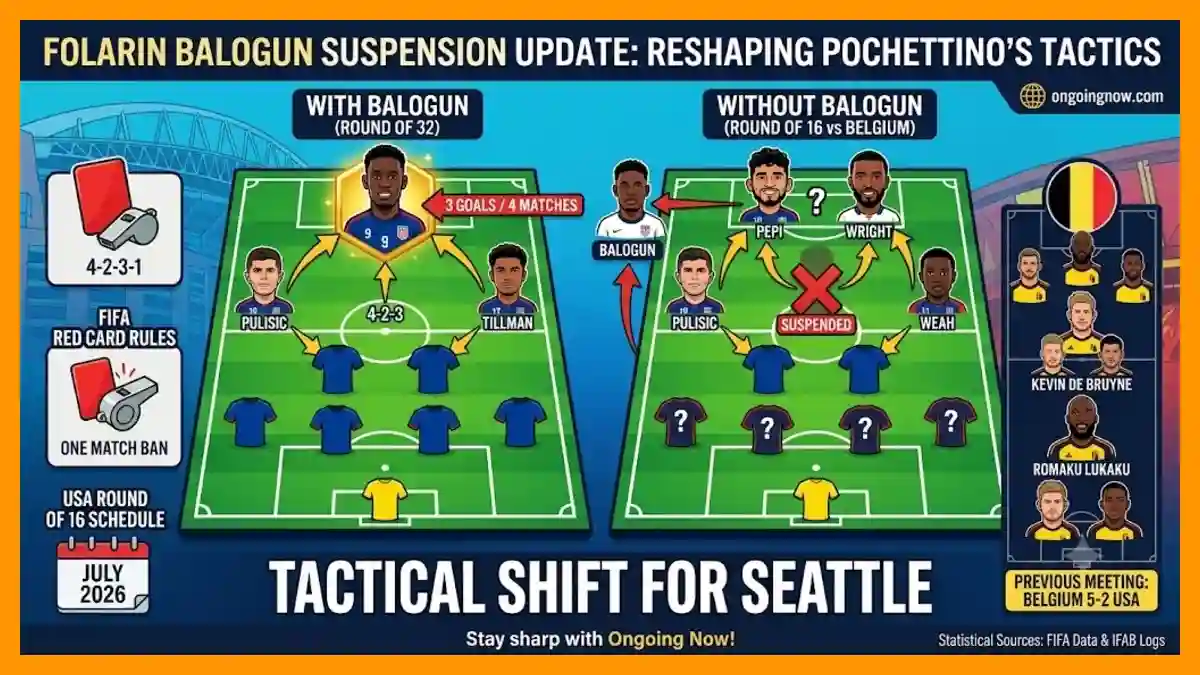
The U.S. Men’s National Team faces an administrative and tactical crossroad ahead of its historic knockout appearance following the official Folarin Balogun suspension update. The AS Monaco striker was issued a straight red card during the 64th minute of the United States’ 2-0 victory over Bosnia and Herzegovina in the Round of 32, triggered by a video review. Under standard FIFA red card suspension length guidelines, a direct dismissal carries an automatic one-match ban that cannot be overturned through standard administrative channels. This development introduces a severe constraint for head coach Mauricio Pochettino as he devises his tactical blueprint for the upcoming Round of 16 fixture against Belgium at Seattle Stadium.
The disciplinary incident occurred when Balogun contested a loose ball with Bosnian central defender Tarik Muharemovic. In the follow-through of the challenge, Balogun’s studs caught Muharemovic’s ankle, causing it to twist and prompting immediate intervention from the Video Assistant Referee. Brazilian match official Raphael Claus initially allowed play to continue but altered his decision to a straight red card after analyzing the pitchside monitor. The enforcement of these rigid tournament rules leaves the host nation without its primary offensive spearhead for the next stage of the bracket.
Technical Analysis of the Folarin Balogun Suspension Update
The finality of the disciplinary action has drawn significant scrutiny from technical analysts and former match officials. Under standard tournament regulations, a straight red card for serious foul play requires the player to immediately vacate the pitch and serve a minimum one-match ban. U.S. Soccer Federation officials quickly verified that the organization holds no legal path to lodge a Monaco striker red card appeal for a single-game suspension. According to FIFA Disciplinary Code statutes, an appeal is only permissible if the Disciplinary Committee extends the ban beyond the mandatory one-match threshold.
The mechanical nature of the challenge sparked extensive commentary regarding how the governing body assesses on-field intent versus physical consequence. Former international referee Mark Clattenburg provided an extensive breakdown of the incident during the official broadcast, highlighting a disconnect between real-time intensity and slow-motion video review.
“When you watch it in real time, you don’t see the ankle twist – and it’s just that accident, as Balogun puts his foot down, he catches underneath his opponent’s foot,” noted FOX broadcast analyst Mark Clattenburg. “This is just an accident. It happens. You can see he’s upset by it. This doesn’t meet, for me, the criteria of a red card, and it certainly is going to change the course of the game.”
Clattenburg further elaborated on the structural criteria used by the modern video review system during the post-match debrief.
“The problem you’ve got is, to reach the criteria of a red card, there has to be some speed, some force and some malice. This lacked that,” Clattenburg stated. “However, in my opinion, this didn’t endanger the safety of the opponent. Balogun doesn’t even look for the foul. It’s one of those where it happens in a split second; he puts his foot down and catches the opponent.”
Regulatory Framework of USA Soccer Red Card Rules
The application of discipline at this stage aligns directly with the established FIFA red card suspension length framework designed for elite international tournaments. Under the tournament guidelines, yellow card accumulations are wiped clean after the quarterfinal stage, but red card expulsions carry immediate, non-negotiable penalties. The International Football Association Board defines serious foul play as any tackle or challenge that actively endangers the safety of an opponent or deploys excessive force. When a referee identifies a foot-on-foot stomp near the Achilles tendon, the protocol mandates a review, irrespective of perceived intent.
This ruling makes Balogun the first player from the United States roster to receive a red card during the current tournament cycle. It also marks the 12th straight red card issued across the tournament overall, demonstrating a highly rigid standard enforced by the refereeing committees. The lack of an independent recourse mechanism ensures that the initial field ruling stands as the definitive operational framework for the team’s upcoming matches.
Statistical Overview of the USMNT Knockout Campaign
Prior to his dismissal, Balogun had established himself as the most productive attacking asset within the domestic tactical system. His opening goal against Bosnia and Herzegovina complemented a strong group-stage performance, including a multi-goal display in the opening match against Paraguay. His absence deprives the frontline of tactical continuity and structural depth precisely as the tournament transition to single-elimination play.
Tournament Metrics and Attacking Contributions
The following data outlines the offensive production and disciplinary data across the squad’s recent tournament appearances:
| Player Name | Matches Played | Goals Scored | Shots on Target | Disciplinary Status |
| Folarin Balogun | 4 | 3 | 9 | Suspended (1 Match) |
| Christian Pulisic | 4 | 1 | 7 | Available |
| Malik Tillman | 4 | 1 | 4 | Available |
| Ricardo Pepi | 3 | 0 | 3 | Available |
| Weston McKennie | 4 | 0 | 2 | Available |
Note: Statistics reflect verified totals through the conclusion of the Round of 32 on July 1, 2026. Disciplinary status applies explicitly to the upcoming Round of 16 phase.
The metrics demonstrate that the forward line has leaned heavily on Balogun’s efficiency in the penalty area. His individual Folarin Balogun World Cup stats reveal an elite conversion rate, capitalizing on limited service to record three goals from just nine total targets. Replacing this level of efficiency presents an immediate challenge for the coaching staff.
Reshaping Mauricio Pochettino Tactics Belgium
The enforcement of the suspension forces an immediate adjustment in the structural layout of the host nation’s attack. Head coach Mauricio Pochettino has primarily deployed a balanced 4-2-3-1 formation that relies on Balogun’s vertical mobility to stretch opposing defensive lines. Without this focal point, the coaching staff must choose between maintaining the tactical shape with a direct replacement or altering the system entirely to utilize a false-nine structure.
The primary USMNT replacement striker option is PSV Eindhoven forward Ricardo Pepi, who offers a traditional aerial presence and physical hold-up play. Another alternative within the roster includes Haji Wright, whose tactical versatility allows him to operate centrally or drift into wide spaces to exploit defensive gaps. The selection will dictate how wide midfielders like Christian Pulisic and Timothy Weah rotate into the box during transitional phases of possession.
Belgium enters the Round of 16 following a highly physical 3-2 comeback victory over Senegal, demonstrating significant resilience in their defensive transitions. In their most recent head-to-head meeting—an international friendly contested on March 29, 2026—Belgium secured a 5-2 victory over the United States. During that exhibition, the Belgian attack exposed structural gaps in the American backline, with forward Dodi Lukébakio scoring twice in the second half. Pochettino will likely emphasize defensive compactness to avoid a repetition of that result under high-stakes tournament conditions.
Strategic Implications for the 2026 World Cup Bracket Live
The upcoming fixture at Seattle Stadium carries profound historical weight for the progression of soccer within the region. The match represents the host nation’s entry into the high-profile USA round of 16 schedule, a phase that historically dictates the long-term legacy of the national team programs. Local interest has surged significantly, with organizers reporting complete sell-outs for all available World Cup Seattle match tickets at the venue.
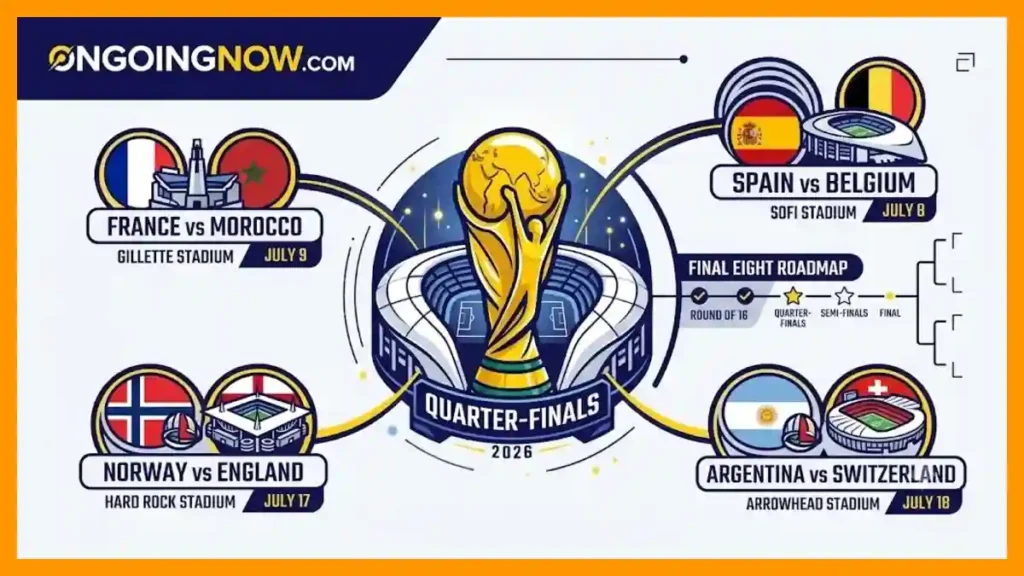
The broader 2026 World Cup bracket live demonstrates a highly balanced path through the knockout stages, where tactical discipline frequently supersedes individual talent spikes. The winner of the United States versus Belgium encounter will advance to the quarterfinal round, facing the victor of a concurrent knockout fixture. The structural resilience displayed by the squad after Balogun’s dismissal against Bosnia—where they successfully protected their lead and added a second goal via a Malik Tillman free-kick—suggests the collective unit remains capable of executing complex defensive assignments under pressure.
Human and Organizational Impact of the Disciplinary Ruling
Beyond the whiteboard adjustments, a sudden roster disruption during a home tournament generates substantial psychological and organizational friction. Roster choices made during a short-turn tournament cycle carry immense weight for the athlete journeys of young professionals. Team staff noted that veteran players immediately rallied around Balogun following the final whistle, attempting to stabilize squad morale ahead of the flight to the Pacific Northwest.
Audience engagement metrics indicate unprecedented domestic interest in this tournament cycle. Television broadcast data reveals record-breaking viewership numbers across metropolitan markets, reflecting a deeply invested fan community. This heightened public interest places a premium on how the coaching staff communicates tactical changes, as the selection of the starting central forward will be analyzed extensively by both domestic and international media.
The collective focus now shifts entirely to preparation at the training facility, where the coaching staff will conduct closed-door sessions to implement the revised attacking patterns. The ability of the remaining roster elements to absorb the loss of their leading goalscorer will serve as the ultimate evaluation of the program’s structural depth and tactical evolution under elite leadership.
Stay sharp with Ongoing Now!
—
Source and Data Limitations: Data compiled from official FIFA disciplinary logs, International Football Association Board (IFAB) legal parameters, and post-match press statements from Santa Clara, California, dated July 1, 2026. Statistics derived from verified tournament performance records. Historical head-to-head information references the international friendly contested between the United States and Belgium on March 29, 2026. This analysis excludes unverified player transfer rumors, speculative injury timelines for opposing rosters, and subjective fan commentary platforms.