Record $9.6B deal triggers historic Seahawks franchise sale parameters
The corporate transition of the defending Super Bowl champions relies on strict league structural approval and divestment rules.
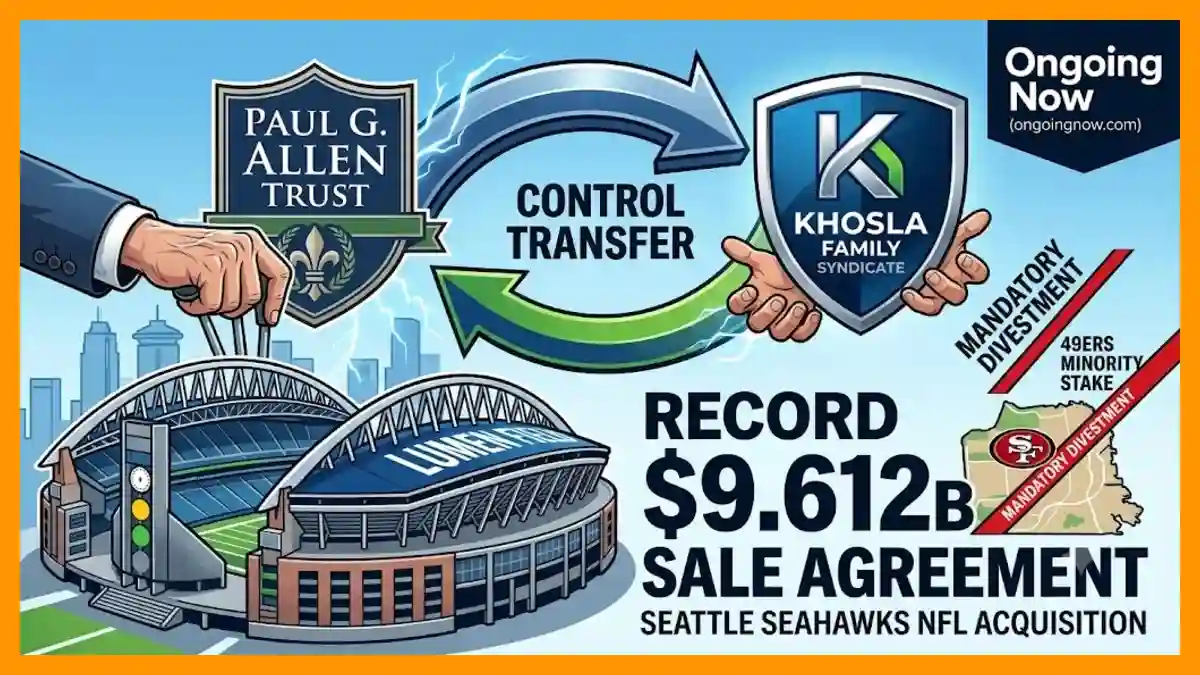
The execution of sports franchise control transactions governs the historic jody allen seahawks sale, marking an unprecedented milestone for any paul allen estate sports team. Driven by record breaking sports team purchases, this historic agreement highlights the largest nfl franchise sales framework under strict sports team ownership group requirements. To finalize the deal, the buyers must navigate the rigorous nfl finance committee approval process alongside rigid nfl ownership divestment rules. A central condition of this transaction is the mandatory san francisco 49ers minority stake divestiture by the purchasing syndicate before ratification.
The formal announcement on July 11, 2026, confirmed that the estate has finalized an agreement to transfer ownership to a group led by the Khosla family. Valued at a historic $9.612 billion, the transaction sets a new high-water mark for professional sports asset valuations globally. The transition shifts the franchise from trust stewardship into a new corporate structure, pending formal ratification by league executives.
The Multi-Billion Dollar Mechanics of Sports Franchise Control Transactions
The scale of modern sports franchise control transactions requires strict adherence to league capitalization rules and organizational mandates. The National Football League maintains an uncompromising stance on primary accountability, requiring a single individual to assume ultimate operational liability. In this transaction, Neeru Khosla has been designated as the primary controlling owner of the franchise. This designation positions her as the first minority woman to serve as a principal controlling partner in league history.
To satisfy league mandates, the primary controlling partner must maintain a significant personal equity stake of at least 30% in the franchise. This rule prevents highly fragmented syndicates from diluting operational accountability or destabilizing club governance. The broader purchasing group must also comply with strict limitations regarding the total number of limited partners involved in the transaction.
Beyond the core family leadership, which includes Vinod Khosla and their son Neal Khosla, the syndicate remains bounded by league limits capping standard ownership groups at 24 individuals. This structure ensures that even the most massive financial transactions preserve a clear, centralized chain of command. The league’s strict capitalization rules also regulate the debt limits permitted to fund such multi-billion dollar acquisitions.
How NFL Ownership Divestment Rules Impact the Khosla Syndicate
A primary regulatory hurdle in major sports acquisitions involves cross-ownership restrictions designed to prevent structural conflicts of interest. The league strictly prohibits any individual or ownership group from holding simultaneous equity positions in multiple franchises. Because the Khosla family acquired a minority interest of approximately 3% in the San Francisco 49ers in May 2025, immediate restructuring is legally mandated.
Under established league policies, the group must completely liquidate its Bay Area sports holdings before the Seattle acquisition can be finalized. This requirement underscores the absolute neutrality demanded by the league to preserve competitive integrity across all member clubs. The process involves finding qualified buyers to absorb the vacated minority equity under independent transactions.
The divestment process runs parallel to the primary acquisition timeline, requiring documentation that proves a total separation from the previous asset. NFL compliance officers meticulously audit these transactions to verify that no residual financial interests or voting rights persist. The mandatory liquidation ensures that the new leadership group operates with single-minded alignment toward their new Pacific Northwest asset.
How Sports Franchise Control Transactions Shift the Paul Allen Estate Legacy
The unwinding of the Paul G. Allen Trust represents one of the most complex asset liquidations in corporate sports history. Following the passing of the visionary Microsoft co-founder in 2018, his sister Jody Allen assumed stewardship of the estate’s extensive sports portfolio. The trust was bound by explicit instructions requiring the eventual sale of both the Seahawks and the NBA’s Portland Trail Blazers.
A critical fiscal boundary was cleared in May 2024 when a specific Washington State public financing provision expired. Had the franchise changed hands prior to that date, a 10% clawback penalty on the gross sales proceeds would have been triggered to reimburse public stadium funds. Waiting until the mid-2026 window allowed the estate to preserve the entirety of the transaction’s value for its intended targets.
Per the foundational mandates established by Paul Allen, 100% of the capital generated from this historic transaction will be channeled directly into philanthropic initiatives. The multi-billion dollar influx will fund medical research, environmental conservation, and educational advancement through the family’s charitable foundations. This structural requirement ensures that the massive financial footprint of the sale serves a broader social purpose beyond the sports industry.
### By the Numbers: The Historic Financial Scale

*   **Total Purchase Price:** $9.612 Billion
*   **Previous NFL Record Sale:** $6.05 Billion (Washington Commanders, 2023)
*   **Original 1997 Purchase Price:** $194 Million
*   **Net Appreciation Percentage:** Approximately 4,854% over 29 years
*   **Required Controlling Equity:** Minimum 30% personal stake
Navigating the NFL Finance Committee Approval Process
The closing of an NFL team sale requires clearing multiple institutional checkpoints managed by the league’s internal governing bodies. The transaction documents first undergo exhaustive scrutiny by the NFL Finance and Ownership committees to verify corporate structures and asset liquidity. Analysts review the debt-to-equity ratios of the purchasing syndicate to guarantee long-term financial stability.
Once the committee completes its forensic financial vetting, it issues a formal recommendation to the full body of league owners. Ratification requires an affirmative vote from a three-fourths majority of the member clubs, translating to at least 24 out of 32 votes. The league has instructed its owners to reserve August 26, 2026, for a special league meeting dedicated to voting on the matter.
During this review period, league investigators conduct comprehensive background checks encompassing legal, financial, and regulatory histories. The institutional vetting process is designed to protect the collective corporate brand of the shield from reputational or systemic risk. Only after the formal vote is recorded and compliance certificates are issued can the transfer of operational control legally occur.
Comparing Sports Franchise Control Transactions with Historic Valuation Leaps
The financial trajectory of professional football franchises has experienced exponential growth over the past three decades, transforming civic institutions into elite global asset classes. When Paul Allen purchased the Seahawks in 1997 for $194 million, the transaction was viewed as a civic rescue mission to prevent relocation to Southern California. The subsequent escalation in value reflects the massive commercialization of media rights and stadium monetization models.
To contextualize this growth, the $9.612 billion valuation eclipses the previous record set in 2023, when the Josh Harris Group purchased the Washington Commanders for $6.05 billion. It also dramatically supersedes the 2022 transaction involving the Denver Broncos, which closed at $4.65 billion. This steep upward curve signals intense global demand for premium sports content assets that command reliable, live-viewing audiences.
| Franchise Transaction | Year of Sale | Purchase Price | Controlling Entity |
| Seattle Seahawks | 2026 | $9.612 Billion | Khosla Family Syndicate |
| Washington Commanders | 2023 | $6.050 Billion | Josh Harris Group |
| Denver Broncos | 2022 | $4.650 Billion | Walton-Penner Syndicate |
| Carolina Panthers | 2018 | $2.275 Billion | David Tepper |
| Buffalo Bills | 2014 | $1.400 Billion | Terry and Kim Pegula |
Why This Result Matters: An Analytical Overview
The record-setting valuation achieved by the estate carries profound implications for future sports franchise control transactions across all major leagues. By establishing a near-ten-billion-dollar benchmark, this transaction immediately elevates the baseline valuation formulas applied to other major market franchises. Financial analysts point to upcoming media rights renegotiations and international expansion initiatives as key drivers behind such premium pricing models.
The transaction also highlights the efficiency of the league’s modified institutional investment rules, which allow approved private equity funds to acquire passive stakes up to 10%. While the Khosla transaction relies primarily on family capital, the availability of institutional secondary capital provides a critical liquidity cushion for modern sports syndicates. The structure implemented here demonstrates how private wealth can integrate cleanly within rigid league frameworks.
Furthermore, the requirement for complete separation from previous team holdings preserves the strict competitive balance that defines the league’s economic model. By forcing a total exit from the Bay Area market, the league prevents any perception of collusive behavior or shared strategic influence. This regulatory firewall remains a cornerstone of professional sports governance, ensuring that every ownership group operates exclusively in the interest of a single club.
The Legacy, Human, and Civic Impact on the Seattle Sports Landscape
Beyond the balance sheets and regulatory filings, the transition of the franchise deeply affects the community and the sporting culture of the Pacific Northwest. The sale occurs at a moment of peak competitive success, following the Seahawks’ decisive 29-13 victory over the New England Patriots in the Super Bowl on February 8, 2026, at Levi’s Stadium. The championship win provided a triumphant conclusion to the Allen family’s 29-year stewardship of the team.
Civic protections remain firmly embedded within the franchise’s operational framework to safeguard local fans from the threat of relocation. The team’s foundational lease at Lumen Field extends securely through the 2032 season, reinforced by three successive 10-year renewal options that stretch potential occupancy for decades. This legal architecture ensures the team remains anchored in the city that fought to retain it nearly thirty years ago.
The Khosla family acknowledged the profound civic responsibility associated with taking over the iconic franchise. In an official statement released through the team’s communications channels, Vinod Khosla emphasized the group’s long-term commitment to the region:
“We are honored to be entrusted as the next stewards of the Seattle Seahawks. We look forward to building on the winning legacy Paul Allen created and to earning the trust of the Seahawks organization and fans everywhere.”
The transition marks the conclusion of a historic chapter in Seattle sports, moving from a period of defensive preservation to one of high-tech global modernism. The massive capital generated will immediately begin working across global philanthropic sectors, fulfilling the ultimate vision of the trust. Meanwhile, the organization prepares its infrastructure for the formal league vote in late August, aiming for a seamless launch to the upcoming competitive season.
Stay sharp with Ongoing Now!
Source and Data Limitations: This news breakdown relies on verified official press releases from the Seattle Seahawks organization, public league memos distributed by NFL Communications, and confirmed reporting from Associated Press and ESPN analysts issued on July 11, 2026. Financial figures regarding historical sales are verified via public league archives and team transaction Ledgers. All data regarding stadium lease parameters and trust requirements are based on Washington State Public Stadium Authority records and official statements from the Paul G. Allen Estate. This analysis excludes speculative commentary regarding future roster moves, player contract negotiations, or unverified management changes, focusing entirely on the verified corporate and regulatory elements of the franchise transaction as of the current date.