Braylon Mullins Stuns Duke as UConn Secures Final Four
Freshman Braylon Mullins secures 73-72 victory with a 35-foot buzzer-beater as UConn overcomes 19-point deficit.
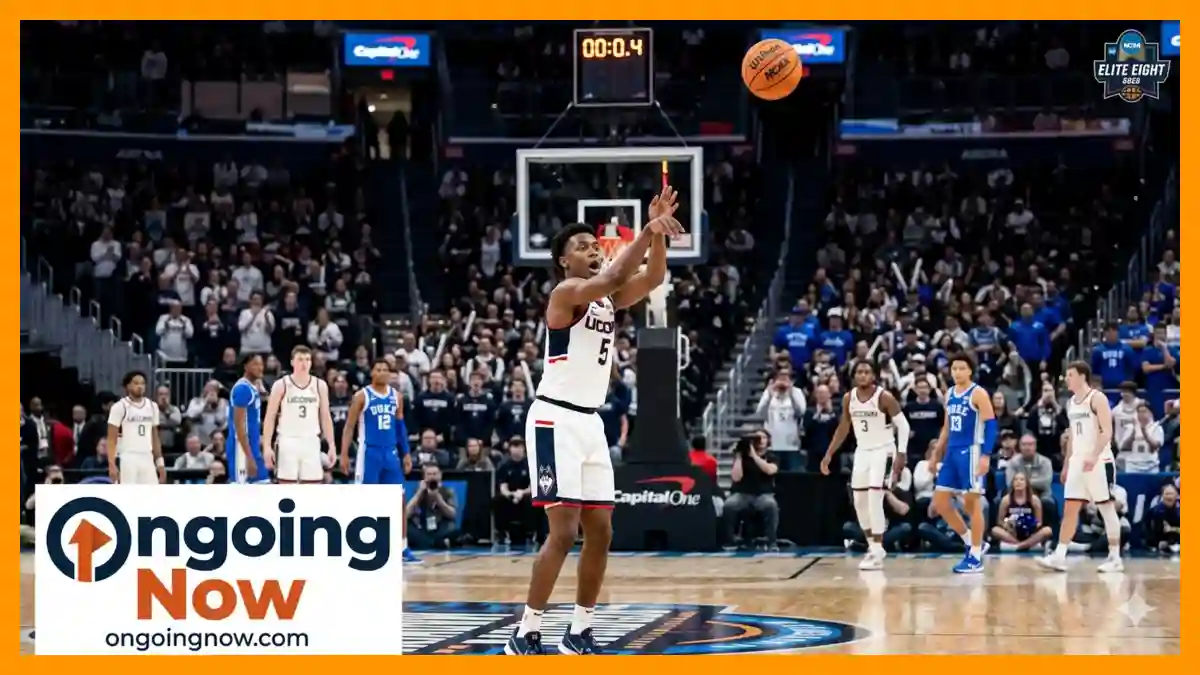
The University of Connecticut (UConn) men’s basketball team secured a spot in the 2026 Final Four following a 73-72 victory over top-seeded Duke on Sunday, March 29. Trailing by as many as 19 points in the first half, the Huskies orchestrated one of the largest comebacks in Elite Eight history, punctuated by a 35-foot three-pointer from freshman guard Braylon Mullins with 0.4 seconds remaining. This result continues a period of sustained postseason success for UConn, marking their third Final Four appearance in four years under head coach Dan Hurley.
The Elite Eight matchup at Capital One Arena in Washington, D.C., featured high-stakes dynamics for both programs. For UConn, the victory maintains a pursuit of collegiate basketball history, while for Duke, the loss ended a season led by standout freshmen Cameron and Cayden Boozer. The game’s final sequence involved a defensive deflection by Silas Demary Jr., leading to the transition opportunity that Braylon Mullins converted to overturn a late Blue Devil lead.
Statistical Overview of the Elite Eight Matchup
The contest was defined by a stark contrast between Duke’s early offensive efficiency and UConn’s persistent second-half execution. Duke established a 44-25 lead late in the first half, representing the largest halftime lead ever surrendered by a No. 1 seed in NCAA Tournament history. Despite shooting only 5-of-23 from three-point range, UConn utilized interior scoring and defensive pressure to reduce the margin.
| Category | UConn Huskies | Duke Blue Devils |
| Final Score | 73 | 72 |
| Halftime Score | 29 | 44 |
| Top Scorer | Tarris Reed Jr. (26 pts) | Cameron Boozer (27 pts) |
| FG % | 46.9% | 48.1% |
| 3PT % | 21.7% (5/23) | 35.0% (7/20) |
| Rebounds | 36 | 31 |
Note: Statistics represent official box score data from the East Regional Final held March 29, 2026.
Braylon Mullins and the Final Sequence
Braylon Mullins emerged as the central figure of the game’s conclusion despite struggling from the perimeter for much of the evening. Before the final shot, Mullins had missed his first four three-point attempts. The final play developed after UConn’s Silas Demary Jr. made one of two free throws to bring the Huskies within two points. During Duke’s subsequent possession, Cayden Boozer attempted a pass near midcourt that was deflected by Demary.
Mullins recovered the loose ball and received a return pass from Alex Karaban. From approximately 35 feet away, Mullins released a shot that reached the net with less than a second on the clock. This specific play has drawn immediate comparisons to historical NCAA Tournament moments, including Christian Laettner’s 1992 game-winner, ironically achieved by Duke against Kentucky.
Professional Prospects and NBA Draft Stock
The performance of Braylon Mullins has direct implications for his standing in the 2026 NBA Draft lottery. Currently projected as a mid-to-late lottery selection, Mullins is frequently linked to the Golden State Warriors in various mock drafts. Analysts, including Jeremy Woo, have noted that Mullins’ 6-foot-6 frame and movement-shooting profile align with modern NBA perimeter requirements.
His scouting report emphasizes “gravity” on the floor, a metric describing how a shooter’s presence forces defensive rotations. While Mullins averaged 12.0 points per game during the regular season, his efficiency from the free-throw line (85.2%) and his defensive competitiveness have solidified his status as a top shooting guard prospect. His performance in high-leverage tournament moments is expected to be a primary focus for NBA front offices during the pre-draft evaluation process.
Editorial Analysis of Team Dynamics
UConn’s success under Dan Hurley is increasingly attributed to a developmental model that integrates experienced veterans with high-upside freshmen. Tarris Reed Jr., who led all Huskies with 26 points against Duke, provided the necessary interior presence to counter Duke’s frontcourt. The physical nature of the game saw several Duke players enter foul trouble, a factor that assisted UConn’s steady accumulation of points in the paint during the second half.
Coach Hurley remarked in postgame statements that the program’s recruiting pitch to Mullins specifically highlighted the goal of returning to Indianapolis for the Final Four. The Huskies have now won 18 consecutive games in the Sweet 16 or later rounds, a streak that dates back to the program’s 2009 loss to Michigan State.
2026 Final Four Schedule and Outlook
The 2026 NCAA Tournament now moves to Lucas Oil Stadium in Indianapolis. UConn is joined in the Final Four by Arizona, Michigan, and Illinois. The Huskies’ victory over the East Region’s top seed establishes them as a significant factor in the national semifinal discussions.
Saturday, April 4: National Semifinals (Indianapolis, IN)
(1) Arizona vs. (1) Michigan
(2) UConn vs. (3) Illinois
Monday, April 6: National Championship Game
Illinois reached the Final Four by defeating Iowa 71-59, setting up a matchup between two programs with distinct styles of play. UConn’s path to the championship will require overcoming an Illinois team that has demonstrated defensive consistency throughout the tournament.
Impact on the Collegiate Sporting Landscape
The 73-72 result at Capital One Arena has broader implications for the “one-and-done” era of college basketball. While Duke’s roster featured premier freshman talent like the Boozer brothers, UConn’s victory underscored the value of defensive continuity and late-game poise. The game drew significant viewership, and the nature of the comeback is likely to remain a reference point for tournament resilience.
For the Duke Blue Devils, the season concludes with a 35-4 record. Despite the loss, the performances of Cameron Boozer (27 points) and Cayden Boozer (15 points) confirmed their status as elite prospects for future professional transitions. The 2026 tournament cycle has highlighted a deep freshman class that continues to influence both collegiate results and professional draft boards.
Stay sharp with Ongoing Now!
—
Source and Data Limitations: This report is based on verified results from the NCAA Men’s Basketball Tournament East Regional Final held on March 29, 2026. Statistical data was sourced from official box scores provided by NCAA and associated broadcast partners (TBS/CBS). Scouting insights and NBA draft projections incorporate analysis from ESPN’s Jeremy Woo and Bleacher Report’s Jonathan Wasserman. Attendance and viewership sentiment are based on preliminary regional reports from Washington, D.C. Regional variations in broadcast availability may apply. This analysis excludes unverified social media speculation regarding player injuries or locker room interactions