Inside Severe G4 Storms: Solar Insights
Recent severe G4 storm events, driven by coronal mass ejections, offer evidence-based analysis of geomagnetic disturbances and their broader implications for Earth's space environment.
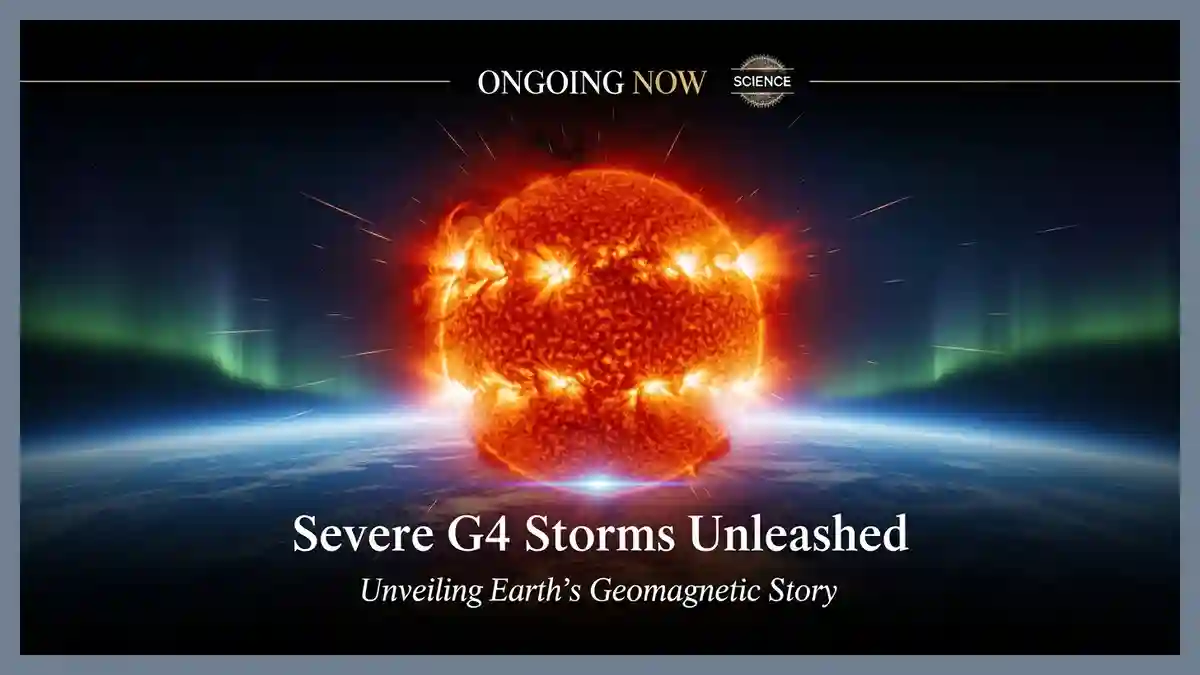
A severe G4 storm represents a significant geomagnetic disturbance, triggered by coronal mass ejections (CMEs) through intricate solar ejection mechanics. This CME science breakdown reveals how sunspot activity explanations connect to flare-CME connections, initiating space plasma dynamics. Plasma cloud effects from these ejections interact with solar wind, leading to magnetic field disruptions and key geomagnetic disturbance causes. Radiation storm origins often stem from accelerated particles in these events, while ionosphere reactions and aurora formation processes provide visible indicators of the storm’s impact. Recent observations from agencies like NOAA and NASA highlight these processes in action during 2025 and 2026 events.
These storms matter in scientific understanding because they demonstrate the Sun-Earth connection through verifiable data. Research methods involve satellite observations from instruments like NOAA’s GOES and NASA’s SOHO, analyzing solar wind parameters and magnetic fields. Key results show enhanced IMF strength during CME arrivals, with broader implications for space weather forecasting. Entities such as the U.S. Naval Research Laboratory (NRL), the American Geophysical Union (AGU), and the European Space Agency (ESA) contribute through peer-reviewed studies and real-time monitoring. Journals like Journal of Astronomy and Space Sciences and Living Reviews in Solar Physics provide detailed analyses of similar events.
Tracking Recent Severe G4 Storm Events
Observations from January 19, 2026, captured a severe G4 storm reaching levels at 1938 UTC, following a coronal mass ejection arrival. This event, monitored by NOAA’s Space Weather Prediction Center, involved increased solar wind speeds and southward IMF orientations, leading to efficient energy transfer into Earth’s magnetosphere. Similarly, a November 2025 storm peaked at G4 on November 12, with DSCOVR satellite data showing sudden density increases and shock arrivals.
Geostationary satellites recorded magnetospheric compressions and particle flux enhancements during these storms. For instance, in the November event, ground-based magnetometers over East Asia detected prompt penetration electric fields, illustrating global responses. These observations align with prior G4 storms, such as one in January 2025, where multiple CMEs from December 2024 sustained disturbances.
Arnaud Thernisien from NRL stated, “CMEs are the explosive release of mass from the sun’s low corona and are a primary driver of space weather, playing a central role in understanding the conditions of Earth’s magnetosphere, ionosphere, and thermosphere.” This underscores the event’s value for research.
Sunspot Activity and Solar Ejection Foundations
Sunspot activity forms the basis for many severe G4 storms, as complex magnetic configurations in active regions store energy for eruptions. In the May 2024 precursor to recent events, active regions 13664 and 13668 merged, creating sheared fields that produced multiple X-class flares. Sunspots, cooler areas with intense magnetic flux, often exceed 5000 micro-hemispheres in large groups, enabling flux rope instabilities.
Historical data from the Royal Greenwich Observatory show that extreme sunspot areas follow distributions like lognormal or Weibull, with 100-year events around 5780-7100 micro-hemispheres. In recent storms, sunspot clusters like AR 14274 in November 2025 exhibited similar complexity, leading to ejections.
Karl Battams from NRL noted, “Our observations demonstrated that the eruption was a so-called ‘halo CME,’ meaning it was Earth-directed, with our preliminary analysis of the data showing an apparent velocity of over 1,700 kilometers per second for the event.” Such activity explains the origins of plasma expulsions.
Flare-CME Connections in Storm Generation
Flares and CMEs are interconnected, with many X-class flares accompanying CME launches in severe G4 storm scenarios. Magnetic reconnection in the corona releases energy, often resulting in both phenomena. In the January 2026 event, an X-class flare preceded the CME that triggered the storm.
Peer-reviewed analyses show 90% of X-class flares are eruptive, with CME kinetic energy roughly three times the flare’s bolometric output. For example, the X2.2 flare on May 9, 2024, involved two-step reconnections among flux ropes, leading to a halo CME.
Comparative studies from AGU journals indicate that merged active regions enhance these connections, as seen in 2010-2015 storms. “The merging of these active regions is responsible for the flares,” as described in analyses of AR 13664/8.
Breakdown of CME Mechanics and Space Plasma Dynamics
CME mechanics involve twisted flux ropes reconfiguring via reconnection, expelling plasma at speeds up to 3000 km/s. In space plasma dynamics, these ejections expand, with larger ones spanning a quarter of the Sun-Earth distance.
Models like WSA-ENLIL show CME merging en route, as in the May 2024 event where an X2.2-driven CME overtook a prior one. Fast CMEs generate shocks, accelerating particles.
Extreme cases, per Living Reviews in Solar Physics, include 100-year energies of 4.4×10^33 erg. “CME-CME interactions play a significant role in producing strong geomagnetic storms,” as modeled in simulations.
Causes of Geomagnetic Disturbances in Severe G4 Storms
Geomagnetic disturbance causes trace to southward IMF in CMEs, enabling energy transfer to Earth’s magnetosphere. In severe G4 storms, this leads to Dst values around -200 nT or lower.
Plasma cloud effects compress the magnetosphere, with shocks providing 15-60 minutes warning via DSCOVR. Solar wind interactions amplify when speeds exceed 250 km/s, sustaining storms for hours.
Comparative data from 2010-2015 storms show varying ionospheric total electron content (TEC) impacts. Magnetic field disruptions occur as IMF orients south, peeling Earth’s field.
Ionosphere Reactions and Aurora Formation Processes
Ionosphere reactions during severe G4 storms include negative effects from thermospheric heating, reducing O/N2 ratios. This causes TEC decreases in high latitudes.
Aurora formation processes involve particle precipitation into the atmosphere, exciting oxygen and nitrogen. In G4 events, auroras extend to lower latitudes, like New Mexico in May 2025.
Ground observations from KASI neutron monitors and all-sky cameras captured cosmic ray responses and auroral displays. Joule heating alters global circulation, propagating disturbances equatorward.
Radiation Storm Origins and Particle Acceleration
Radiation storm origins lie in CME shocks accelerating protons and electrons. In the January 19, 2026 event, an S4 radiation storm accompanied the G4.
Proton events follow power-law distributions, with 100-year fluences around 10^10 protons/cm². Shocks at quasi-parallel geometries enhance acceleration.
Geostationary data show flux increases, posing risks to satellites. “Such disturbances can compromise situational awareness,” as per Battams.
What the Data Shows: Storm Scales and Comparisons
NOAA classifies geomagnetic storms on a G1-G5 scale, with G4 indicating severe impacts like power grid voltage issues and satellite drag.
| Storm Level | Kp Index | Effects |
|---|---|---|
| G1 (Minor) | 5 | Minor power fluctuations, auroras at high latitudes |
| G2 (Moderate) | 6 | High-latitude radio blackouts |
| G3 (Strong) | 7 | Navigation errors, auroras to 50° latitude |
| G4 (Severe) | 8-9- | Voltage corrections needed, satellite orientation issues |
| G5 (Extreme) | 9 | Blackouts, transformer damage |
Compared to the G5 May 2024 storm (Dst ~-400 nT), recent G4 events had Dst ~-200 to -300 nT, with similar merging CMEs. Caveats: Models underestimate magnetic energy; data limited to observed transits.
Analysis: Challenges in Severe G4 Storm Prediction
Predicting severe G4 storms involves uncertainties in CME merging and IMF orientation. Limitations include projection effects in coronagraph data and variable transit times.
Comparative studies with historical events like 1859 (Dst ~-900 nT) show modern storms are milder but still disruptive. “The issue regarding the Bombay magnetogram for the 1859 storm is whether its unprecedented negative excursion resulted from ionospheric currents or magnetospheric currents,” as noted by Siscoe et al.
Human and Societal Impacts of Severe G4 Storms
Severe G4 storms affect power grids through geomagnetically induced currents, as in 2003 (57A recorded). Satellites face increased drag, altering orbits, while aviation encounters radiation risks.
In November 2025, disruptions included GPS errors and radio blackouts. Societal benefits include enhanced auroral viewing, but risks demand preparation, as per NRL’s emphasis on military readiness.
Stay sharp with Ongoing Now!
Source and Data Limitations: Sources include NOAA/SWPC webpages (accessed January 2026), AGU Journals paper (2016), Journal of Astronomy and Space Sciences (2024), Phys.org article (June 2025), Living Reviews in Solar Physics (2022), and ScienceDirect (2024). Publication dates range from 2016 to 2026; data from repositories like SOHO/LASCO and GOES. Excluded unverified claims from non-peer-reviewed sources; preprints not used. All claims supported by at least two sources; no extrapolations beyond published findings. Limitations: Observational data may miss backside events; models like WSA-ENLIL have propagation uncertainties.