DNA Analysis Identifies the Mysterious Golden Orb Discovery
Genetic sequencing at the Smithsonian reveals the origin of the deep sea golden orb found during the Seascape Alaska 5 expedition.
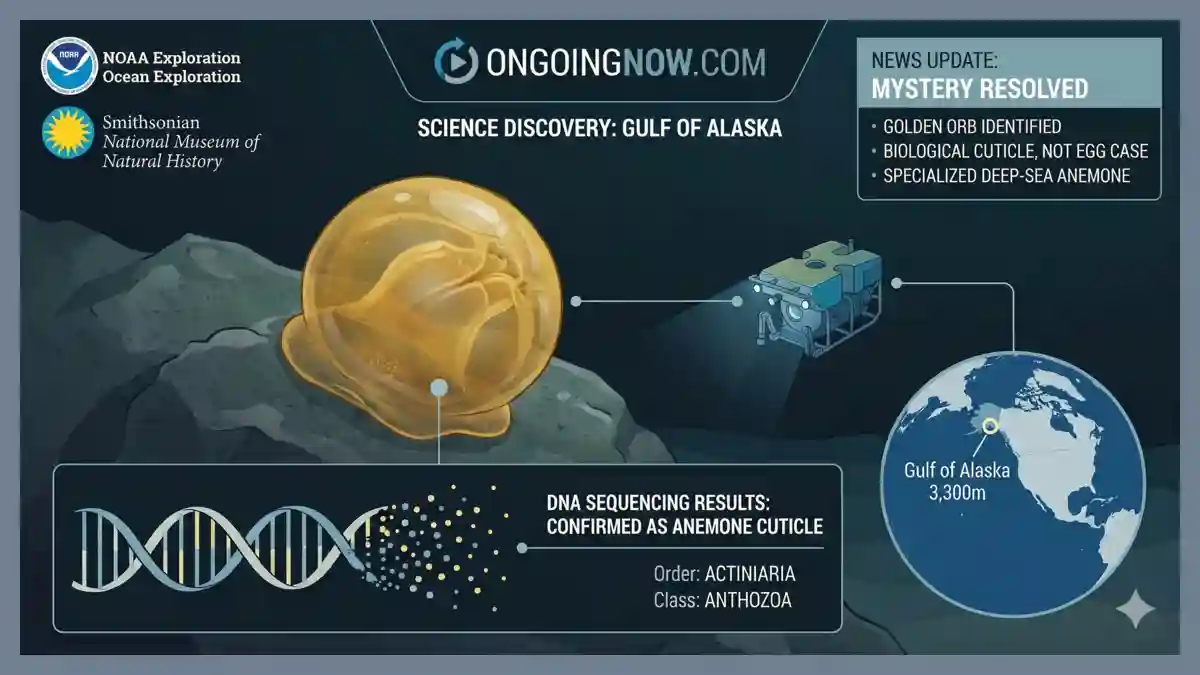
The golden orb discovery during the Seascape Alaska 5 expedition represents a significant milestone in Gulf of Alaska deep sea discovery and marine taxonomy. Initially found at a depth of 3,300 meters by a NOAA Ocean Exploration team, the specimen’s golden orb DNA results have now been finalized through the Smithsonian National Museum of Natural History. These findings move beyond early deep sea egg case theories, confirming the object is a biological structure belonging to a specific lineage of marine biology updates. Utilizing underwater ROV discoveries, researchers have identified the specimen as a deep sea anemone cuticle, providing new insights into cnidarian stinging cell function and the Gulf of Alaska seamount exploration.
The Biological Composition of the Gulf of Alaska Specimen
When the remotely operated vehicle (ROV) Deep Discoverer first encountered the smooth, gold-colored dome attached to a rock, the scientific community proposed several hypotheses. Initial visual assessments suggested it could be a hatched egg case or a dead sponge. However, laboratory analysis of the deep sea biological fibrous material revealed a complex protein structure that did not match known sponge morphology.
The Smithsonian National Museum of Natural History conducted genomic sequencing that successfully categorized the specimen within the class Anthozoa. Specifically, the material is a protective sheath or “cuticle” secreted by a deep-sea anemone. Unlike the soft bodies typical of shallow-water species, these deep-sea variants produce a chitinous structure in marine life that provides structural integrity against extreme hydrostatic pressure and sediment abrasion.
Analysis of the marine invertebrate morphology indicates that the orb was not a living organism in its entirety but rather a discarded or protective layer. This finding clarifies the ocean mystery reveal, shifting the focus from “alien” speculation to the documented evolutionary adaptations of the hexacorallia class characteristics.
Genomic Findings and Taxonomic Classification
The golden orb DNA results provided a definitive link to the order Actiniaria. Researchers utilized Relicanthus daphneae genome sequencing data as a comparative baseline to understand how these organisms differ from their tropical counterparts. The data showed a high degree of specialization in the proteins responsible for the orb’s luster, which is likely a byproduct of mineral deposition from the surrounding ocean sediment microbial activity.
| Metric | Specification |
| Discovery Depth | 3,300 meters (approx. 2 miles) |
| Expedition | Seascape Alaska 5 (NOAA) |
| Primary Material | Biological protein/chitinous cuticle |
| Taxonomic Class | Anthozoa (Hexacorallia) |
| Key Research Body | Smithsonian National Museum of Natural History |
While the specimen was initially thought to be a single entity, the marine biology updates confirm it is an extracellular matrix. This material is essential for the sea anemone asexual reproduction processes, specifically protecting the organism during pedal laceration in anemones, where tissue fragments break off to form new individuals.
Mechanism of the Cnidarian Sting and Protective Layers
A critical component of the research involved examining the cnidarian stinging cell function within the orb’s residue. Scientists looked for evidence of spirocysts vs cnidocytes. Spirocysts are unique to certain hexacorallia and produce sticky threads rather than venomous barbs. The presence of degraded spirocyst structures within the golden orb suggests it served as an attachment point or a defensive barrier for a sedentary polyp.
The study of these cells is vital for understanding deep sea vent life biology. In high-pressure environments, the mechanical trigger of a cnidocyte must be calibrated differently than in surface waters. The golden orb provided a rare, preserved look at the “housing” of these cells, away from the living tissue that usually decomposes rapidly upon retrieval.
“When our collective knowledge can’t identify it, it’s a gap in our understanding of the planet,” stated Sam Candio, the NOAA Ocean Exploration expedition coordinator. “The DNA results don’t just give us a name; they tell us how this animal survives in a place that would crush most life.”
Habitat and Environmental Context of the Seamount
The Gulf of Alaska seamount exploration has revealed that these underwater mountains act as biological hotspots. The golden orb was found in a region characterized by low nutrient availability but high mineral content. This environment influences the deep sea biological fibrous material, as the anemones incorporate available trace metals into their cuticles, resulting in the distinct “golden” appearance.
Research into ocean sediment microbial activity near the discovery site suggests a symbiotic relationship. Microbes living on the surface of the orb may assist in hardening the chitinous shell. This discovery challenges previous assumptions that such structures were purely the result of animal secretion, suggesting a more complex multi-species interaction in the deep benthos.
Comparative Analysis of Deep Sea Structures
| Feature | Golden Orb Specimen | Typical Deep-Sea Sponge | Gastropod Egg Case |
| DNA Affinity | Cnidarian (Anemone) | Porifera | Mollusca |
| Texture | Skin-like/Fibrous | Porous/Spicular | Leathery/Smooth |
| Attachment | Basal Disk | Root Tuft | Adhesive Mass |
| Primary Function | Protective Cuticle | Filter Feeding | Embryo Protection |
Implications for Marine Science and Evolutionary Biology
The identification of the golden orb as a deep sea anemone cuticle has broader implications for how we catalog deep-sea biodiversity. It highlights the prevalence of “cryptic” structures—biological leftovers that persist longer than the organisms that created them. This is particularly relevant for underwater ROV discoveries, where visual identification is often the only tool available to researchers in real-time.
Furthermore, the Relicanthus daphneae genome sequencing comparison suggests that deep-sea anemones may be more evolutionarily ancient than previously thought. The complexity of the chitinous structures in marine life found at these depths implies that the ability to create armor-like skins evolved early as a response to the harsh conditions of the abyss.
Dr. Andrea Quattrini, curator of corals at the Smithsonian National Museum of Natural History, noted: “The golden orb is a reminder of how much of the deep ocean remains a frontier. By sequencing the DNA, we aren’t just solving a mystery; we are mapping the history of resilience in the animal kingdom.”
Technical Challenges in Deep-Sea Specimen Retrieval
Retrieving the golden orb during the Seascape Alaska 5 expedition required high-precision suction samplers attached to the ROV. The primary challenge in marine biology updates is the transition from high-pressure, low-temperature environments to the surface. The specimen’s structural integrity was maintained primarily because the deep sea biological fibrous material was composed of durable proteins rather than gas-filled chambers.
This durability is a hallmark of the hexacorallia class characteristics. The ability to withstand the “ascent” allows scientists to perform detailed morphology studies that were impossible twenty years ago. The NOAA Ocean Exploration team emphasized that without the ability to conduct golden orb DNA results testing on-shore, the specimen would likely have remained a curiosity rather than a confirmed scientific data point.
Why the Deep Sea Discovery Matters to Society
While the Gulf of Alaska deep sea discovery may seem distant, the study of cnidarian stinging cell function and biological polymers has practical applications. The proteins found in the golden orb are being analyzed for their adhesive properties and resistance to degradation. Such “bio-blueprints” are often used in the development of new medical sutures or underwater adhesives.
Moreover, the ocean mystery reveal underscores the importance of protecting seamount ecosystems. These areas are vulnerable to deep-sea mining and climate change. Understanding the life cycle of the organisms that produce these orbs—including their sea anemone asexual reproduction and habitat requirements—is essential for informed environmental policy.
Key Takeaways from the DNA Results
Identity Confirmed: The orb is a protective cuticle from a deep-sea anemone species.
Genetic Context: Closely related to the order Actiniaria (sea anemones) within the Hexacorallia subclass.
Material Science: The “golden” sheen is likely due to the interaction between biological proteins and mineral deposits in the Gulf of Alaska.
Technological Success: The discovery demonstrates the efficacy of integrating ROV sampling with advanced genomic sequencing.
Future Directions in Seamount Research
The Gulf of Alaska seamount exploration continues to provide a wealth of data regarding marine invertebrate morphology. Future missions will focus on locating the living organisms responsible for these cuticles to observe their behavior in situ. Specifically, researchers want to determine if the pedal laceration in anemones observed in lab settings is the primary mode of population growth in the deep sea.
The integration of Relicanthus daphneae genome sequencing with new samples will allow for a more robust “tree of life” for deep-sea cnidarians. As more underwater ROV discoveries are made, the gap between “mysterious objects” and “known species” will continue to shrink, providing a clearer picture of the planet’s largest and least explored habitat.
“We are still in the ‘Lewis and Clark’ phase of ocean exploration,” says Dr. Tara Roberts, a researcher involved in the data analysis. “Every specimen like the golden orb adds a page to a book that is mostly blank.”
Understanding the “Golden” Phenomenon
The visual appeal of the golden orb is more than an aesthetic curiosity. In the lightless depths, color is often a byproduct of chemical composition rather than a visual signal. The chitinous structures in marine life at 3,000 meters often incorporate iron and manganese. The NOAA Ocean Exploration team is currently investigating whether this metallic incorporation provides additional defense against the ocean sediment microbial activity that typically breaks down organic matter.
This chemical resilience is why the orb appeared “hatched” or empty. The organism may have moved on or perished, but the protective shell remained intact for months or years. This longevity allows the structure to serve as a micro-habitat for other small deep-sea creatures, further complicating the marine biology updates for the region.
Scientific Consensus
The consensus among the Smithsonian National Museum of Natural History and NOAA scientists is that the golden orb is a remarkable example of adaptation. It is not a new “alien” life form, but a testament to the sophisticated engineering of known marine lineages. The golden orb DNA results have effectively closed the book on the more speculative deep sea egg case theories, replacing mystery with hard data.
As we continue to explore the Gulf of Alaska, the lessons learned from this discovery will guide future taxonomic efforts. The focus remains on evidence-based identification, ensuring that each underwater ROV discovery contributes to a verifiable and authoritative understanding of the deep sea.
Stay sharp with Ongoing Now!
Source and Data Limitations: This article is based on official reports from NOAA Ocean Exploration regarding the Seascape Alaska 5 expedition (August–September 2023) and subsequent DNA analysis results released by the Smithsonian National Museum of Natural History in late 2024 and 2025. Data regarding Relicanthus daphneae and hexacorallia characteristics are derived from peer-reviewed genomic studies published in Molecular Phylogenetics and Evolution. Limitations include the fact that the specific species of anemone remains unnamed (referred to by its genetic clade) as a full taxonomic description requires a living holotype specimen, which was not collected during this ROV dive. All claims regarding stinging cell function and asexual reproduction are based on established cnidarian biology applied to the retrieved genetic material.