Joe Kent Resignation: Why the NCTC Chief Left
Joseph Kent cites "pressure from Israel" and lack of imminent threat in his resignation from the Trump administration.
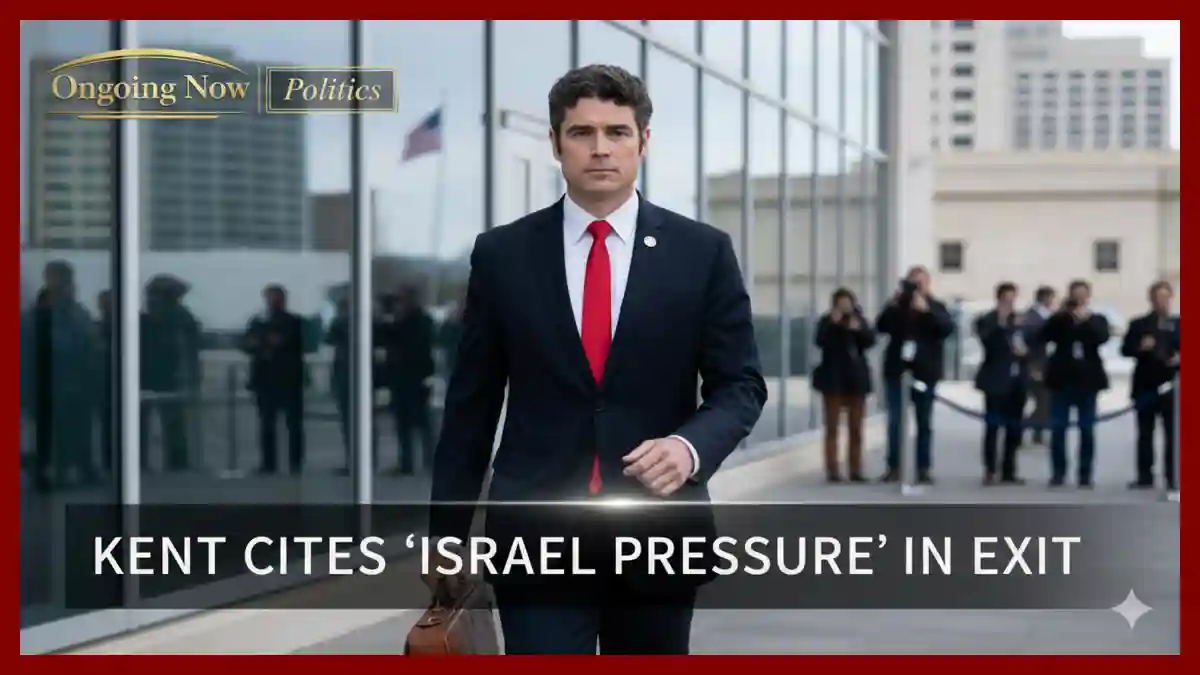
The National Counterterrorism Center (NCTC) director, Joseph “Joe” Kent, resigned Tuesday, stating he could no longer support the ongoing U.S.-led war in Iran. In a detailed resignation letter, Kent asserted that Iran “posed no imminent threat” to the United States and alleged that the conflict was initiated due to “pressure from Israel and its powerful American lobby.” This departure marks the first high-level defection from the Trump administration since the conflict began on February 28, 2026. The resignation of the nation’s top counterterrorism official raises significant questions regarding the intelligence used to justify the war and its alignment with the “America First” foreign policy 2026 platform.
Counterterrorism Chief Resignation Reasons and Intelligence Disparity
Joseph Kent, a former Green Beret and CIA paramilitary officer, was confirmed as the NCTC director in July 2025. His role placed him at the center of the U.S. government’s efforts to analyze and integrate intelligence related to global threats. In his resignation, Kent challenged the White House’s narrative of an “imminent threat,” a term frequently used by Secretary of State Marco Rubio to justify the late February airstrikes.
According to Kent’s public statement, the intelligence assessments he oversaw did not support the administration’s claims of an immediate Iranian attack. This assertion directly contradicts President Trump’s recent comments that Iran was “planning to strike first.” The NCTC, as the primary hub for counterterrorism data, is legally mandated to provide objective analysis, making Kent’s public dissent a significant institutional development.
Democratic leaders, including Senator Mark Warner, Vice Chairman of the Senate Intelligence Committee, noted that while they have historically disagreed with Kent, his assessment of the Iran threat warrants a congressional review. “There was no credible evidence of an imminent threat from Iran that would justify rushing the United States into another war of choice,” Warner stated following the news.
Joe Kent Resignation Letter and the “America First” Doctrine
In his Joe Kent resignation letter, which was shared publicly on the social media platform X, Kent addressed President Trump directly. He characterized the current conflict as a “war without justification” and a departure from the isolationist principles that defined the president’s previous campaigns. Kent wrote that until June 2025, the administration seemed to understand that Middle Eastern conflicts were “traps that drain the lives of patriots.”
Kent specifically highlighted his background as a Gold Star husband to emphasize his opposition. His late wife, Navy Senior Chief Petty Officer Shannon Kent, was killed in a 2019 suicide bombing in Syria. Kent argued that his personal loss and 11 combat deployments informed his decision to step down, stating he could not support sending a new generation to fight in a war that “serves no benefit to the American people.”
The letter also alleges a “misinformation campaign” led by “high-ranking Israeli officials and influential members of the American media.” Kent claimed this campaign was designed to deceive the administration into believing a swift victory was possible, drawing parallels to the lead-up to the 2003 Iraq War.
Key Developments: The U.S.-Iran Conflict Timeline 2026
| Date | Event | Significance |
| Feb 28, 2026 | U.S. and Israel launch airstrikes on Iranian military sites. | Commencement of active hostilities; Tehran’s nuclear facilities targeted. |
| March 1, 2026 | Iran retaliates with drone and missile strikes against U.S. regional assets. | Escalation to direct regional conflict; Strait of Hormuz closure follows. |
| March 3, 2026 | President Trump denies Israel “forced his hand” regarding the operation. | White House asserts independent decision-making despite Israeli cooperation. |
| March 16, 2026 | Secretary Marco Rubio cites “imminent threat” to justify ongoing strikes. | Formal policy justification provided to Congress and the public. |
| March 17, 2026 | NCTC Director Joe Kent resigns in protest. | First senior institutional break from the administration’s war policy. |
Israel Influence on U.S. Policy and Republican Reactions
The Joe Kent Israel comments have sparked a sharp divide within the Republican Party. Representative Don Bacon, an Air Force veteran, condemned the resignation letter, alleging it contained “antisemitic overtones” by focusing on the “American lobby.” Bacon defended the war effort, citing Iran’s history of hostility toward U.S. personnel in the region and calling Kent’s departure a “good riddance.”
Conversely, some “America First” advocates have echoed Kent’s concerns. Figures aligned with the anti-interventionist wing of the GOP have questioned the strategic necessity of the war, especially as global oil prices rise following the closure of the Strait of Hormuz. The J Street response to Joe Kent, while differing on his political history, acknowledged the gravity of a top intelligence official claiming the threat was manufactured.
The National Counterterrorism Center role explained involves a complex web of data sharing between the CIA, FBI, and NSA. As director, Kent was the final arbiter of how these threats were presented to the President. His claim that he was “treated like a second-class citizen” within the administration suggests a breakdown in the traditional intelligence-to-policy pipeline.
Institutional Impacts and the Role of Tulsi Gabbard
The resignation has placed Director of National Intelligence (DNI) Tulsi Gabbard in a delicate position. Kent was considered a close ally of Gabbard, and both have historically advocated for a non-interventionist foreign policy. While a Tulsi Gabbard response to Joe Kent has not yet been formally issued through a press release, her office has remained notably silent as the war progressed.
An administration official, speaking on the condition of anonymity, indicated that Kent’s exit reflects a broader “unease” within the intelligence community. The source suggested that the NCTC’s assessments were increasingly bypassed in favor of “alternative channels” that emphasized the need for pre-emptive action. This tension between institutional analysts and political advisors is a recurring theme in modern U.S. national security debates.
The White House statement on Joe Kent was brief, with President Trump telling reporters that Kent was “very weak on security” and that his departure was a positive development for the administration’s “strength-based” approach to Tehran.
Regional and Societal Impact of the Resignation
The political fallout of Kent’s resignation is already being felt in his home state of Washington and across the Pacific Northwest. Having run for Congress in the past, Kent remains a significant figure in local conservative circles. His resignation may galvanize a faction of the GOP base that is wary of renewed involvement in Middle Eastern conflicts.
Beyond the political theater, the war itself has direct consequences for American communities:
Economic Strain: The closure of the Strait of Hormuz has led to a 15% spike in domestic gas prices within two weeks.
Military Readiness: The Pentagon has had to redeploy assets from the Indo-Pacific to the Middle East, a move Kent criticized as detrimental to long-term U.S. interests.
Public Trust: The discrepancy between Kent’s “no imminent threat” claim and the White House narrative may impact public support for future military authorizations.
Analysis: Why the NCTC Resignation Matters
This event is more than a personnel change; it is an institutional crisis. The NCTC was created post-9/11 specifically to prevent the politicization of intelligence that occurred before the Iraq War. When the director of that very agency claims that a “misinformation campaign” is driving the country toward war, it challenges the integrity of the national security apparatus.
What the Data Shows
Recent polling from the mid-March 2026 cycle indicates that while 52% of Republicans initially supported the strikes on Iran, that number has dipped to 46% following reports of rising energy costs and the lack of a “swift victory.” Kent’s resignation provides a high-profile “America First” justification for this skepticism, potentially broadening the gap between the administration and its more isolationist supporters.
The Joe Kent X post has been shared over 200,000 times in six hours, indicating that his message is reaching a wide audience outside of traditional news cycles. This digital reach ensures that the “pressure from Israel” narrative will remain a central point of debate in the 2026 midterm elections.
Historical Comparison: Resignations in Protest
Kent’s departure draws comparisons to historical precedents where high-ranking officials resigned over military escalations. In 2003, several State Department officials resigned over the Iraq War, citing similar concerns about the misuse of intelligence. However, Kent’s role as the NCTC director—a position focused purely on threat integration—makes his dissent uniquely focused on the factual basis of the war’s justification.
Unlike the 2003 resignations, which often came from the political center or left, Kent represents the “pro-Trump” right. His resignation suggests that the internal coalition that supported the 2024 campaign is fracturing over the U.S.-Iran conflict. Whether this leads to a formal shift in policy or merely a reshuffling of the national security team remains to be seen.
The National Counterterrorism Center will now require a new director, a process that will likely involve a contentious Senate confirmation hearing. This hearing will serve as a platform for lawmakers to demand the release of the very intelligence assessments Kent claims were ignored.
Stay sharp with Ongoing Now!
Source and Data Limitations: This article is based on official resignation letters and public statements released on March 17, 2026. Data regarding the NCTC’s role is sourced from the Intelligence Reform and Terrorism Prevention Act of 2004. Quotes are attributed to the Washington Post, AP, and official social media accounts. At this time, the White House has not released the specific intelligence briefings cited by Secretary Rubio, and the Iranian government’s casualty reports remain unverified by independent international bodies. Internal administration deliberations regarding “alternative channels” are based on reporting from credible national security correspondents and have not been confirmed by the ODNI.