Shocking state primary tally keeps Wisconsin Democratic governor candidate race deadlocked
Early vote tallies reveal narrow margins in key urban hubs as state election authorities finalize county canvassing reports.
The initial wisconsin primary results 2026 establish a pivotal juncture for Midwestern governance following the August 11 voting. Early wisconsin election night updates revealed high voter engagement, as the state governor primary tally showed tight margins between contenders. Tracking governor race turnout wisconsin highlighted key regional shifts in urban hubs. Every democratic governor candidate wisconsin put forward distinct policy agendas. In the milwaukee county executive election coalition push, David Crowley leveraged municipal experience, while the madison governor candidate primary campaign of Francesca Hong mobilized progressive networks. As election boards finalize counting to determine the wisconsin democratic nominee 2026, the outcome dictates legislative alignment against Republican nominee Tom Tiffany.
Election administration officials across Wisconsin spent election night processing ballots under established state statutory frameworks. The nonpartisan Wisconsin Elections Commission oversaw county-level canvassing across all 72 counties, ensuring every absentee and election-day ballot was verified. Early data indicated that urban centers, suburban municipal districts, and rural communities exhibited varying turnout rates that directly affected the final primary tallies.
Primary voter participation served as a major indicator of voter enthusiasm ahead of the upcoming fall general election. Institutional dynamics within the state legislature and local municipal boards remain closely linked to the executive branch transition. The open-seat gubernatorial contest follows the retirement of two-term Democratic Governor Tony Evers, creating an unprecedented structural shift in state executive leadership.
Election Dynamics and Initial State Governor Primary Tally Metrics
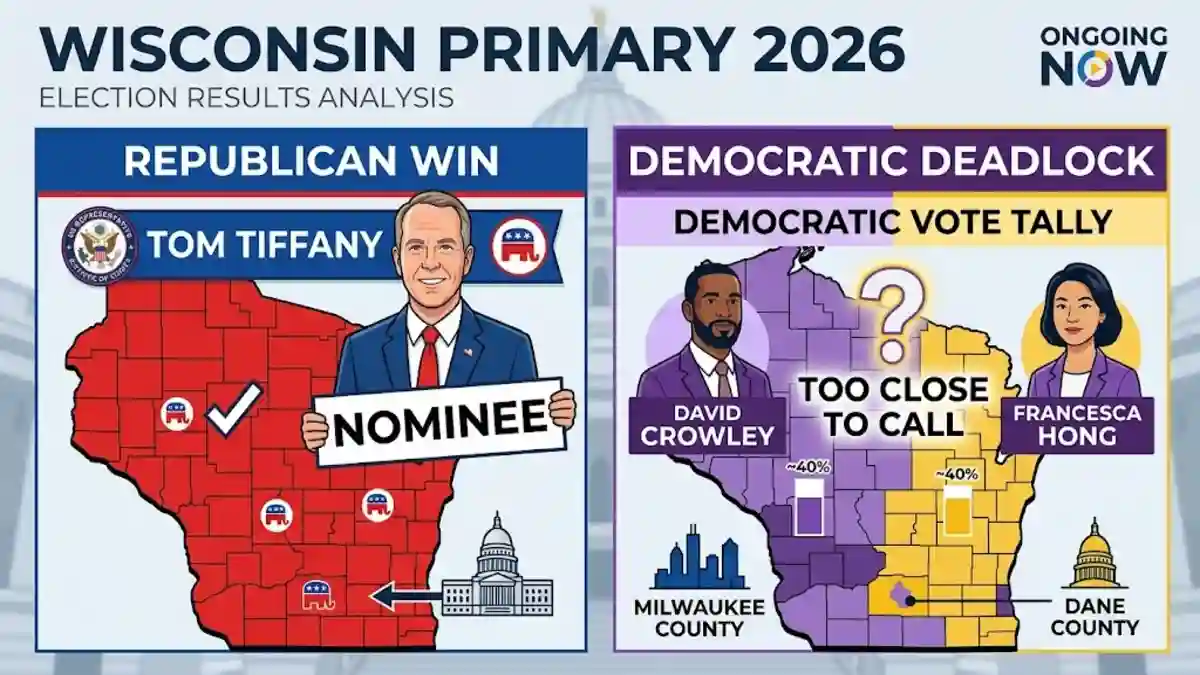
In the Republican primary for governor, U.S. Representative Tom Tiffany secured his party’s nomination decisively shortly after polls closed. With over 95 percent of the vote reported in early returns, Tiffany defeated primary challengers Andrew Manske and Dennis Williams. Supported by endorsements from President Donald Trump and state legislative leaders, Tiffany established a unified conservative platform centered on fiscal policy, regulatory reform, and tax restructures.
The Democratic primary presented a far closer contest that remained unresolved into the morning following election day. Milwaukee County Executive David Crowley and state Representative Francesca Hong of Madison held nearly equal shares of the popular vote as precinct reports arrived from the state’s highest-density areas. State Senator Kelda Roys and former Department of Administration Secretary Joel Brennan trailed the lead candidates in early tabulations.
With over 80 percent of statewide precincts reported, less than one percentage point separated Crowley and Hong, reflecting an evenly divided Democratic electorate. The Associated Press and local election authorities refrained from declaring a winner until final municipal absentee counts were processed in Milwaukee and Dane counties. The narrow gap highlighted differing coalition strategies between municipal leaders in southeastern Wisconsin and progressive organizations centered in the state capital.
Following his primary victory, Representative Tom Tiffany stated, “Wisconsinites are looking for proven leadership that focuses on economic growth, energy independence, and strict government accountability.” The statement outlined the core themes expected to define the Republican campaign strategy throughout the general election cycle.
Analysis of Urban and Rural Divisions in Wisconsin Primary Results 2026
Analysis: Electoral Geography and Regional Voting Patterns
An examination of county-level returns reveals stark regional divisions that dictated the outcome of the primary races. In Dane County, home to Madison and the University of Wisconsin campus, Representative Francesca Hong established a commanding lead. Hong’s platform centered on expanding public transit funding, implementing statewide labor protections, and increasing state investment in climate infrastructure.
Conversely, Milwaukee County Executive David Crowley demonstrated strong performance across the Milwaukee metropolitan region, combining support from urban precincts and surrounding inner-ring suburbs. Crowley’s campaign emphasized his administrative track record in managing county budgets, stabilizing local emergency services, and negotiating bipartisan shared-revenue agreements with the state legislature.
| Candidate Name | Party Affiliation | Key Regional Support Base | Campaign Funds Raised (as of July 2026) | Primary Vote Share Estimate |
| Tom Tiffany | Republican | Northern & Rural WI (7th District) | $13.3 Million | 95.9% (Nominated) |
| David Crowley | Democrat | Milwaukee Metro & Southeast WI | $1.1 Million | ~40.0% (Too Close to Call) |
| Francesca Hong | Democrat | Dane County (Madison) & Urban Core | $1.0 Million | ~40.0% (Too Close to Call) |
| Kelda Roys | Democrat | South-Central Wisconsin | Sub-$500k | Single Digits |
| Joel Brennan | Democrat | Southeastern Business Districts | Sub-$500k | Single Digits |
In rural northern and western Wisconsin, Republican turnout remained stable, providing a consistent baseline for Representative Tiffany. The regional distribution of votes illustrates that candidate success in statewide elections depends heavily on managing the political contrast between urban cores and surrounding rural towns.
Commenting on the primary dynamics, Charles Franklin, Director of the Marquette University Law School Poll, noted, “Wisconsin primaries repeatedly demonstrate how distinct political sub-cultures operate across Dane County, Milwaukee, and the WOW suburbs. Reaching a statewide majority requires aligning these divergent geographic interests.”
Institutional Framework, Voting Rules, and State Election Administration
The administration of Wisconsin elections relies on a decentralized model managed by municipal clerks across more than 1,800 cities, villages, and towns. Under Wisconsin state law, election clerks cannot begin processing absentee ballots until 7:00 a.m. on election morning. This requirement frequently leads to late-night tabulations from central count facilities in larger jurisdictions such as Milwaukee and Green Bay.
The Wisconsin Elections Commission provides guidance on statutory deadlines for county canvass boards. Each county canvass board must convene by the Tuesday following the election to review precinct tallies, reconcile vote totals, and certify official results. If the final margin between the top two candidates is within 1 percentage point, state law allows the trailing candidate to petition for a formal recount.
If a candidate requests a recount when the margin is within 0.25 percentage points, the state covers the cost of the process. If the margin is between 0.25 and 1 percentage point, the candidate requesting the recount must pay the required administrative fee upfront. This institutional framework ensures that precise verification protocols take place before state authorities issue a formal certificate of nomination.
State election officials noted during vote tabulation that all security protocols functioned as designed. Representatives from the bipartisan state board emphasized that transparency measures, including public observation of central count locations, remained fully operational throughout the night.
Comparative Insight: Contextualizing Wisconsin Primary Results 2026 Against Previous Cycles
What the Data Shows: Historical Turnout Comparisons
To evaluate the significance of the 2026 primary turnout, historical comparison with previous gubernatorial primary cycles provides key context. Open-seat elections in Wisconsin historically generate elevated voter participation compared to cycles featuring an incumbent governor. During the 2018 gubernatorial primary, Democratic turnout exceeded 530,000 votes, laying the groundwork for high general election participation.
Preliminary estimates for the 2026 primary suggest total democratic primary participation met or exceeded 600,000 votes, reflecting strong engagement among primary voters. High turnout in primary elections typically correlates with increased voter activation during autumn campaigns.
WISCONSIN GUBERNATORIAL PRIMARY TURNOUT TRENDS (2014–2026)
----------------------------------------------------------------------
Year   Incumbent Status     Total Primary Votes    Primary Margin (Dem)
2014   Incumbent (R)        ~540,000               Uncontested
2018   Incumbent (R)        ~1,020,000             +12.4% (Evers)
2022   Incumbent (D)        ~1,070,000             Uncontested
2026   Open Seat            ~1,100,000 (Est.)      <1.0% (Crowley/Hong)
----------------------------------------------------------------------
Source: Wisconsin Elections Commission & Historic Canvass Records
The data demonstrates that open-seat contests eliminate incumbent advantages, forcing both major political parties to spend substantial resources during the primary phase. In 2026, the contrast between a unified Republican primary and a highly competitive Democratic primary generated distinct strategic advantages and financial realities for both camps.
Reflecting on progressive mobilization during election night, Representative Francesca Hong remarked, “Our campaign demonstrated that voters across Wisconsin are seeking direct solutions to housing affordability, public education funding, and economic justice.”
Public and Societal Impacts on Wisconsin Communities and Local Governance
The policy trajectory established by the 2026 primary election bears direct consequences for Wisconsin residents and local government administration. The governor of Wisconsin possesses one of the most powerful executive vetoes in the nation, including the line-item veto authority over state budget appropriations. This executive mechanism directly influences municipal funding levels, public school state aid, and infrastructure allocations.
In urban centers like Milwaukee and Madison, municipal leaders depend heavily on state shared-revenue agreements to maintain local emergency services, road repair programs, and public health departments. The candidate who ultimately assumes the governor’s office will negotiate the state’s 2027–2029 biennial budget with the state legislature, determining state revenue distribution formulas.
For rural communities across northern and central Wisconsin, state policy decisions govern health care access, broadband expansion grants, and agricultural regulation. Small business owners and agricultural producers monitor executive appointments to state agencies, including the Department of Natural Resources and the Department of Agriculture, Trade and Consumer Protection.
Voters across the state also face distinct choices regarding reproductive healthcare regulations, state environmental standards, and higher education funding for the University of Wisconsin System. The outcome of the gubernatorial contest will directly dictate whether Wisconsin continues a model of divided government or shifts toward single-party legislative and executive alignment.
David Crowley underscored the practical impact of executive leadership during his campaign address, stating, “Effective governance requires building coalitions that deliver real investments for local communities, protect essential public services, and create economic opportunity in every corner of Wisconsin.”
Policy Platforms and Strategic Directions for the Fall Campaign
As the political focus turns toward the November general election, clear policy contrasts have emerged between the major party candidates. Representative Tom Tiffany’s campaign platform prioritizes state tax reductions, deregulation of business operations, expanded school choice vouchers, and increased funding for law enforcement agencies. Tiffany’s fiscal proposals advocate for flat income tax structures designed to enhance regional economic competitiveness.
The Democratic platform, whether led by Crowley or Hong, focuses on protecting public education funding, expanding state Medicaid coverage under the Affordable Care Act, and protecting abortion access under state law. Furthermore, Democratic policy proposals emphasize clean energy transition goals, state workforce development initiatives, and increased state aid for public universities.
Campaign finance records indicate a significant disparity in available cash reserves entering the general election phase. Representative Tom Tiffany ended the primary season with approximately $5 million in campaign funds available, having raised over $13.3 million during the election cycle. By comparison, the lead Democratic contenders spent a substantial portion of their campaign capital during the competitive primary, entering August with lower immediate cash balances.
Outside expenditure groups, national political action committees, and party campaign committees are projected to invest heavily in Wisconsin television, digital, and grassroots mobilization networks. Because Wisconsin remains one of the nation’s premier battleground states, presidential political organizations view the 2026 gubernatorial contest as a key test of party infrastructure ahead of federal midterm elections.
Evidence-Based Insights on Wisconsin Governance and Electoral Realities
The outcome of the August 11 primary highlights several structural features of contemporary Wisconsin politics. First, political competition within both major parties reflects national policy debates regarding institutional pragmatism versus ideological alignment. The tight contest in the Democratic primary demonstrates that progressive activists and moderate municipal officials command comparable influence within the party’s primary electorate.
Second, institutional stability in Wisconsin relies on strict adherence to statutory vote-counting and canvassing procedures. Despite narrow margins and intense political scrutiny, county election officials continue to process ballots according to established legal timelines, protecting public confidence in election administration.
Third, executive leadership transitions in swing states carry significant implications for judicial appointments, administrative rulemaking, and federal-state relations. The governor of Wisconsin plays a central role in appointing state judges to fill vacancies, managing federal grant funding allocations, and representing the state in national policy discussions.
As county canvass boards complete their official vote tabulations, state political organizations are actively shifting personnel and advertising resources toward general election field operations. The upcoming debates, campaign stops, and policy disclosures will provide voters with further clarity on how each candidate plans to address the economic, educational, and governance challenges facing Wisconsin over the next four years.
Stay sharp with Ongoing Now!
—
Source and Data Limitations: Official precinct returns and preliminary vote tabulations provided by the Wisconsin Elections Commission, Milwaukee County Election Commission, and Dane County Clerk’s Office following the August 11, 2026 partisan primary. Additional campaign finance data compiled from Federal Election Commission (FEC) reports and Wisconsin Campaign Finance Information System (CFIS) filings as of July 27, 2026. Contextual reporting and historical vote comparisons adapted from Associated Press, Reuters, and Marquette University Law School Poll releases. Unverified social media claims, speculative vote projections, and non-certified candidate statements were excluded from this analysis. All vote percentages and financial totals reflect certified preliminary records at the time of publication.