Indian American Reaction to Modi Victory and U.S. Policy
As the BJP secures historic state mandates, the US-India relations post-2026 election trajectory faces new diplomatic and diaspora dynamics.
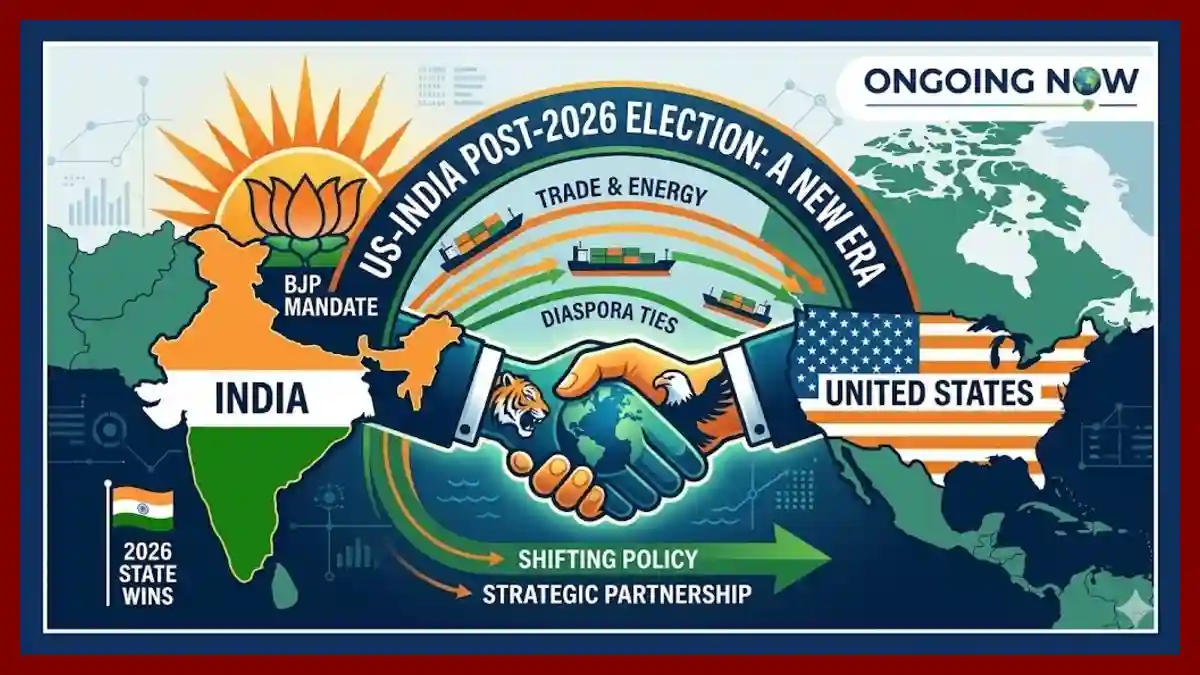
The landscape of US-India relations post-2026 election is undergoing a significant transformation following a series of pivotal state-level contests in India that have resonated deeply across the global stage. Current reporting confirms that the Bharatiya Janata Party (BJP) has achieved a historic breakthrough in West Bengal, ending the 15-year tenure of the Trinamool Congress (TMC), while also securing a third consecutive term in Assam. These results, coupled with a notable BJP entry into the Kerala Assembly and a sweeping victory for the Congress-led United Democratic Front (UDF) in that state, have prompted a multifaceted Indian American reaction to Modi victory across major metropolitan hubs.
The geopolitical implications are immediate, as the US State Department on India elections prepares to navigate a strengthened BJP mandate alongside shifting Indian diaspora political trends 2026. This alignment comes at a time of complex bilateral negotiations regarding trade, energy, and regional security. The following analysis examines the institutional, regional, and societal impacts of these developments on the partnership between Washington and New Delhi.
Historical Mandates and the Electoral Map of 2026
The 2026 electoral cycle in India has delivered results that redefine the country’s internal political geography and, by extension, its external diplomatic standing. The Bharatiya Janata Party’s victory in West Bengal—a state traditionally resistant to the saffron tide—represents a “tectonic shift,” according to regional analysts. Prime Minister Narendra Modi, addressing party workers in New Delhi, remarked that the “lotus had now bloomed everywhere, from Gangotri to Ganga Sagar,” framing the win as a national endorsement of the BJP’s policy agenda.
Key Electoral Outcomes by State
| State | Winning Alliance/Party | Primary Outcome |
| West Bengal | BJP | Unseated 15-year TMC government; Suvendu Adhikari defeated Mamata Banerjee. |
| Assam | NDA (BJP-led) | Secured 102 of 126 seats; historic third consecutive term. |
| Kerala | UDF (Congress-led) | Landslide victory with 100 seats; BJP won a record 3 seats. |
| Tamil Nadu | TVK (Vijay-led) | Sensational debut; emerged as a significant new political force. |
| Puducherry | NDA (AINRC-led) | Retained power under Chief Minister N. Rangasamy. |
In West Bengal Election results, the BJP crossed the majority mark of 148 in the 294-member house, while the TMC was reduced to approximately 54 seats. This turnover is particularly significant for the U.S. government, which often monitors the stability and political alignment of India’s large, economically vital states.
The Indian American Reaction to Modi Victory
Across the United States, the New York Indian community election news and Chicago Indian consulate election updates reflect a deeply engaged diaspora. In New York and Chicago, BJP supporters in USA celebrations were observed in various cultural centers, citing the Bengal victory as a validation of the central government’s economic and security policies. However, the reaction is far from monolithic; the 2026 Indian American Attitudes Survey (IAAS) indicates a community grappling with ideological polarization.
The Hindu American Foundation election statement highlighted the importance of religious freedom and minority rights, though the organization has also faced internal and external pressure regarding its stances on Indian domestic policy. The diaspora’s influence on U.S. policy remains high, as Indian Americans continue to be the fastest-growing ethnic group with significant voting power in swing districts.
Diaspora Trends and Political Ambivalence
Data from the Carnegie Endowment for International Peace suggests that while the Democratic Party remains the preferred choice for a majority of Indian Americans, Republican identification has seen a modest increase. This shift is partly attributed to perceptions of U.S. foreign policy and the perceived strength of the Modi administration.
“The shift marks a meaningful softening of the Democratic Party’s dominance amongst the Indian American electorate,” noted the 2026 IAAS report, highlighting that younger men, in particular, are showing increased interest in Republican-aligned platforms.
US State Department: Navigating Diplomacy and Democracy
The US State Department on India elections typically maintains a neutral stance, emphasizing the procedural integrity of the democratic process. In the wake of the 2026 results, Washington’s focus has turned toward the “Special Intensive Revision” of electoral rolls and how these shifts might impact the Indo-Pacific strategy.
Bilateral relations are currently influenced by a “healthy dose of realism,” as both nations manage disagreements over energy imports and trade tariffs. The U.S. has pressured India to further reduce its dependence on Russian crude oil, which has dropped from 40% to approximately 25% of total imports. In response, a potential trade agreement is being discussed that could see India purchasing $500 billion worth of U.S. products over five years in exchange for lower tariffs.
US-India Relations: The Strategic Hedging Factor
Despite the reset in relations, New Delhi remains committed to “strategic hedging.” This approach involves maintaining strong ties with the U.S. while preserving its historic relationship with Moscow and diversifying defense partnerships with nations like France.
Regional Analysis: The Southern Shift and Eastern Expansion
The Kerala Election and Tamil Nadu election results provide a counterpoint to the BJP’s expansion in the north and east. In Kerala, the Congress-led UDF’s sweep signifies a return to power for the opposition, though the BJP’s breakthrough of three seats—including a victory by Rajeev Chandrasekhar in Nemom—marks its strongest performance in the state’s history.
In Tamil Nadu, the debut of actor-turned-politician Vijay’s party, TVK, has disrupted the traditional DMK-AIADMK duopoly. This emergence of new regional actors adds a layer of complexity for U.S. diplomats who must engage with a variety of state leaders whose policies on technology, labor, and investment significantly affect American businesses operating in India.
Focus on the Northeast: Assam and Beyond
The Assam Election victory for the NDA consolidates the BJP’s hold on Northeast India. Chief Minister Himanta Biswa Sarma’s win in Jalukbari ensures continuity in a region that is critical for India’s “Act East” policy, which overlaps with U.S. interests in Southeast Asian connectivity and security.
Institutional and Policy Impacts
The 2026 elections occurred against the backdrop of significant legislative changes, including the controversial revision of the Nari Shakti Vandan Adhiniyam (Women’s Reservation Bill). Prime Minister Modi attributed the opposition’s setbacks in West Bengal and Assam to their resistance to this bill, framing the election as a mandate for women-led development.
| Policy Area | Status/Update | Potential US Impact |
| Energy | Pivot from Russian crude to US/Middle East. | Shifts in global energy prices; increased US exports. |
| Trade | Proposed $500B purchase agreement. | Reduced tariffs for Indian goods in US markets. |
| Security | Indo-Pacific cooperation. | Joint naval exercises; defense technology transfers. |
| Immigration | H-1B and Green Card reform talks. | Impact on diaspora mobility and tech sector labor. |
The Puducherry Election also saw the NDA retain control, reinforcing a sense of administrative continuity within the smaller territories. This stability is often cited by institutional investors as a positive signal for long-term project planning.
Societal Effects and Community Impact
The societal impact of these electoral shifts is felt most acutely in the shifting demographics of political support. In West Bengal, analysts noted a split in the traditionally cohesive Muslim vote and a movement of women voters toward the BJP, which influenced the final tally significantly.
For the Indian diaspora, these domestic changes in India often mirror or catalyze shifts in their own political organizing in the U.S. The rise of “identity-based polarization” among Indian Americans has led to more frequent public demonstrations and a more vocal presence in U.S. congressional offices.
Analysis: Why the 2026 Mandate Matters
The 2026 results suggest that the “peak Modi” narrative has been challenged by the BJP’s ability to capture new territories like West Bengal. For the U.S., a politically dominant BJP means a more predictable, albeit assertive, partner on the global stage. However, the resurgence of the Congress-led UDF in Kerala and the rise of TVK in Tamil Nadu indicate that India’s federalist structure remains vibrant and capable of producing diverse regional outcomes.
Global Diplomacy and Economic Realities
The US-India relations post-2026 election are also being shaped by the “US war on Iran” and subsequent economic challenges. India’s role as a major crude importer makes it a central player in global energy stability. The Biden administration, or its successor, will likely continue to view India as a necessary counterweight in the region, regardless of domestic political friction.
Verified quotes from officials reflect this cautious but cooperative tone:
“The LDF will evaluate and study the defeat, after which required corrections will be made,” stated CPI(M) State secretary M.V. Govindan following the Kerala results.
“The lotus has now bloomed everywhere,” Prime Minister Narendra Modi declared, signaling a shift in the party’s reach.
The State Department has emphasized that India is a “key strategic partner,” even as it monitors internal human rights reports and electoral roll revisions.
Evidence-Based Political Insights
What the data shows is a shifting center of gravity in Indian politics. The BJP is no longer just a “Hindi heartland” party; its victory in the East and progress in the South demonstrate a nationalization of its platform. Simultaneously, the Indian diaspora in the U.S. is becoming more diverse in its political affiliations, moving away from a monolithic support for the Democratic Party.
For policymakers in Washington, the 2026 results provide a roadmap of who will lead India’s most influential states for the remainder of the decade. Engaging with these leaders—from the BJP in Bengal to the UDF in Kerala—will be essential for the next phase of the U.S.-India strategic partnership.
Stay sharp with Ongoing Now!
Source and Data Limitations: This report is based on verified electoral data from the Election Commission of India (ECI) as of May 4, 2026, and official statements from the US State Department and the Bharatiya Janata Party. Polling data for the Indian diaspora was sourced from the 2026 Indian American Attitudes Survey (IAAS) conducted by the Carnegie Endowment for International Peace. Analysis of trade and energy imports relies on reports from Chatham House and the Ministry of External Affairs. Unverified social media claims regarding specific constituency margins not confirmed by the ECI were excluded. Information regarding regional party debuts, such as TVK in Tamil Nadu, is based on preliminary but official tallies from regional news outlets like The Hindu and India Today.