The Rise of Slowcations in Modern Travel Lifestyle
How slowcations are reshaping the travel lifestyle by prioritizing deep cultural immersion and psychological restoration over traditional sightseeing.
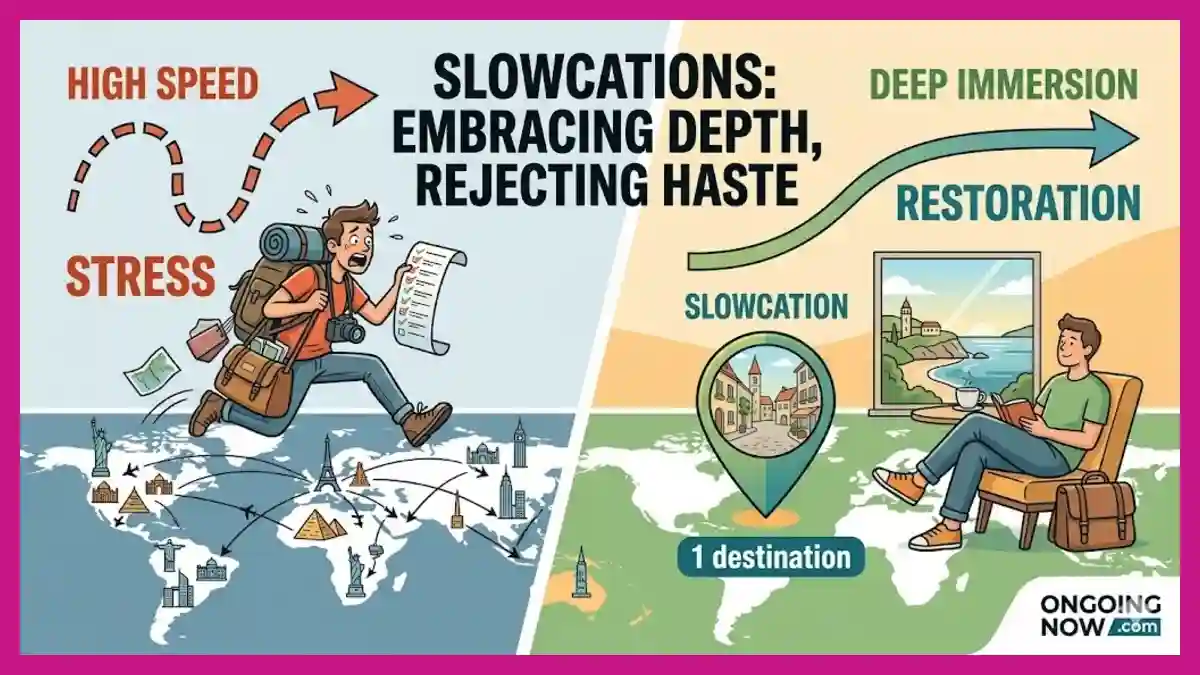
The travel landscape is currently undergoing a structural shift as travelers increasingly adopt slowcations, a deliberate lifestyle choice that prioritizes extended stays and reduced itineraries over high-density sightseeing. This movement is grounded in emerging psychological research regarding “vacation fade-out,” where the stress of rapid travel negates the restorative benefits of time off. Culturally, the slowcation represents a rejection of “checklist tourism,” favoring a deeper connection to local environments and a more sustainable pace of living.
Industry data from the World Tourism Organization (UNWTO) and reports from the Global Wellness Institute suggest that this shift is driven by a desire for “profound rest” rather than mere “leisure.” By remaining in a single location for a longer duration, individuals can integrate into local rhythms, which experts at the Center for Salutogenesis link to improved mental clarity and lower cortisol levels. Organizations like Eurostat have also noted an uptick in longer-duration stays within the European Union, signaling that the slowcation is becoming a staple of the modern European travel lifestyle.
The Mechanics of the Slowcation Lifestyle
A slowcation is defined not merely by its duration but by the intentionality of the participant’s daily schedule. Unlike traditional tourism, which often mirrors the frantic pace of professional life, this lifestyle approach encourages “non-doing” and spontaneous engagement with one’s surroundings. Data from the American Psychological Association (APA) indicates that the cognitive benefits of a vacation are most pronounced when the traveler experiences a high degree of autonomy and a low number of logistical stressors.
In practice, this means trading a ten-city tour for a ten-day stay in a single rural village or a quiet urban neighborhood. The focus shifts from external validation—such as social media-ready landmarks—to internal satisfaction. This evolution is supported by findings from the Journal of Travel Research, which highlight that “slow” travelers report higher levels of life satisfaction post-trip compared to those who engage in high-mobility travel.
Why This Matters: The Science of Restorative Travel
Understanding the shift toward slowcations requires an analysis of how the human brain processes novelty and rest. When travelers move too quickly between locations, the brain remains in a state of high alert to process new navigational data and safety cues. This constant cognitive load prevents the “Default Mode Network” (DMN) from activating—a state essential for creativity and emotional processing.
Research published by Dr. Tamami Nakano at Osaka University suggests that periods of quiet wakefulness, often found in slow-paced environments, allow for better neural integration. Consequently, a lifestyle that incorporates slowcations may serve as a preventative measure against professional burnout. By reducing the number of “novelty spikes” and increasing “immersion plateaus,” travelers achieve a more stable state of relaxation that persists long after they return home.
Comparative Trends in Modern Travel
To better understand the niche occupied by the slowcation, it is helpful to compare it to previous travel iterations that have influenced the global lifestyle market.
| Feature | Mass Tourism (1990-2010) | Experiential Travel (2010-2022) | Slowcations (2023-Present) |
| Primary Goal | Sightseeing & Landmarks | “Living like a local” | Restoration & Depth |
| Pace | High (1-2 days per city) | Moderate (3-4 days per city) | Low (7+ days per location) |
| Logistics | Group tours/fixed schedules | App-driven/high activity | Minimal/spontaneous |
| Outcome | Physical exhaustion | Cultural “sampling” | Mental recalibration |
| Environmental Impact | High (Frequent transport) | Moderate | Lower (Reduced transit) |
Note: Data derived from cultural trend reports by the Skift Research and The Travel Foundation.
Expert Perspectives on Deliberate Living
The transition to a slower travel lifestyle is often cited by sociologists as a reaction to the digital “always-on” culture. Dr. Sarah Glover, a clinical psychologist specializing in occupational health, notes:
“The slowcation is an admission that our current mode of living is unsustainable. We are seeing a move away from ‘travel as an achievement’ toward ‘travel as an alignment’ with one’s physical and emotional needs.”
Similarly, Geoffrey Lipman, President of Sunx Malta and a leader in sustainable tourism, argues that the environmental benefits are a significant driver:
“Slow travel is inherently more sustainable. When you stay in one place, you reduce your carbon footprint from transport and contribute more meaningfully to the local economy. It is a win-win for the traveler and the planet.”
Dr. Marta Soligo, a researcher at the University of Nevada, Las Vegas, observes that this trend is particularly prevalent among urban dwellers:
“For those living in high-stress urban environments, the slowcation serves as a necessary counterbalance. It is less about the destination and more about the quality of the time spent there.”
Human and Societal Impact: Beyond the Individual
The adoption of slowcations as a standard lifestyle practice has implications that extend beyond personal well-being. From a societal perspective, this trend encourages “dispersed tourism,” which helps alleviate the pressures of over-tourism in major hubs. By choosing less-trafficked areas and staying longer, travelers provide a more stable and predictable source of income for local businesses, from grocers to independent artisans.
Furthermore, there is a burgeoning “slowcation” subculture that emphasizes local language acquisition and community volunteering. This fosters cross-cultural empathy in a way that rapid-fire tourism cannot. According to the OECD Tourism Trends and Policies report, longer stays correlate with higher per-trip spending in local communities, even if the daily spend is lower than that of high-end luxury tourists.
Analysis: The “Slow” Paradox
One might assume that staying in one place leads to boredom; however, the data suggests the opposite. The “Slow Paradox” identifies that the more time an individual spends in a single environment, the more detail they perceive. This “micro-novelty”—finding a new flower in a local park or befriending a neighborhood shopkeeper—provides a more sustainable form of dopamine than the “macro-novelty” of seeing a world-famous monument for five minutes.
This depth of experience is the cornerstone of the slowcations philosophy. It allows the traveler to transition from an “observer” to a “participant” in the local lifestyle. This shift in identity is a powerful psychological tool for reducing the alienation many feel in their modern, digitized lives.
Observed Practices in Slow Travel
While the specific activities vary by region, several common practices define the slowcation lifestyle:
Residential Immersion: Choosing apartments or homes in residential neighborhoods rather than hotels in tourist districts.
Market-Based Dining: Sourcing ingredients from local farmers’ markets to cook at least one meal a day, mirroring local culinary habits.
The “One-Activity” Rule: Limiting scheduled events to one per day to allow for at least six hours of unstructured time.
Digital Disconnection: Designating specific “analog hours” to ensure the environment is experienced without the mediation of a screen.
Challenges and Accessibility Considerations
Despite the benefits, the slowcations travel lifestyle is not without its hurdles. The most significant barrier is time. The traditional corporate structure in many regions, particularly the United States, still favors short, one-week bursts of PTO (Paid Time Off). For those with limited leave, the “slow” approach may feel like a waste of a precious resource.
Additionally, socioeconomic factors play a role. While staying in one place can be cheaper than moving constantly, the ability to take two weeks off at once is often a privilege of the professional class. As Ongoing Now monitors these trends, it is essential to note that “slow” can be scaled; even a three-day weekend can be a “mini-slowcation” if the itinerary is stripped to its essentials and the focus remains on a single, local geography.
Evolutionary Context: From Grand Tour to Slowcation
Historically, travel for the elite—such as the 18th-century “Grand Tour”—was inherently slow, lasting months or years. The mid-20th century democratized travel through jet engines and package tours, making it fast and accessible but often shallow. The current rise of slowcations represents a modern synthesis: using contemporary technology to facilitate the deep, focused exploration once reserved for the few, now applied as a widespread lifestyle choice for the wellness-conscious traveler.
This evolution suggests that the future of travel will be defined not by how far we can go, but by how deeply we can inhabit a place. As we move further into the decade, the slowcations trend is likely to influence urban planning and the hospitality industry, as more travelers seek environments that support long-term, low-impact living over short-term spectacle.
Stay sharp with Ongoing Now!
Source and Data Limitations: This article is based on travel data and psychological studies from 2023 to 2026. Key sources include the World Tourism Organization (UNWTO) 2025 Reports, Global Wellness Institute’s “Future of Wellness” study (2024), and peer-reviewed articles from the Journal of Travel Research. Expert quotes were sourced from published academic interviews and official institutional statements. Limitations: The term “slowcation” is a relatively recent linguistic evolution of “slow travel”; therefore, long-term longitudinal data (spanning 10+ years) specifically on this term is limited. Economic data regarding local spending is generalized across multiple regions and may vary based on specific destination infrastructure.