Slavery and Splendor Uncovered: How Pompeii Regio IX Rewrites Roman History
Advanced preservation technology and recent villa excavations uncover the brutal economic realities and hidden daily lives of the Roman Empire.
Redefining Roman Social Strata Through Pompeii Regio IX
The recent focus on the unexcavated Insula 10 of Pompeii Regio IX has yielded some of the most significant archaeological breakthroughs in Southern Italy in over a century. Unlike earlier 19th-century excavations that prioritized elite mansions, modern teams are exposing highly complex, multi-use structures where wealth and heavy manual labor existed side-by-side.
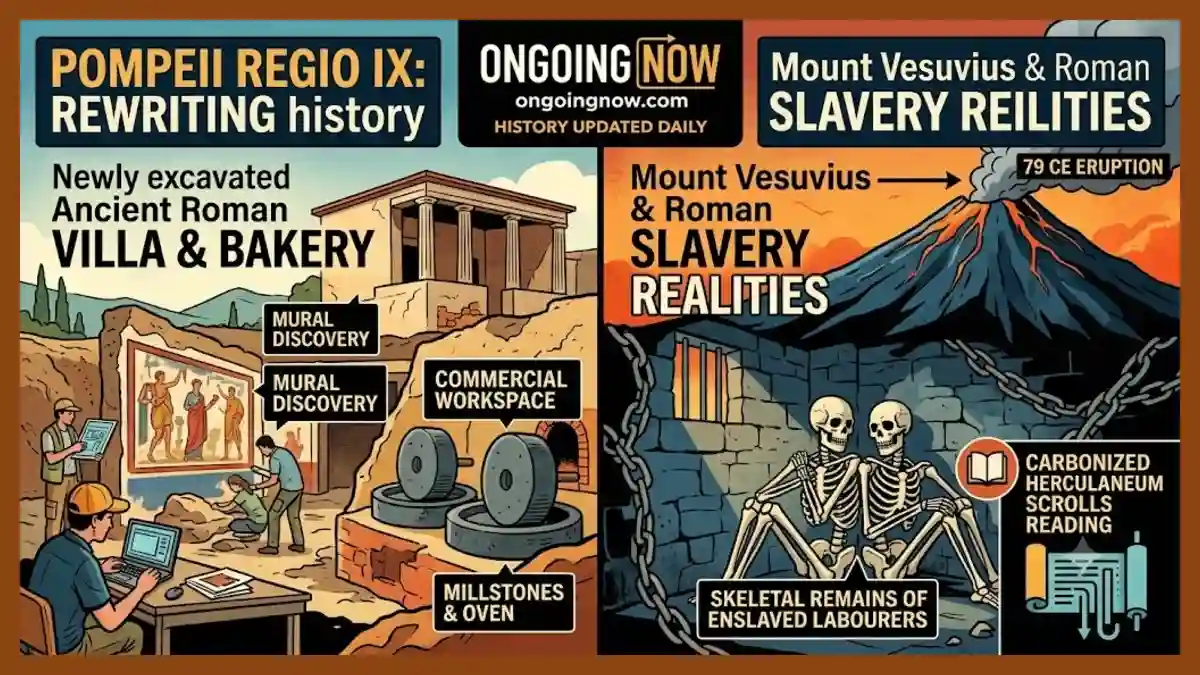
One prominent discovery features a large domestic home connected directly to a commercial bakery. This spatial layout demonstrates that elite property owners were tightly integrated with industrial processing operations.
Within these working quarters, researchers found tight, barred rooms where enslaved laborers and working animals were confined together to turn heavy basalt millstones. The physical evidence refutes romanticized literary depictions of Roman urban harmony, showing instead a highly controlled, highly squeezed operational framework at the ground level of provincial commerce.
Engineering Survival: Pompeii Structural Preservation Technology
The long-term survival of these delicate internal spaces is directly tied to the unique nature of the 79 CE pyroclastic event and the modern preservation methods applied to them. As Mount Vesuvius erupted, it released successive waves of pumice, ash, and dense pyroclastic flows that completely sealed entire structures.
[Volcanic Stratification Process]
 -> Phase 1: White Pumice Fall (Early morning accumulation)
 -> Phase 2: Grey Pumice Layer (Increasing weight, roof collapses)
 -> Phase 3: High-Velocity Pyroclastic Surges (Thermal shock, sealing structures)
To safely clear these spaces without triggering structural collapses, the Parco Archeologico di Pompei employs advanced engineering protocols. Excavators use horizontal stratigraphic scraping alongside real-time architectural shoring.
By systematically injecting customized conservation grouts into fragile volcanic tuff walls, teams stabilize ancient plaster before exposing it to ambient air. This methodology ensures that delicate frescoes, charcoal inscriptions, and structural timbers remain structurally intact during and after extraction.
What the Material Evidence Discloses: Regio IX vs. Wider Contexts
The material culture recovered from recent digs allows historians to build comparative models analyzing provincial life against Rome’s imperial center. Rather than relying solely on grand architectural ruins, researchers analyze ordinary domestic items to map regional trade networks, dietary limits, and wealth distribution.
| Artifact Category | Regio IX Specific Find | Historical Analysis & Caveats |
| Culinary Art | Still-life fresco depicting a flatbread (focaccia) with fruits and spices. | Demonstrates complex provincial dietary habits; often mislabeled in popular media as a modern pizza despite lacking tomatoes and cheese. |
| Industrial Tools | Iron-bound basalt millstones arranged in a confined interior workspace. | Confirms intensive, localized food production models; structural wear indicates continuous, heavy mechanical use. |
| Skeletal Remains | Multiple individuals discovered in sealed inner rooms, alongside heavy cloaks. | Indicates that many residents chose to seek shelter indoors from falling debris rather than fleeing immediately, ultimately succumbing to gas surges. |
Note on Data Limitations: Artifact distribution within these rooms can be altered by historical looting. Evidence shows that “tombaroli” (tomb raiders) dug exploratory tunnels through these exact walls centuries before official scientific documentation began.
Decoding the Unreadable: Carbonized Herculaneum Scrolls Reading
While Pompeii Regio IX provides unparalleled physical contexts, the nearby town of Herculaneum offers a matching textual revolution. The Villa of the Papyri, buried under dense volcanic mud, preserved hundreds of philosophical texts that were instantly carbonized by extreme heat. For centuries, attempting to unroll these fragile papyri resulted in their complete destruction.
Today, high-resolution X-ray phase-contrast tomography combined with trained machine learning algorithms allows scientists to perform non-invasive digital unrolling. By detecting minuscule variations in surface thickness caused by carbon-based ink, researchers can read complete lines of text inside the rolled sheets.
This breakthrough has already recovered lost Epicurean philosophical treatises by Philodemus of Gadara. The ability to read text within completely carbonized layers perfectly complements the physical architecture uncovered in Pompeii, directly linking physical Roman spaces to their intellectual movements.
Human Labor and Institutional Realities Under the Empire
The skeletal remains uncovered within the bakery complex of Regio IX offer a sobering look at how institutional power and human vulnerability interacted during crises. Archaeologists discovered the remains of at least three individuals confined within a small room.
Forensic analysis indicates that these individuals were unable to escape due to the physical modifications made to the building, including heavily reinforced walls and highly restricted exit routes.
Dr. Gabriel Zuchtriegel, Director of the Archaeological Park of Pompeii, noted that this specific architecture represents “the most shocking side of ancient slavery, where there were no relations of trust, and owners restricted freedom of movement via structural barriers.” This material evidence directly grounds our understanding of Roman law, demonstrating that the empire’s grand economic outputs were entirely dependent on structural confinement and forced labor.
The Evolution of Archaeological Practice in Southern Italy
The systematic exploration of Regio IX highlights a major paradigm shift in how classical sites are treated. Early excavations in the 18th and 19th centuries operated largely as treasure hunts designed to extract valuable sculptures and frescoes for royal collections, leaving underlying structures exposed to rapid environmental decay.
Modern Italian archaeology, by contrast, functions as an interdisciplinary science combining vulcanology, bioarchaeology, paleobotanical analysis, and structural engineering. Whole blocks are no longer cleared out rapidly; instead, they are treated as complex, interconnected micro-environments. Every layer of volcanic ash is carefully screened for microscopic organic remains, allowing researchers to reconstruct the exact seasons, crops, and local environmental conditions that defined life right before the disaster.
Modern Legacy and Technical Innovations in Heritage Management
The discoveries coming out of Pompeii Regio IX provide a crucial blueprint for global cultural heritage preservation under modern environmental pressures. The integration of digital mapping, 3D laser scanning, and non-destructive imaging ensures that even if physical structures degrade over time, a perfect millimeter-accurate record remains preserved forever in digital archives.
Furthermore, these finds demonstrate that ancient history is far from a static, completed field of study. The ongoing application of advanced imaging to carbonized scrolls and newly opened urban sectors proves that new technologies can unlock deep historical secrets from materials previously thought to be completely unreadable or permanently lost. For global institutions tasked with protecting historic sites, the combination of active structural preservation and digital recording used in Italy sets a rigorous, baseline standard for modern archaeological science.
Stay sharp with Ongoing Now!
Source and Data Limitations: This analysis is based on official excavation reports, press releases, and research updates published by the Parco Archeologico di Pompei (2023–2026), alongside peer-reviewed updates from the Herculaneum Society regarding digital papyrology developments. Direct quotes and structural interpretations are drawn from statements by Director Gabriel Zuchtriegel and affiliated research institutions. Factual descriptions exclude popular media speculations regarding alternative eruption timelines and unverified anecdotal identifications of skeletal remains. All architectural descriptions rely on verified stratigraphic data compiled during the ongoing Italian Ministry of Culture excavation campaigns.