May Day History: Why the 8 Hour Workday Legacy Stays
Explaining the 1886 labor movement, the Haymarket Square riot, and why the US celebrates Labor Day in September.
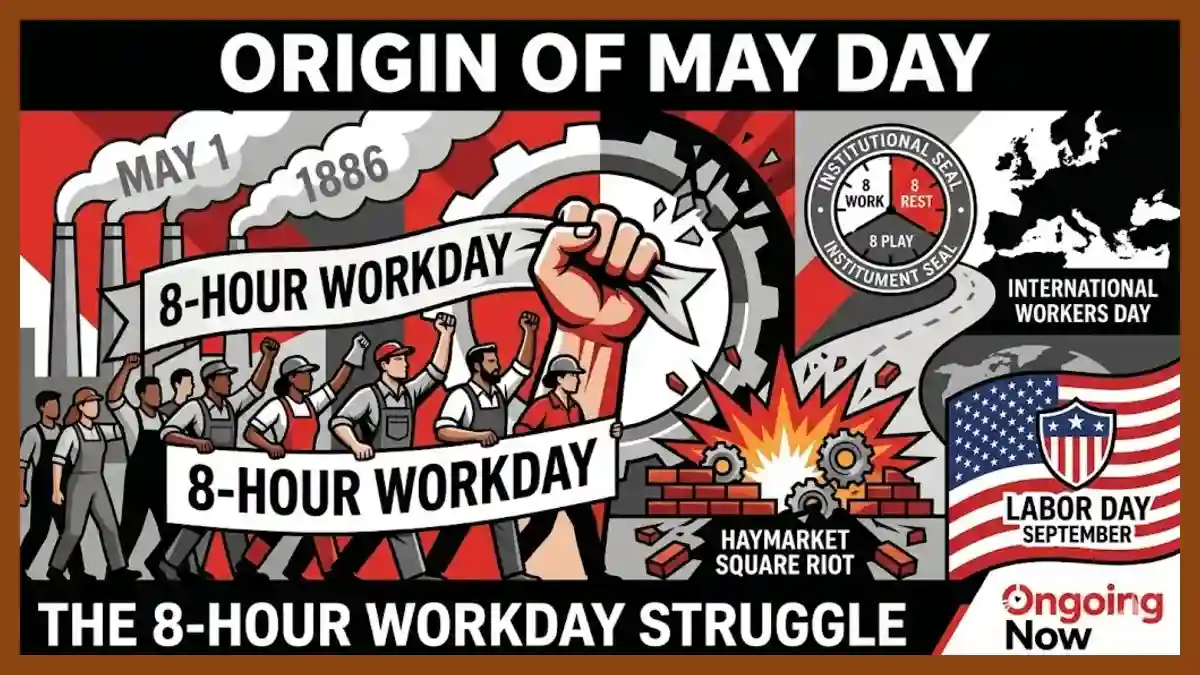
The modern observation of May Day serves as a global commemoration of the 1886 labor movement explained through the lens of industrial struggle and the history of the 8 hour workday. This movement reached a violent crescendo during the Haymarket Square riot in Chicago, an event that fundamentally altered the trajectory of organized labor and international relations. While the 1889 Second International declaration established May 1st as International Workers Day to honor the Haymarket martyrs names, the United States eventually charted a different course, which explains why US celebrates Labor Day in September. Today, the legacy of these events persists in standard labor laws and the institutionalized recognition of worker contributions worldwide.
The 1886 Labor Movement Explained: A Push for Standardized Time
By the mid-1880s, the United States was undergoing a rapid and often chaotic industrial transformation. The transition from agricultural rhythms to factory shifts created a grueling environment where 10- to 12-hour shifts were the standard, often extending to six or seven days a week. The Federation of Organized Trades and Labor Unions, a predecessor to the American Federation of Labor (AFL), sought to standardize the American work experience by demanding a universal limit on labor.
On May 1, 1886, an estimated 300,000 to 500,000 workers across the United States walked off their jobs. Chicago became the epicenter of this strike, with roughly 40,000 workers participating in work stoppages. The movement was not merely about fatigue; it was an ideological assertion that workers deserved “eight hours for work, eight hours for rest, and eight hours for what we will.” This tripartite division of the day became the foundational philosophy of the history of the 8 hour workday.
The Escalation at Haymarket Square: May 4, 1886
The peaceful strikes of May 1st began to fray as the week progressed. On May 3, a confrontation at the McCormick Reaper Works resulted in the deaths of several strikers at the hands of the police. In response, labor activists called for a protest meeting the following evening at Haymarket Square. Despite the tense atmosphere, the meeting on May 4 was initially peaceful, even as the weather turned rainy and the crowd dwindled.
The situation shifted when a contingent of 176 police officers arrived to disperse the remaining attendees. An unknown individual threw a dynamite bomb into the police ranks, causing an explosion that killed one officer instantly and fatally wounded several others. In the ensuing chaos and gunfire, both police and civilians suffered heavy casualties. The Haymarket Square riot became a pivotal moment of “Red Scare” sentiment in America, leading to a swift and controversial crackdown on labor leaders and anarchists regardless of their direct involvement in the bombing.
The Trial and the Haymarket Martyrs Names
The subsequent trial of eight men associated with the labor movement and anarchist circles is widely cited by legal historians as a miscarriage of justice. The prosecution focused more on the defendants’ radical writings and speeches than on physical evidence linking them to the bomb. Of the eight convicted, four were executed by hanging on November 11, 1887.
| Name | Fate | Role/Background |
| Albert Parsons | Executed | Confederate veteran turned radical editor |
| August Spies | Executed | Editor of the Arbeiter-Zeitung |
| Adolph Fischer | Executed | Printer and labor organizer |
| George Engel | Executed | Small business owner and anarchist |
| Louis Lingg | Suicide in cell | Carpenter; found with explosive materials |
| Samuel Fielden | Life Sentence | Lay preacher and teamster (Later pardoned) |
| Michael Schwab | Life Sentence | Editorial assistant (Later pardoned) |
| Oscar Neebe | 15 Years | Yeast maker and organizer (Later pardoned) |
“The time will come when our silence will be more powerful than the voices you are strangling today.” — August Spies, final words before execution.
The 1889 Second International Declaration
The shockwaves of the Haymarket Square riot traveled across the Atlantic, resonating deeply with European socialist and labor movements. In 1889, during the first congress of the Second International in Paris, Raymond Lavigne proposed an international demonstration to commemorate the Chicago protests. This led to the 1889 Second International declaration, which formally designated May 1st as a day of international labor solidarity.
The goal was to create a synchronized global effort to pressure governments for the legal establishment of the 8-hour limit. While the American labor movement had been temporarily suppressed following Haymarket, the European adoption of May Day ensured that the memory of the Chicago strikers remained a central pillar of global labor identity. This formalization turned a local American tragedy into a permanent fixture of the international political calendar.
Why US Celebrates Labor Day in September
A common point of confusion in modern history is why the United States, the site of the Haymarket events, does not officially recognize May 1st as Labor Day. The explanation is rooted in late 19th-century political maneuvering. President Grover Cleveland and other federal officials were wary of the radical and socialist associations that had become tethered to May Day following the 1886 riots and the subsequent 1889 Second International declaration.
In 1894, following the violent Pullman Strike, Cleveland sought a way to reconcile with the labor movement without emboldening its more radical elements. He chose to sign into law a bill making the first Monday in September a federal holiday. This date had been used by the Central Labor Union in New York since 1882 and lacked the “martyrdom” connotations of May 1st. By institutionalizing the September date, the US government successfully decoupled the celebration of labor from the revolutionary undertones of the Haymarket Square riot.
Legacy and the Long History of the 8 Hour Workday
The transition to a standard 40-hour work week was a protracted legal battle that spanned decades after 1886. It was not until the Fair Labor Standards Act of 1938, signed by President Franklin D. Roosevelt, that the 8-hour day became a federally mandated reality for many American workers. This legislation represented the ultimate victory of the movement that had sparked the strikes in Chicago fifty years earlier.
Historically, the 1886 labor movement explained much more than just a shift in clock hours; it signaled the rise of collective bargaining as a fundamental aspect of democratic societies. The Haymarket martyrs names became symbols of the high cost of civil liberties and the right to assemble. Even today, the divergence between the American September holiday and the International Workers Day in May remains a testament to the complex political history of the working class.
Comparative Labor Movements: US vs. Europe
The trajectory of labor rights in the US often differed from European counterparts in its emphasis on “bread and butter” unionism—focusing on wages and hours—versus the more explicitly political and class-based movements in Europe. While the 1889 Second International declaration solidified a political identity for European workers, American labor organizations like the AFL under Samuel Gompers eventually moved toward a more pragmatic relationship with industrial capitalism.
Europe: May Day became a day for political rallies and socialist affirmations.
United States: Labor Day in September became a “day of rest” and a celebration of economic productivity.
Global South: Many nations later adopted May 1st during their own decolonization and industrialization periods as a symbol of anti-imperialist struggle.
Evidence-Based Historical Insights
Scholars such as James Green, author of Death in the Haymarket, emphasize that the 1886 labor movement was a unique moment of cross-ethnic and cross-skill solidarity. Before Haymarket, the movement included both skilled craftsmen and unskilled immigrants, a rare occurrence in 19th-century labor history. The subsequent crackdown disrupted this unity, leading to a more fragmented labor landscape that took decades to recover.
The enduring relevance of this history lies in the ongoing discussions surrounding “work-life balance” and the “gig economy.” As the nature of work shifts in the 21st century, the original demands of 1886—the right to personal time and the protection of the worker’s physical well-being—continue to inform modern labor policy and social advocacy.
Stay sharp with Ongoing Now!
Source and Data Limitations: This article is based on established historical records from the Library of Congress, the Illinois Labor History Society, and the Chicago Historical Society. Primary sources include the 1889 proceedings of the Second International and court transcripts from the 1886 Haymarket trial. Information regarding the Fair Labor Standards Act is sourced from US Department of Labor archives. While the identity of the Haymarket bomber remains a subject of historical debate and is unverified, the legal outcomes and executions of the eight defendants are documented facts. This analysis avoids speculative theories regarding the specific identity of the bomb-thrower to maintain scholarly neutrality.