Proof of Canadian Citizenship Application Guide 2026
A comprehensive look at the steps and requirements for obtaining a Canadian citizenship certificate.
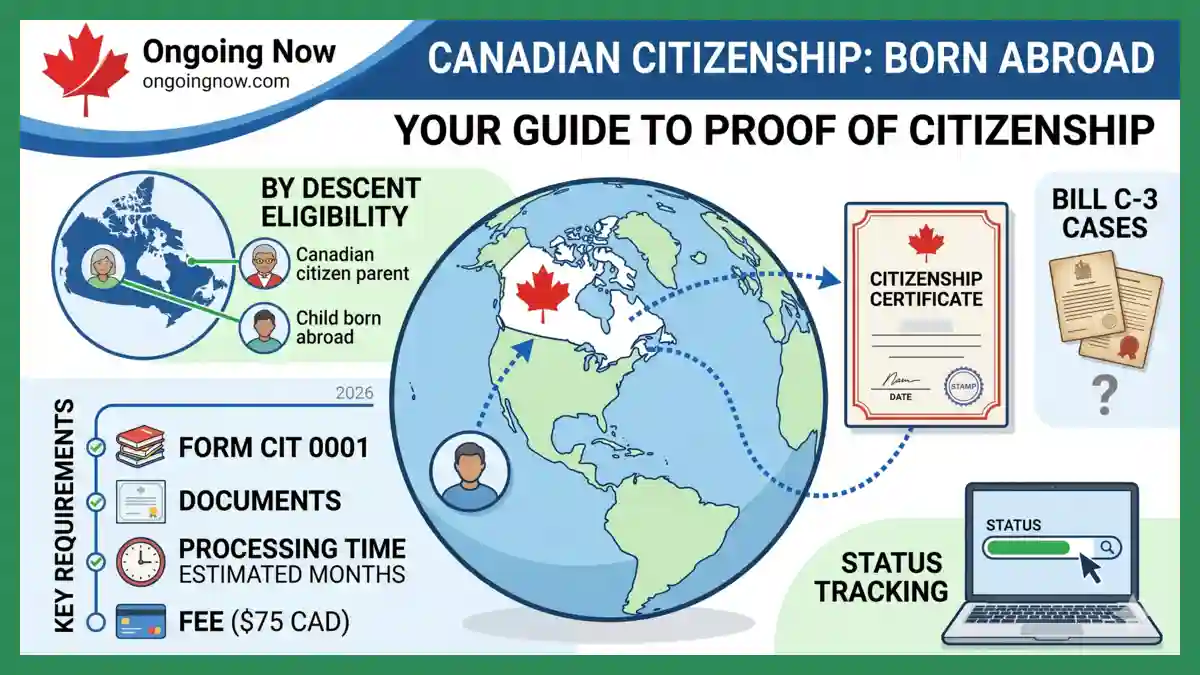
Applying for a Canadian citizenship certificate is a standard process for individuals born outside Canada to a Canadian parent. This guide provides a high-level overview of the proof of citizenship application guide 2026, covering eligibility, required documentation, and the application steps for those seeking to confirm their status.
Quick Answer Summary:
Eligibility: Generally applies to those born outside Canada with at least one Canadian parent at the time of birth.
Key Form: Most applicants utilize the IRCC form CIT 0001.
Timeline: Processing times vary by year and region, often taking several months for standard paper or digital applications.
Disclaimer: This is for informational purposes only and not personalized advice. Consult a qualified professional or official government sources for your specific situation.
Understanding the Proof of Citizenship Application Guide 2026
A citizenship certificate is the only official document issued by the Canadian government that proves an individual is a Canadian citizen. It is not a travel document; however, it is required to apply for a Canadian passport.
The proof of citizenship application guide 2026 outlines the process for “claims to citizenship,” which frequently involves demonstrating a biological or legal connection to a parent who was a citizen at the time of the applicant’s birth.
Who Should Apply?
The application is typically used by individuals who fall into the following categories:
Individuals born outside Canada who believe they acquired citizenship at birth through a parent.
Citizens who have lost or damaged their original certificate.
Individuals who need to update the information on their current certificate (such as a name change).
Eligibility and the First-Generation Limit
Before beginning the proof of citizenship application guide 2026, it is important to understand the legal framework surrounding citizenship by descent. Canada generally applies a “first-generation limit” to citizenship by descent.
This means that citizenship is usually passed down from a Canadian parent who was either born in Canada or naturalized in Canada. In many cases, the children of those born abroad (the second generation) do not automatically acquire citizenship, though recent legal developments like Bill C-3 have modified how lineage is viewed in specific historical contexts.
Proving Canadian Lineage for Bill C-3
Bill C-3 and subsequent legislative updates have sought to address “lost Canadians”—individuals who lost or never acquired citizenship due to outdated provisions in former citizenship acts.
When proving Canadian lineage for Bill C-3, applicants often need to provide extensive historical documentation. This may include marriage certificates or birth records of grandparents if the claim involves rectifying a historical exclusion based on gender or marital status of ancestors.
Document Checklist for Citizenship by Descent
A successful application relies heavily on the quality and authenticity of the supporting documents. Below is a standard document checklist for citizenship by descent for 2026.
| Document Category | Examples of Required Items |
| Proof of Identity | Two pieces of government-issued ID (e.g., driver’s license, foreign passport). |
| Birth Records | Original birth certificate showing the names of the parents. |
| Parental Proof | The Canadian parent’s birth certificate (if born in Canada) or citizenship certificate. |
| Translation | Certified translations for any documents not in English or French. |
| Photos | Two identical citizenship photos meeting specific IRCC dimensions. |
How to Find Canadian Ancestor Birth Records
One of the most common hurdles is locating historical proof. If you are wondering how to find Canadian ancestor birth records, the process usually begins at the provincial level.
Provincial Vital Statistics: Each province (e.g., Service Ontario, Vital Statistics BC) maintains its own registry of births, deaths, and marriages.
Library and Archives Canada: For older records (typically over 100 years old), national archives can be a valuable resource for census data and immigration manifests.
Church Records: In some cases, baptismal certificates from Canadian parishes are accepted if civil birth records are unavailable.
IRCC Form CIT 0001 Instructions 2026
The primary application for a citizenship certificate is Form CIT 0001. Following the IRCC form CIT 0001 instructions 2026 carefully is essential to avoid delays or rejections.
Step 1: Download and Complete the Form
The form can be completed digitally or printed. It requires detailed information about the applicant’s birth, their parents’ history, and how the parents obtained Canadian citizenship.
Step 2: Provide Parental History
Applicants must disclose when their parents lived in Canada and if the parents ever held citizenship in another country. This helps the IRCC determine if the parent was a citizen at the time of the applicant’s birth.
Step 3: Sign and Date
For applicants under 18, a parent or legal guardian must sign the form. Applicants 18 and older must sign their own forms.
Applying for Citizenship Certificate from Abroad
If you are currently residing outside of Canada, the process for applying for citizenship certificate from abroad remains largely the same, but the submission method may differ.
Online Applications: Many applicants can now submit their requests through the secure IRCC online portal. This is generally the fastest method.
Consular Services: In some regions, you may be required to submit a paper application through the nearest Canadian embassy or consulate.
Fees: Fees must be paid online in Canadian dollars ($75 CAD is the standard fee as of 2026). Ensure you keep a copy of the digital receipt.
Step by Step Citizenship by Descent Application
Following a step by step citizenship by descent application process helps ensure no details are missed.
Determine Eligibility: Confirm that at least one parent was a Canadian citizen at the time of your birth.
Gather Evidence: Collect birth certificates for yourself and your Canadian parent.
Complete CIT 0001: Fill out the application form accurately.
Pay Fees: Use the IRCC online payment system and print the receipt.
Submit: Send the application via the online portal or mail it to the Case Processing Centre in Sydney, Nova Scotia.
Wait for Acknowledgment: You will receive an Acknowledgment of Receipt (AoR) once the office begins processing your file.
Citizenship Certificate Processing Time 2026
Understanding the citizenship certificate processing time 2026 is vital for planning, especially if you need a passport for upcoming travel.
Standard Processing: Typically ranges from 6 to 12 months.
Urgent Processing: May be available if you can prove a need for urgency, such as a death in the family, a job opportunity, or an immediate need for health care.
Digital vs. Paper: Online applications generally move through the system faster than paper-based submissions.
How to Track Citizenship Certificate Status
Once you have submitted your application, you can use the IRCC online status tool. When learning how to track citizenship certificate status, keep your Application Number or Client ID (UCI) ready. The tracker will show stages such as “Received,” “In Progress,” and “Decision Made.”
Dealing with a Lost Canadian Application Process
If you have already applied but have not heard back within the standard timeframe, or if your original certificate was lost in the mail, you must follow the lost Canadian application process.
Contact IRCC: Use the Web Form to inquire about applications that have exceeded normal processing times.
Statutory Declaration: If a certificate was issued but never received, you may need to submit a sworn statement regarding the lost document to receive a replacement.
Key Takeaways
The proof of citizenship application guide 2026 is the primary resource for confirming Canadian status for those born abroad.
Most applicants will use IRCC form CIT 0001 instructions 2026 to complete their filing.
A complete document checklist for citizenship by descent must include the applicant’s birth certificate and proof of the parent’s citizenship.
Processing times for a citizenship certificate typically take several months; tracking is available online.
Bill C-3 provides pathways for those who may have been historically excluded from citizenship.
Navigating the requirements for Canadian citizenship documentation requires patience and attention to detail. By following the proof of citizenship application guide 2026, applicants can systematically gather their records, submit their forms, and monitor their status. While the process can be lengthy, obtaining a citizenship certificate is a definitive step in securing one’s rights and identity as a Canadian.
Stay sharp with Ongoing Now!
Source and Data Limitations: This guide is based on general procedures provided by Immigration, Refugees and Citizenship Canada (IRCC) as of 2026. Requirements, fees, and processing times are subject to change by the Canadian government. Data regarding Bill C-3 and citizenship by descent is provided for informational purposes and reflects high-level regulatory frameworks. This content does not constitute legal advice. For specific legal questions or complex cases involving citizenship law, individuals should consult with a regulated Canadian immigration consultant or a qualified lawyer. Sources include official IRCC portals, provincial vital statistics offices, and legislative summaries of the Canadian Citizenship Act.