Unlocking Calm: How to Practice Baduanjin Qigong for Daily Vitality
A complete, high-level overview of the eight pieces of brocade routine postures and breathing techniques.
Maintaining a consistent daily exercise routine can be challenging when balancing a busy schedule. Many people seek low-impact, mindful movement practices that can be easily performed at home without specialized equipment.
This guide provides a comprehensive overview of how to practice baduanjin qigong for beginners, breaking down the traditional philosophy, core postures, and general movement sequences.
Quick Answer
What it is: Baduanjin is a traditional Chinese mind-body exercise consisting of eight distinct, fluid movements.
How it works: The routine combines slow physical stretching, deep diaphragmatic breathing, and focused mental attention.
Daily commitment: A standard eight pieces of brocade routine instructional takes approximately 10 to 15 minutes to complete.
Understanding the Fundamentals of Baduanjin
Baduanjin translates literally to “Eight Pieces of Brocade,” implying that the movements are silky, elegant, and interconnected. Originating centuries ago in China, it serves as a foundational form of Qigong designed to promote physical alignment and mental calm.
When learning how to practice baduanjin qigong for beginners, it is helpful to view the practice as a form of moving meditation. The routine relies on gentle resistance, precise alignment, and natural breathing patterns rather than intense cardiovascular exertion.
The Role of Mind-Body Breathing Techniques
A central component of this practice is the baduanjin mind body breathing techniques guide philosophy. Practitioners generally use abdominal breathing, where the abdomen expands on inhalation and contracts on exhalation.
Breathing should remain slow, deep, and coordinated with the physical transitions. As a general rule, movements that expand the chest or move upward involve inhalation, while movements that compress or lower the body involve exhalation.
Core Posture and Preparation Guidelines
Before initiating the eight movements qigong sequence instructions, establishing a stable physical foundation is necessary for balance and safety. Proper alignment helps prevent joint strain and ensures smooth transitions between movements.
Key Alignment Principles
The Stance: Keep the feet parallel and shoulder-width apart for standard postures, or wider for specific stances like the horse stance.
The Spine: Maintain a neutral spine with the crown of the head reaching upward and the tailbone slightly tucked.
The Joints: Keep the knees, elbows, and shoulders slightly soft and unlocked to allow for fluid energy flow.
Baduanjin 8 Movements Step by Step Guide
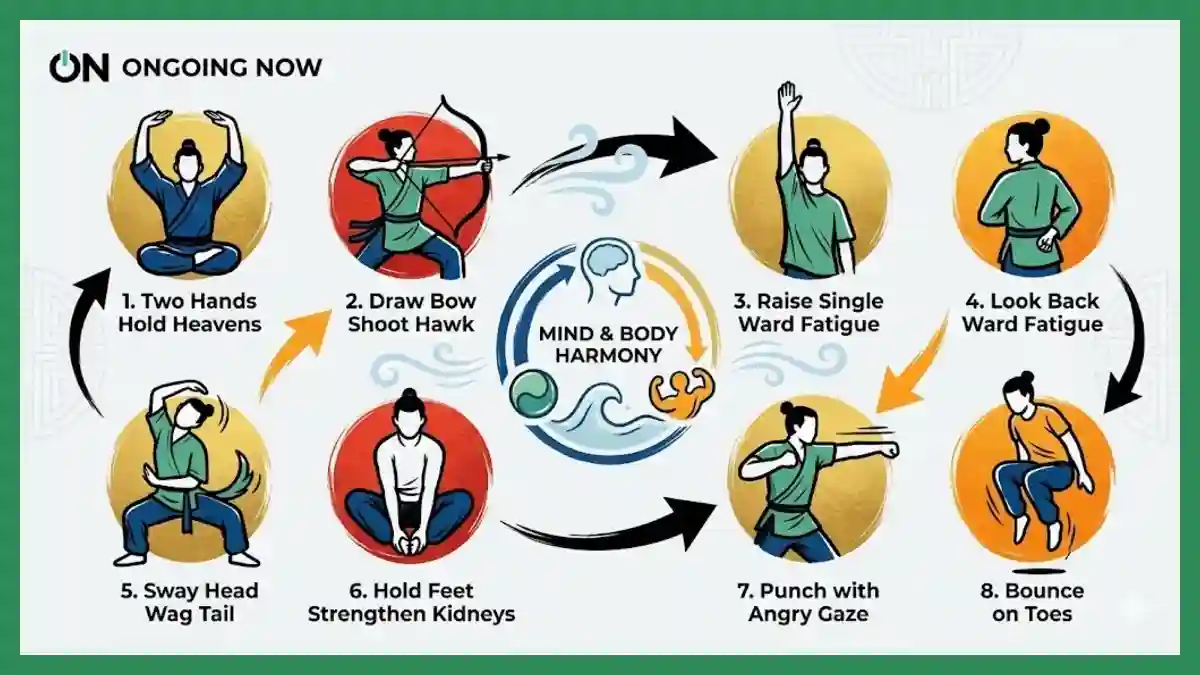
The complete eight pieces of brocade routine instructional consists of eight distinct segments, performed in a specific, continuous sequence.
[Preparation Stance] ➔ [Movements 1 to 8] ➔ [Closing Posture]
Step 1: Two Hands Hold up the Heavens
The initial movement focuses on stretching the torso and aligning the triple burner (an anatomical concept in traditional Chinese medicine relating to internal organs).
Action: Interlace the fingers in front of the abdomen with palms facing upward. Slowly lift the hands along the centerline of the body, turning the palms outward at chest level to press toward the sky.
Gaze: Look upward toward the hands as they rise, then look straight ahead as you lower the arms smoothly back to the sides.
Breathing: Inhale as the arms ascend; exhale as they descend.
Step 2: Drawing the Bow to Shoot the Hawk
This posture utilizes a wider stance, often referred to as the horse stance, to strengthen the lower body and open the chest.
Action: Step the left foot out wide and sink the hips slightly. Cross the arms in front of the chest, then extend the left hand to the side with the index finger pointing up, while pulling the right hand back to the shoulder as if drawing a bowstring.
Gaze: Focus intently on the extended index finger.
Repetition: Return to the center stance and repeat the movement on the opposite side.
Step 3: Raising the Single Arm
This movement targets the coordination of opposite sides of the body, promoting flexibility in the shoulders and spine.
Action: Start with both hands near the abdomen, palms up. Raise the left hand upward, turning the palm to press toward the ceiling, while simultaneously pressing the right hand downward toward the ground.
Alignment: Ensure the spine remains straight without leaning to either side. Alternate sides smoothly.
Step 4: Looking Backward to Ward off Fatigue
This segment introduces a gentle spinal twist designed to relieve tension accumulated in the neck and upper back.
Action: Stand with feet shoulder-width apart, arms hanging naturally. Slowly turn the head, neck, and upper torso to look back over the left shoulder as far as comfortable.
Hands: Slightly rotate the palms outward during the turn, then return them to the neutral position when facing forward. Repeat on the right side.
Step 5: Swaying the Head and Wagging the Tail
This posture requires a wide horse stance and addresses tension in the core and lower back by promoting hip mobility.
Action: Place the hands on the thighs with thumbs pointing backward. Lower the torso slightly forward, then smoothly shift the weight to swing the upper body in a gentle arc from one side to the other.
Caution: Avoid over-extending the lower back; keep the movement controlled and within a comfortable range of motion.
Step 6: Two Hands Hold the Feet to Strengthen the Kidneys
This movement involves a full-body forward bend that stretches the hamstrings and the entire posterior chain of muscles.
Action: Raise both arms overhead, palms facing forward. Guide the hands down the chest, around the waist to the lower back, and then slide them down the back of the legs toward the feet.
Modification: If flexibility is limited, bend the knees slightly and only reach as far as the shins or ankles.
Step 7: Clenching the Fists with Angry Gaze
This dynamic posture combines physical tension and release to help expend stagnant energy and build internal stamina.
Action: Assume a stable horse stance and bring both hands into loose fists at the waist. Punch one arm forward firmly but without locking the elbow, while widening the eyes into a focused, intent gaze.
Release: Relax the eyes and pull the fist back to the waist, then repeat with the opposite arm.
Step 8: Bouncing on the Toes to Banish Illness
The final movement settles the body and utilizes gentle vibration to stimulate circulation throughout the limbs.
Action: Stand straight with feet close together. Slowly raise the heels off the ground, balancing on the balls of the feet for a brief moment, then let the heels drop down lightly to create a gentle jar through the skeletal frame.
Breathing: Inhale during the lift; exhale fully upon dropping the heels.
Baduanjin Posture Correction Tips for Beginners
When practicing a learn baduanjin qigong routine at home system, minor alignment errors can reduce the effectiveness of the exercise. Reviewing baduanjin posture correction tips for beginners can help ensure a safe experience.
| Common Mistake | Correction Method | Focus Area |
| Locking the elbows or knees | Maintain a slight, soft bend in all joints | Joint Safety |
| Holding the breath | Keep inhalation and exhalation continuous and natural | Breathing Flow |
| Forcing deep forward bends | Round the spine gently and bend knees if hamstrings are tight | Strain Prevention |
| Shrugging the shoulders | Keep shoulders dropped away from the ears | Tension Release |
Setting Up a Daily 10 Minute Baduanjin Routine Walkthrough
Consistency provides more long-term benefits than occasional long sessions. A daily 10 minute baduanjin routine walkthrough can fit easily into morning or evening schedules.
Sample Practice Timeline
Minute 0–2 (Preparation): Stand quietly, focus on abdominal breathing, and clear the mind of external distractions.
Minute 2–9 (The Routine): Perform each of the eight physical postures exactly three to six times, maintaining a steady, unhurried pace.
Minute 9–10 (Closing): Place both hands over the lower abdomen, take three final deep breaths, and allow the body to return to a restful state.
Key Takeaways
High Accessibility: Baduanjin requires no special tools, extensive space, or advanced physical fitness, making it highly suitable for home practice.
Structured Sequence: The routine relies on eight specific movements performed in a precise order to balance the body’s major muscle groups.
Breath Synchronization: Physical movements must match smooth, natural abdominal breathing to achieve the full mindfulness benefits.
Pacing Over Intensity: Success with the routine depends on slow, deliberate execution rather than speed or physical strain.
Understanding how to practice baduanjin qigong for beginners opens the door to a time-tested method of stress reduction and physical conditioning. By prioritizing proper physical postures and breathing tutorial instructions, anyone can safely enjoy this traditional art. Start with just a few repetitions each day, focus on smooth transitions, and allow the body to adapt naturally to the flow of the movements.
Stay sharp with Ongoing Now!
Source and Data Limitations: This guide is based on traditional Qigong instructional methodologies and historical texts detailing the Eight Pieces of Brocade routine. It provides generalized, high-level informational steps for educational purposes only. This is for informational purposes only and not personalized advice. Consult a qualified professional or a certified fitness/mindfulness instructor before beginning any new physical exercise regimen, especially if you have pre-existing joint, spinal, or cardiovascular conditions.