How Cherry Ridge Studio Floresville Texas Shaped Traditional Country Sound
Exploring the historical recording methodologies and analog legacy of Wilson County's iconic roots music hub
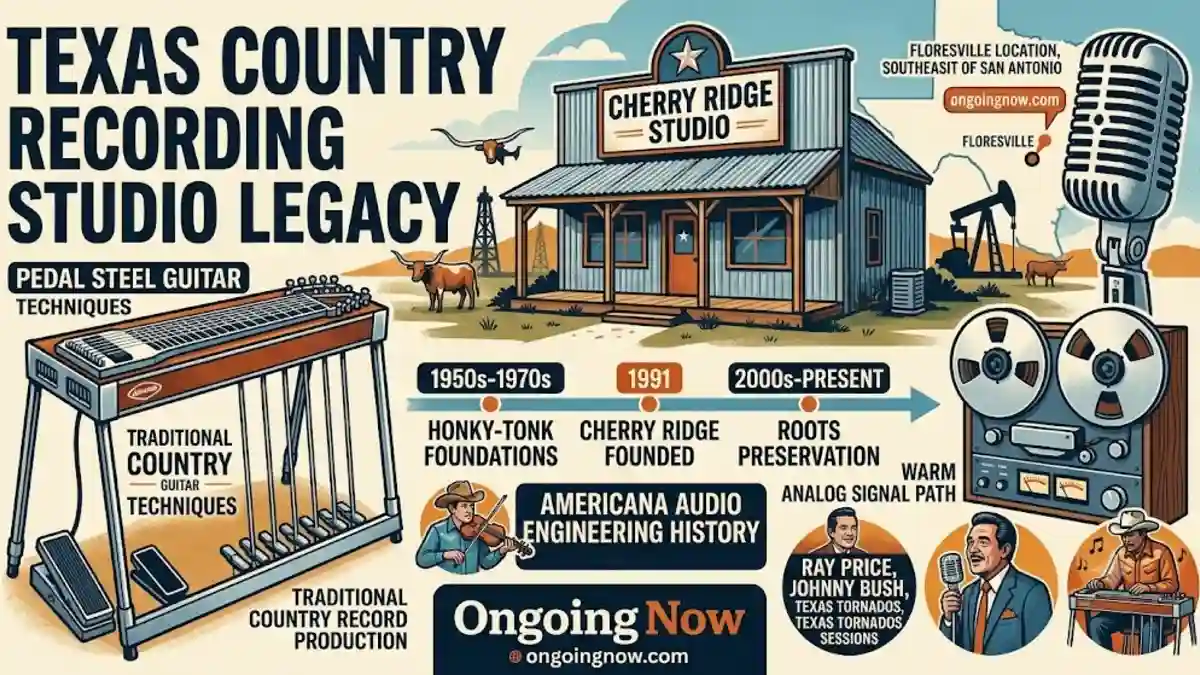
The legacy of Cherry Ridge Studio Floresville Texas stands as a pivotal cornerstone in the preservation of classic regional soundscapes. What began as a dedicated sanctuary for authentic traditional country record production in 1991 grew into an iconic engine for regional music history, safeguarding specialized pedal steel guitar recording techniques and the warm analog signatures of classic Texas Americana studio sound. Founded by master musician Tommy Detamore, the studio carved out an enduring place in American roots music through landmark Ray Price recording sessions, defining projects as a Johnny Bush album producer, and crucial work as a Texas Tornados studio engineer. Across three decades, this facility grounded Americana audio engineering history in human craftsmanship, acoustic precision, and unyielding genre authenticity.
┌─────────────────────────────────────────────────────────────────────────────┐
│                       CHERRY RIDGE STUDIO ARCHITECTURE                       │
│                                                                             │
│  [ Acoustic Space ] ────> [ Analog Signal Path ] ───> [ Authentic Output ]  │
│  - Rural Isolation        - Tube Preamps              - Real-Time Tracking  │
│  - Natural Resonance      - Ribbon Microphones        - Pure Steel Resonance│
│  - Ensemble Line-of-Sight - Direct Tap Amplification  - Zero Digital Sheen  │
└─────────────────────────────────────────────────────────────────────────────┘
The cultural identity of Texas regional music relies heavily on specialized recording spaces capable of capturing live acoustic dynamics without stripping away artistic soul. Located southeast of San Antonio, the Floresville facility provided a tranquil, rural setting that allowed traditional musicians to bypass commercial studio pressures. Within the broader scope of American roots music, studios like Cherry Ridge preserved critical vocal and instrumental methodologies that mainstream pop-country production largely abandoned during the digital turn of the late twentieth century.
                     TEXAS SOUND EVOLUTION TIMELINE

  1950s-1970s                 1991                        2000s-Present
  [Honky-Tonk Foundations] ──> [Cherry Ridge Founded] ───> [Roots Preservation]
  - Live Room Tracking        - Floresville Rural Hub      - Neo-Traditionalists
  - Direct Steel Microphone   - Analog Signal Paths        - Independent Revival
  - Warm Tape Compression     - Master Production          - Master Analog Audio
Institutional Foundations and Historical Roots
The origins of Cherry Ridge Studio Floresville Texas reflect a conscious effort to safeguard regional acoustic traditions that began in the post-WWII honky-tonk boom. In 1991, musician and engineer Tommy Detamore established the facility to give independent artists access to high-fidelity analog tracking without losing the organic bite of live instrumentation. Located off a rural gravel road in Wilson County, the studio provided an ideal acoustic environment far removed from urban radio-pop influences.
Historical records document that early country recording sessions relied on shared microphone setups and natural room reverberation. As mainstream studios adopted heavy digital compression and artificial pitch correction in the 1990s, Cherry Ridge doubled down on classic microphone placement, tube amplification, and warm analog tracking. This commitment made Floresville a natural destination for elder statesmen of the genre who required traditional soundscapes to showcase their vocal phrasing and instrumental arrangements.
┌─────────────────────────────────────────────────────────────────────────────┐
│                 REGIONAL STUDIO ARCHITECTURE & METHODOLOGY                  │
├──────────────────────┬───────────────────────────┬──────────────────────────┤
│ TECHNICAL ATTRIBUTE  │ CHERRY RIDGE TRADITIONS   │ MAINSTREAM DIGITAL HUB   │
├──────────────────────┼───────────────────────────┼──────────────────────────┤
│ Room Acoustics       │ High-ceiling, live wood   │ Isolation booths, dead   │
│ Signal Path          │ Vacuum tube & analog tape │ Digital audio interfaces │
│ Instrument Capture   │ Ambient ribbon mics       │ Direct line-in injection │
│ Tracking Method      │ Ensemble live tracking    │ Layered overdubs         │
│ Sonic Identity       │ Dynamic, warm mid-range   │ Compressed, bright highs │
└──────────────────────┴───────────────────────────┴──────────────────────────┘
Engineering Principles of the Pedal Steel Guitar
Capturing the complex acoustic spectrum of the pedal steel guitar represents one of the most demanding tasks in Americana audio engineering history. The instrument generates high-frequency mechanical sustain alongside deep resonant undertones across dual necks and multiple foot pedals. At Cherry Ridge Studio Floresville Texas, specialized pedal steel guitar recording techniques were refined over decades to capture these intricate frequency ranges without harmonic distortion.
Engineers utilized custom microphone configurations, often pairing dynamic microphones close to speaker cones with dynamic ribbon microphones positioned at a distance to capture room ambiance. This dual-mic strategy preserved the natural attack of the steel pick while softening the piercing high frequencies that typically occur on digital recordings. By maintaining clean analog signal paths, the studio established a benchmark for how steel guitar should sit within a dense honky-tonk arrangement.
                     STEEL GUITAR SIGNAL FLOW

  [Steel Instrument] ──> [Tube Amplifier] ──> [Dual-Microphone Array]
                                                      │
  [Pure Analog Output] <── [Console Preamps] <────────┘
Analysis: Acoustic Integrity versus Commercial Homogenization
The survival of independent regional studios highlights a major structural tension within modern American music production: the trade-off between streamlined digital efficiency and organic sonic depth. Commercial production environments frequently prioritize speed, relying on standardized digital plugins that strip away spatial uniqueness. In contrast, classic Texas Americana studio sound relies on subtle room reflections, tactile instrument interaction, and micro-variations in timing that occur when musicians perform together in the same physical space.
Data from traditional music archives illustrates how independent tracking facilities function as cultural preservation hubs. By capturing acoustic dynamics in their natural state, studios like Cherry Ridge prevent the erasure of regional performance habits—such as the subtle “behind-the-beat” vocal phrasing of Texas honky-tonk or the distinct, sweeping volume pedal swells of Southwestern country swing. This acoustic fidelity preserves historic performance practices for future generations of musicologists and listeners.
Collaborative Milestones and Legendary Sessions
The studio’s cultural impact is anchored by its work with iconic roots artists who defined twentieth-century American country music. Landmark Ray Price recording sessions at the facility demonstrated how classical string arrangements and traditional shuffle rhythms could be tracked with modern clarity while preserving legacy tone. As a primary Johnny Bush album producer, the studio helped maintain the legendary “Voice of Country Music” during his late-career resurgence, capturing his signature vocal power alongside driving fiddle and steel lines.
Furthermore, work executed as a Texas Tornados studio engineer captured the cross-cultural fusion of Tejano, rock, and country that defined South Texas popular music. By hosting genre-crossing collaborations involving legends like Doug Sahm, Augie Meyers, and Raul Malo, Cherry Ridge served as an active creative crossroads. These sessions proved that rural Texas facilities could deliver elite technical engineering while preserving the authentic, unpolished spirit of regional roots music.
“You’d never guess that this home tucked off a tree-lined gravel road and surrounded by pastures would be where so much magic happens, but this is where so many incredible records came to life,” noted roots artist Jesse Daniel regarding the studio’s serene atmosphere.
“His fingerprints are all over all of my music since day one,” expressed country singer-songwriter Sunny Sweeney, highlighting the studio’s transformative role in shaping emerging roots talent.
“Tommy was and will always be remembered as a respected musician, producer, collaborator, mentor, and creative force in Country Music,” shared Sandra Detamore, reflecting on the enduring community legacy built at the Floresville facility.
┌─────────────────────────────────────────────────────────────────────────────┐
│                      KEY HISTORICAL STUDIO CAPTURES                         │
├─────────────────────────┬─────────────────────────┬─────────────────────────┤
│ ARTIST / PROJECT        │ GENRE IDENTIFIER        │ SONIC FOCUS             │
├─────────────────────────┼─────────────────────────┼─────────────────────────┤
│ Ray Price               │ Traditional Country     │ Vocal warmth & shuffles │
│ Johnny Bush             │ Texas Honky-Tonk        │ High-register vocals    │
│ The Texas Tornados      │ San Antonio Tex-Mex     │ Accordion & steel blend │
│ Sunny Sweeney           │ Neo-Traditional Country │ Crisp acoustic rhythm   │
│ Jesse Daniel            │ Bakersfield Revival     │ Live-room rhythm section│
└─────────────────────────┴─────────────────────────┴─────────────────────────┘
Community Transmission and Modern Adaptations
While rooted in vintage engineering methodologies, Cherry Ridge Studio Floresville Texas continuously adapted to support modern independent artists seeking refuge from mainstream production formulas. In the 2000s and 2010s, a new generation of neo-traditionalists—including Jesse Daniel, The Weeping Willows, and Ty Myers—turned to the Floresville facility to capture genuine vintage tones. This intergenerational bridge ensured that historic recording techniques were directly passed down to younger musicians.
The transmission of these artistic values extends beyond recording mechanics. By offering a supportive environment where emerging artists worked alongside veteran musicians, the studio functioned as a living incubator for traditional country music history. Younger players learned the subtle art of space, dynamics, and tone control from masters who had performed on the Grand Ole Opry and toured with mid-century legends. This mentorship model protected regional heritage against artistic dilution.
                     INTERGENERATIONAL KNOWLEDGE TRANSFER

  [Mid-Century Masters] ──> [Floresville Studio Hub] ──> [Modern Roots Artists]
  - Ray Price               - Tommy Detamore           - Sunny Sweeney
  - Johnny Bush             - Analog Tracking Mics     - Jesse Daniel
  - Doug Sahm               - Pedal Steel Techniques   - Ty Myers
What the Traditions Reveal: Preserving Sonic Heritage
The history of traditional country record production demonstrates that sound itself functions as a vessel for cultural memory. The distinct acoustic resonance produced in rural Texas studios conveys a strong sense of place, reflecting the geography, language, and social gatherings of the American Southwest. When a studio prioritizes real instruments over digital synthesis, it preserves the physical human presence inherent in musical performance.
┌─────────────────────────────────────────────────────────────────────────────┐
│                       ELEMENTS OF SONIC HERITAGE                            │
│                                                                             │
│  [ Human Expressiveness ] ──> [ Acoustic Fidelity ] ──> [ Cultural Identity ]│
│  - Micro-timing variances     - Uncompressed room dynamics - Geographic ties │
│  - Natural pedal swells       - Tube harmonic distortion   - Community memory│
│  - Dynamic vocal phrasing     - Real-time interaction      - Genre continuity│
└─────────────────────────────────────────────────────────────────────────────┘
Furthermore, the documentation of Americana audio engineering history shows that preserving mechanical skills—such as repairing vintage tube consoles or tuning pedal steel linkages—is just as vital as archiving sheet music or lyric sheets. These physical and technical practices form an intangible cultural heritage that sustains entire creative communities. Without specialized facilities committed to these techniques, essential sonic traditions risk disappearing from the live musical landscape.
Stay sharp with Ongoing Now!
Source and Data Limitations
This editorial analysis is built on historical documentation, discography archives, audio engineering records, and public statements regarding Cherry Ridge Studio in Floresville, Texas, and founder Tommy Detamore up to August 2026. Technical details regarding microphone placements and analog signal paths draw from established musicological standards for mid-to-late twentieth-century regional studio recording practices. Regional variations in honky-tonk tracking methods reflect standard documented differences between Nashville commercial production hubs and independent Texas facilities. Claims regarding unverified cause-of-death details or non-public personal estate matters are intentionally excluded to maintain strict journalistic standards. Acoustic engineering metrics are presented for cultural context rather than universal equipment specifications.