Market Fallout Explodes After Kevin Warsh Fed Chair Confirmation Legacy Shift
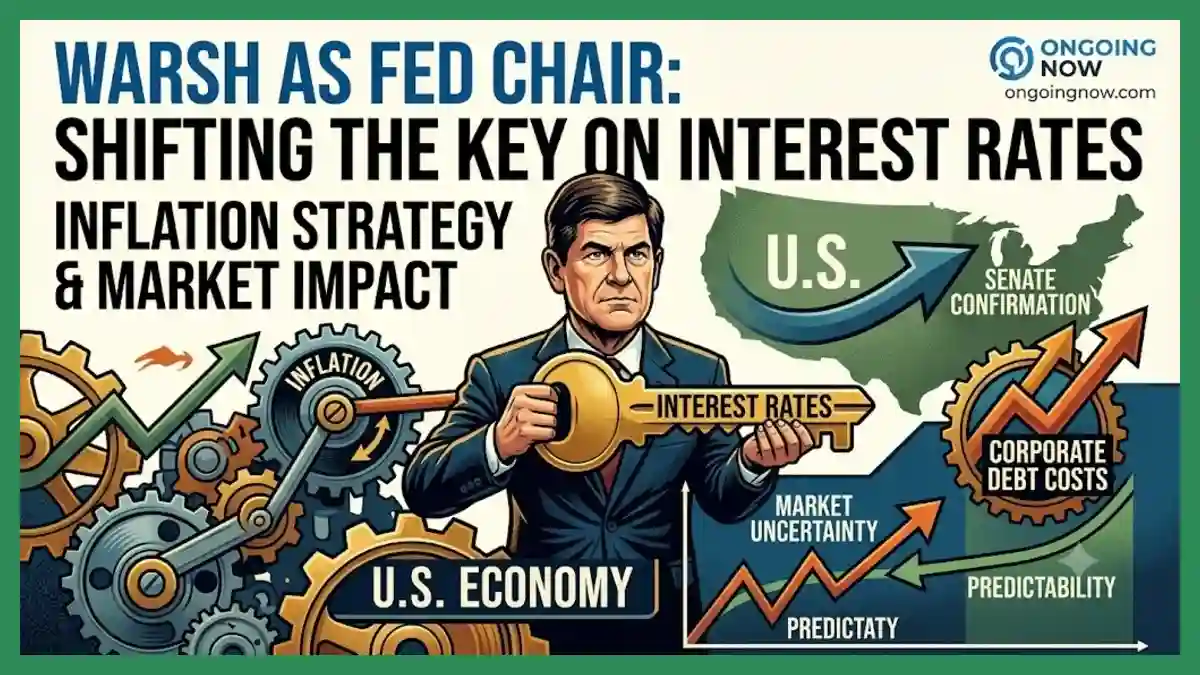
The United States Senate has confirmed Kevin Warsh as the next chairman of the Federal Reserve, initiating a significant shifts in monetary policy.
Market Adaptation Following historically Narrow Senate Confirmation
The United States Senate confirmed Kevin Warsh as the next chair of the Federal Reserve on May 13, 2026, marking a foundational shift in American monetary governance. The appointment of the 56-year-old lawyer and financier concludes a highly contested transition period, following the conclusion of Jerome Powell’s leadership term. The legislative action has immediate implications for global capital markets, financial institutions, and corporate credit structures.
The political and economic environment surrounding this transition is exceptionally complex. Policymakers are navigating an environment where the domestic producer price index jumped 6% in April 2026 compared to the prior year, signaling persistent wholesale inflationary pressures. Concurrently, the central bank’s internal rate-setting body, the Federal Open Market Committee (FOMC), has shown historically high levels of internal division.
Senate Banking Committee Warsh Vote Breakdown
The confirmation encountered unprecedented institutional resistance within the legislature. The final tally in the full chamber concluded at 54-45, establishing the narrowest confirmation margin for a Federal Reserve chair in modern history. The process largely adhered to strict party lines.
+------------------------------------------------------------+
|        SENATE CONFIRMATION VOTE TALLY: KEVIN WARSH         |
+------------------------------------------------------------+
| Vote Metric               | Value                          |
+---------------------------+--------------------------------+
| Yea Votes                 | 54                             |
| Nay Votes                 | 45                             |
| Bipartisan Cross-Over     | 1 Democrat (John Fetterman)    |
| Historic Precedent        | Narrowest margin on record     |
+---------------------------+--------------------------------+
Note: Prior narrowest confirmation was Janet Yellen in 2014 at 56-26.
The Senate Banking Committee warsh vote breakdown reflected intense scrutiny over central bank autonomy. Lawmakers focused heavily on whether the incoming chair could maintain strict operational independence from executive branch policy preferences.
Technical Strategy Targets Persistent Domestic Inflation
The incoming chair assumes leadership at a time when the consumer price index is expanding at its fastest pace in three years. This trend complicates any near-term efforts to reduce the federal funds rate, which currently sits at a target range of 3.5% to 3.75%. The structural inflation strategy kevin warsh fed intends to deploy relies on systemic changes to how the central bank measures and reacts to price data.
Warsh has publicly stated that “inflation is a choice, and the Fed must take responsibility for it.” This philosophy marks a departure from theories that attribute price volatility entirely to external supply shocks or temporary geopolitical events. His approach emphasizes strict accountability and a tighter adherence to the statutory 2% price stability mandate.
The Role of Productivity Gains
A core element of the incoming leadership’s economic outlook is the belief that structural changes in the private sector can alter traditional inflation dynamics. Specifically, Warsh has argued that capital investments in artificial intelligence and automation are driving systemic productivity gains.
In theory, an economy experiencing a supply-side productivity boom can support higher rates of non-inflationary growth. This viewpoint suggests that if output per worker rises sufficiently, the neutral interest rate—the rate at which monetary policy is neither stimulative nor restrictive—may shift. This conceptual framework could eventually justify lower interest rates, but only if hard productivity data validates the disinflationary trend.
Institutional Reforms and the Future of Forward Guidance
The transition from the Powell administration to the Warsh era represents a fundamental overhaul of central bank communication strategies. For over a decade, the Federal Reserve has relied heavily on “forward guidance”—providing explicit projections and public signals regarding the future path of interest rates to manage market expectations.
Elimination of the Dot Plot
The incoming chairman has expressed deep skepticism toward these forward-looking communication tools, characterizing them as counterproductive. Under his leadership, the central bank plans to scale back or entirely eliminate the Summary of Economic Projections, commonly known as the “dot plot.”
“I don’t believe in forward guidance. I don’t believe that I should be previewing for you what a future decision might be. I think it’s essential that the Fed make decisions in the room.” — Kevin Warsh, Senate Banking Committee Testimony
This shift is designed to restore maximum policy flexibility, preventing the central bank from becoming locked into predetermined rate paths. However, fixed-income markets utilize these projections to price long-term corporate bonds and consumer credit products. The removal of this data stream is expected to introduce greater day-to-day volatility into Treasury markets.
Shifting FOMC Dynamics
The internal operations of the FOMC are also projected to become less centralized. Rather than presenting a carefully managed public consensus, the incoming chair has stated he welcomes more open, unstructured debate among regional Fed presidents and governors. This may result in a higher frequency of dissenting votes during policy announcements, reflecting real-time economic disagreements rather than scripted agreements.
Quantitative Tightening and Balance Sheet Normalization
The Federal Reserve’s balance sheet remains an area of structural concern for the incoming leadership. After expanding significantly to approximately $9 trillion during the pandemic era, the central bank’s asset holdings have been reduced through quantitative tightening (QT) to roughly $7 trillion.
Accelerating Asset Reductions
Warsh has long characterized large-scale asset purchases and sustained balance sheet expansion as “fiscal policy in disguise.” His stated policy objective includes a slow, deliberate, but permanent reduction in the central bank’s bond portfolio.
+------------------------------------------------------------+
|             FEDERAL RESERVE BALANCE SHEET TRAJECTORY       |
+------------------------------------------------------------+
| Era / Phase               | Approximate Portfolio Size    |
+---------------------------+--------------------------------+
| Pre-2008 Baseline         | Less than $1 Trillion          |
| 2022 Peak Expansion       | $9 Trillion                    |
| Current 2026 Level        | $7 Trillion                    |
| Stated Policy Objective   | Accelerated Reduction (QT)     |
+---------------------------+--------------------------------+
Source: Federal Reserve Board of Governors statistical releases.
An acceleration of quantitative tightening removes liquidity from the institutional banking system. When the Federal Reserve allows Treasury securities to mature without reinvesting the proceeds, or shifts toward active bond sales, it requires the private market to absorb more government debt.
Fixed-Income Market Implications
The reduction of the central bank’s balance sheet has direct consequences for the broader economy:
Yield Pressure: As the supply of bonds available to private investors increases, bond prices typically decline, causing yields to rise.
Corporate Borrowing Costs: Higher Treasury yields raise the benchmark capital costs for corporations, lowering net profit margins as interest expenses expand.
Asset Allocation Shifts: Elevating risk-free bond yields increases competition for equities, often prompting institutional capital to reallocate money from speculative growth stocks to fixed-income instruments.
Global Financial Stability and Credit Market Repercussions
The transition at the world’s primary central bank introduces a period of reassessment for international financial institutions and sovereign debt markets. Because the U.S. dollar serves as the primary global reserve currency, changes in the federal funds rate path immediately alter cross-border capital flows.
Sovereign Debt and Yield Divergence
International credit markets reacted with immediate volatility following the confirmation vote. Capital flows quickly adjusted as traders repriced the front end of the yield curve, factoring in fewer interest rate cuts for the remainder of 2026 than had been anticipated under previous guidance.
+------------------------------------------------------------+
|           GLOBAL CREDIT MARKET CONTEXT & CREDIT METRICS     |
+------------------------------------------------------------+
| Indicator                 | Status / Market Observation    |
+---------------------------+--------------------------------+
| Short-Dated US Yields     | Elevated on hawkish transition |
| Sovereign Yield Spreads   | Widening between US and Europe |
| Emerging Market Debt      | Increased service costs (USD)  |
| Corporate Credit Spreads  | Tighter compliance monitoring  |
+---------------------------+--------------------------------+
Caveat: Global yield data is subject to rapid shifts based on data prints.
Sovereign rating agencies are monitoring the transition closely, focusing on institutional continuity and the maintenance of clear boundary lines between monetary policy and fiscal expenditures. Rating agencies emphasize that the structural credibility of the central bank remains a core component of sovereign credit health.
Real-World Consequences for Corporate Credit and Consumers
While the debates over monetary frameworks and balance sheet mechanics occur within institutional settings, the outcomes directly impact the broader economy, corporate strategies, and consumer purchasing power.
Corporate Capital Allocation Strategies
For enterprise-level businesses, the combination of persistent wholesale inflation and a less predictable Federal Reserve complicates long-term capital expenditure planning. Without the forward visibility provided by explicit forward guidance, corporate chief financial officers are adopting more defensive positions.
Debt Issuance Timing: Companies are accelerating or delaying multi-billion-dollar bond offerings based on immediate yield movements rather than a projected multi-year path.
M&A Valuations: Mergers and acquisitions rely on discounting future cash flows back to the present. Increased interest rate volatility makes it more difficult to establish definitive valuations for acquisition targets, slowing corporate consolidation trends.
Direct Impact on the Consumer Economy
The structural policy shift has immediate transmission channels to everyday economic activity. Higher terminal interest rates and increased volatility directly influence consumer credit pricing models used by commercial banks.
+------------------------------------------------------------+
|           CONSUMER CREDIT TRANSMISSION CHANNELS            |
+------------------------------------------------------------+
| Credit Sector             | Economic Transmission Effect   |
+---------------------------+--------------------------------+
| Housing Market            | Sustained elevation of fixed   |
|                           | mortgage rates, slowing sales  |
+---------------------------+--------------------------------+
| Auto Financing            | Higher monthly originations,   |
|                           | rising subprime defaults       |
+---------------------------+--------------------------------+
| Retail Credit Cards       | Floating variable APRs track   |
|                           | the higher federal funds rate  |
+---------------------------+--------------------------------+
As long-term borrowing costs remain elevated, consumer demand for big-ticket items typically moderates. This cooling effect is the exact mechanism through which traditional monetary policy seeks to slow velocity and bring aggregate consumer demand back into equilibrium with economic supply.
Defending Central Bank Independence in a Polarized Environment
The defining operational challenge of the incoming chairman’s tenure will be the preservation of central bank independence trump administration dynamics. Over multiple political cycles, executive branch leadership has consistently criticized high interest rates, publicly advocating for aggressive policy easing to support equity markets and short-term economic expansion.
The Institutional Guardrails
The statutory design of the Federal Reserve isolates its policy decisions from short-term political pressures, allowing governors to make necessary, if unpopular, stabilization decisions. During his confirmation testimony, Warsh explicitly rejected the premise that his policy choices would be dictated by external political demands.
He affirmed his status as an “independent actor” and noted that central bank autonomy is not an inherent entitlement, but rather an institutional privilege that “has to be earned” by delivering stable prices and long-term economic predictability.
The Path Forward into June
The financial community will receive its first official look at the reformed central bank reaction function during the upcoming FOMC meeting scheduled for June 16–17, 2026. With short-dated yields already pricing in a more restrictive policy path and the corporate sector adapting to a less communicative central bank, the operational execution of the new chairman’s inflation strategy will determine the trajectory of the broader domestic economy.
Stay sharp with Ongoing Now!
Source and Data Limitations: This analysis relies strictly on public legislative records from the United States Senate, official confirmation hearing transcripts from the Senate Banking Committee dated April and May 2026, and formal statistical releases from the U.S. Department of Labor regarding the April 2026 Producer Price Index and Consumer Price Index. Market reactions and structural commentary are pulled from verified financial reporting via Bloomberg and public transcripts provided by the Federal Reserve Board of Governors. All unverified rumors, speculative private conversations, and predictive asset price targets have been explicitly excluded from this report.