Uncertainty Surrounds Status of Ali Khamenei Compound Strike
Joint military operations in Tehran raise questions regarding the Ali Khamenei compound strike and regional stability.

The Ali Khamenei compound strike has emerged as the central focus of a massive joint military operation launched by Israel and the United States on February 28, 2026. This development marks a significant escalation in the Middle East conflict news 2026, as the Israel Defense Forces (IDF) and U.S. Air Force targeted more than 500 sites across Iran, including the high-security district in central Tehran. While Israeli Prime Minister Benjamin Netanyahu delivered a televised address suggesting the “tyrant is gone,” the Iranian government official statement continues to maintain that the leadership remains “firmly commanding the field.” The ambiguity over whether the Supreme Leader is dead or alive has triggered a global diplomatic scramble and a surge in market volatility.
Strategic Objectives of Operation Rising Lion
The military campaign, referred to by the IDF as Operation Rising Lion (and by the U.S. as Operation Epic Fury), represents the most significant direct assault on the Iranian capital in decades. According to the Israeli Ministry of Defense, the primary objective was to dismantle Iran’s missile and nuclear infrastructure while targeting the core of the clerical establishment. The Ali Khamenei compound strike was the opening salvo of this mission, reportedly involving nearly 30 precision-guided munitions aimed at the Supreme Leader’s residence and administrative offices.
Israeli officials stated that the operation was “preemptive,” designed to remove what they described as an existential threat. U.S. President Donald Trump, in a video address on Truth Social, framed the mission as a “major combat operation” to support the Iranian people in reclaiming their destiny. The scale of the sortie was unprecedented, involving approximately 200 fighter jets and a barrage of Tomahawk cruise missiles launched from the USS Abraham Lincoln and nine supporting destroyers.
Conflicting Reports on Leadership Status
The question of whether Ali Khamenei is dead or alive remains the subject of intense international debate. Following the Ali Khamenei compound strike, satellite imagery verified by independent news agencies showed the central Tehran complex reduced to “blackened rubble.” Israeli security officials, speaking on the condition of anonymity, briefed reporters that they believe the 86-year-old leader was killed in the initial wave.
However, Iranian state-run agencies, including Tasnim and Mehr, have dismissed these claims as “psychological warfare.” A formal Iran government official statement released via the Supreme National Security Council advised citizens to remain calm but did not provide visual proof of the Supreme Leader’s safety. Foreign Minister Abbas Araghchi stated to international media that the leadership was “safe and sound,” though no public appearance has been made since the Tehran explosions today.
Verified IRGC Leadership Status
Beyond the Supreme Leader, the IRGC leadership status has been severely impacted. The Israeli military confirmed the deaths of several high-ranking officials during the strikes:
General Mohammad Pakpour: Commander of the IRGC Ground Forces.
Aziz Nasirzadeh: Iranian Defense Minister.
Ali Shamkhani: Senior advisor and former security chief.
Majid Mousavi: IRGC Air Force chief overseeing ballistic missiles.
Analysis: Geopolitical Implications of the Strike
The Ali Khamenei compound strike signifies a shift from tactical deterrence to a strategy of leadership decapitation. For decades, international norms generally discouraged the direct targeting of a sovereign state’s head, but the events of February 28 suggest those boundaries have been redefined.
“There are many signs that the tyrant is also gone. Our joint operation will create the conditions for the brave Iranian people to take their fate into their own hands.” — Benjamin Netanyahu, Israeli Prime Minister.
Analysts suggest that even if the Supreme Leader survived, the destruction of the central command hub disrupts the IRGC’s ability to coordinate its “Axis of Resistance” across Lebanon, Syria, and Yemen. This vacuum could lead to internal power struggles within the Assembly of Experts, the body responsible for choosing a successor.
Human and Community Impact in Tehran
The Tehran explosions today have caused significant disruption to civilian life. Following the Ali Khamenei compound strike, Iranian authorities shut down major roads in the capital and restricted internet access. Long queues formed at petrol stations as residents attempted to flee the city for safer provinces.
The Iranian Red Crescent Society reported that the death toll from the nationwide strikes has reached at least 201, with over 747 injured. Among the casualties, IRNA reported that a strike hit a school in Tehran, resulting in the deaths of 53 students. Humanitarian organizations have expressed concern over the “clashing directives” given to civilians, as the government urges them to stay calm while the military prepares for a “crushing response.”
Timeline of Key Events: February 28 – March 1, 2026
| Time (Tehran) | Event Description | Source |
| 01:00 AM | Initial explosions reported in downtown Tehran; Ali Khamenei compound strike begins. | AP / IRNA |
| 02:30 AM | President Trump announces “Operation Epic Fury” via Truth Social. | White House |
| 09:32 AM | Iran’s Foreign Ministry condemns “flagrant violation” of sovereignty. | IRNA |
| 08:00 PM | Benjamin Netanyahu televised address signals “many signs” of Khamenei’s death. | AFP |
| 01:30 AM | Iran launches retaliatory missiles at U.S. bases in Bahrain, UAE, and Kuwait. | Reuters |
Regional Responses and Retaliation
The Middle East conflict news 2026 took an even more volatile turn as Iran initiated its promised retaliation. Waves of ballistic missiles and Shahed drones were launched toward Israel and Gulf Arab states hosting U.S. military facilities.
Bahrain: Thick smoke was reported near the U.S. Navy’s Fifth Fleet headquarters in Manama.
United Arab Emirates: Air defenses intercepted missiles over Abu Dhabi, with falling debris reportedly killing a migrant worker.
Israel: A 48-hour state of emergency was declared; hospitals were moved to underground facilities as sirens sounded in Tel Aviv and Jerusalem.
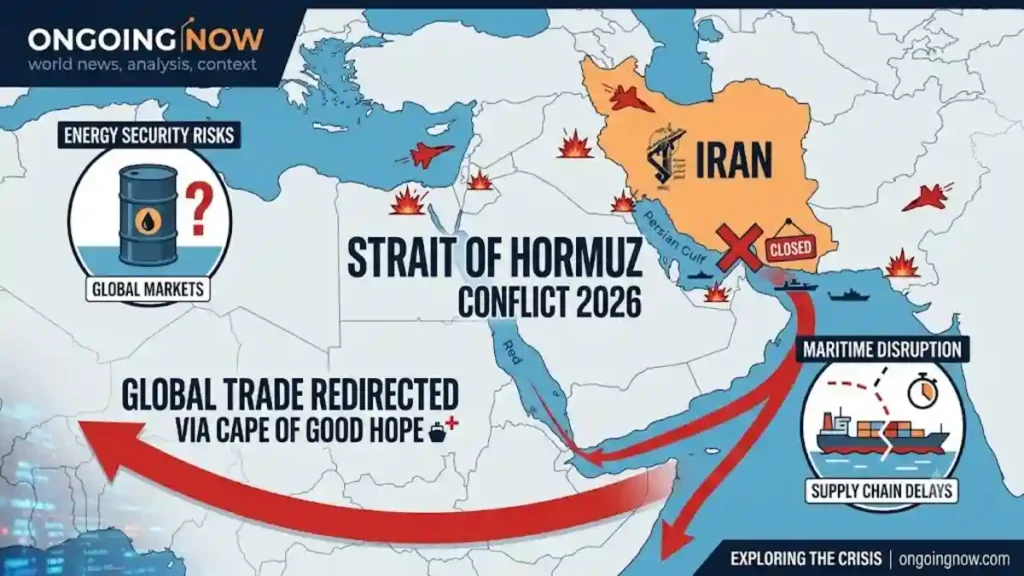
The United Nations has condemned the escalation, calling for an immediate cessation of hostilities to prevent a wider regional war. Meanwhile, the Strait of Hormuz—through which one-third of the world’s seaborne oil passes—remains a flashpoint as the IRGC issued radio transmissions warning that no ships would be allowed to pass.
Future Outlook: Succession and Stability
If the reports following the Ali Khamenei compound strike are confirmed, Iran faces its first leadership transition since 1989. Potential successors include Ayatollah Alireza Arafi and Judiciary Chief Gholam Hossein Mohseni Ejei. However, the loss of the IRGC leadership status through targeted strikes may complicate a smooth transition. The international community remains on high alert, as the outcome of this confrontation will likely reshape the geopolitical map of the Middle East for generations.
Stay sharp with Ongoing Now!
—
Source and Data Limitations: This report is based on verified field reporting from the Associated Press, Reuters, and Agence France-Presse as of March 1, 2026. Data regarding casualties is sourced from the Iranian Red Crescent Society and state media (IRNA), which may be subject to reporting delays or censorship. Information regarding the death of Ali Khamenei remains unconfirmed by the Iranian government; statements from Israeli officials represent intelligence assessments rather than forensic verification. Some digital evidence, such as satellite imagery of the Tehran compound, has been cross-referenced with military analysts but remains subject to the “fog of war” common in active conflict zones. Reports of civilian casualties in specific districts are currently based on preliminary emergency responder data.