NATO Baltic Air Policing Intercepts Strategic Bombers
Alliance aircraft from six nations, including French Rafale jets, monitored a large formation of Russian supersonic bombers and fighters over the Baltic Sea.
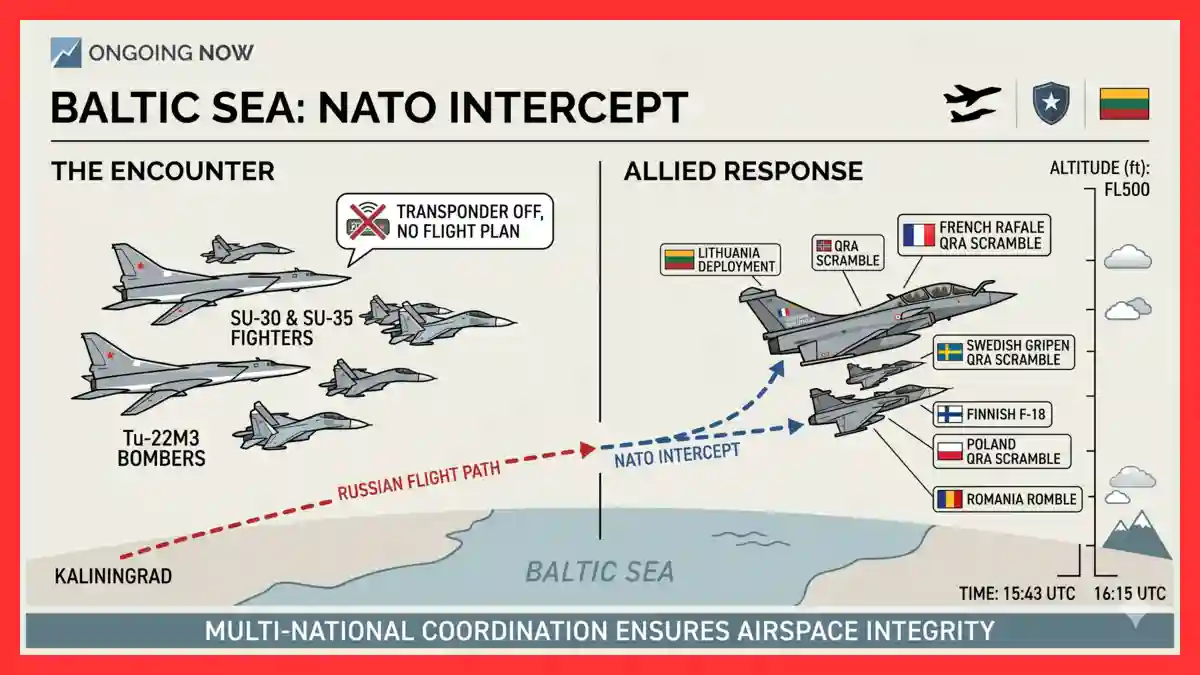
On April 20, 2026, NATO Baltic air policing assets conducted a multi-national interception of two Russian Tu-22M3 strategic bombers and approximately ten escorting Su-30 and Su-35 fighter jets. The operation involved a coordinated response from Sweden, Finland, Poland, Denmark, Romania, and France, marking one of the most comprehensive aerial monitoring efforts on the eastern flank this year. French Rafale fighters, currently leading the mission from Šiauliai Air Base in Lithuania, were scrambled alongside regional allies to identify and shadow the Russian aircraft as they transited international airspace near NATO borders.
The intercept highlights the heightened state of vigilance maintained by the Alliance as Sweden and Finland integrate fully into NATO’s collective defense architecture. While the Russian Ministry of Defense characterized the four-hour mission as a “planned flight” over neutral waters, NATO officials emphasized that the scramble was necessitated by the flight’s non-compliance with standard aviation protocols. Specifically, the Russian aircraft reportedly flew without submitted flight plans and frequently operated with transponders disabled, posing a potential risk to civilian air traffic in the crowded Baltic corridor.
Collective Defense: The French Rafale Lithuania Deployment
The current rotation of the air policing mission is led by the French Air and Space Force, which deployed four Rafale B aircraft to Lithuania on April 1, 2026. This deployment, the ninth of its kind for France in Lithuania, serves as the cornerstone of the Alliance’s Integrated Air and Missile Defence system in the region. The French contingent operates out of Šiauliai, working in tandem with Romanian F-16s and Portuguese assets to maintain a constant “Quick Reaction Alert” (QRA) status.
Lt. Col. Alexandre, chief of the French detachment, noted that the mission’s primary objective is to ensure the integrity of Allied airspace through a “detect, identify, and intervene” framework. The April 20 encounter tested the “Agile Combat Employment” (ACE) model, which emphasizes the rapid movement of air assets across different Allied bases with a minimal logistical footprint. This agility is considered vital for maintaining a credible deterrent posture on the eastern flank, where air activity has remained consistently high throughout the spring of 2026.
By the Numbers: April 2026 Aerial Activity
| Metric | Detail |
| Russian Aircraft Intercepted | 2 Tu-22M3 Bombers, ~10 Su-30/Su-35 Fighters |
| Participating NATO Nations | France, Sweden, Finland, Poland, Denmark, Romania |
| Duration of Russian Flight | Over 4 hours in international airspace |
| French Deployment Duration | April 1 to August 1, 2026 |
| Recent Scrambles | 4 intercepts reported between April 13–19, 2026 |
Technical Friction: Russian Aircraft Flight Transponder Rules
A recurring point of contention in Baltic Sea military maneuvers is the adherence to international flight safety standards. According to NATO’s Allied Air Command and the Lithuanian Ministry of National Defence, Russian military flights frequently violate three core “flight rules”: they often do not activate their onboard transponders, fail to maintain radio communication with regional Air Traffic Control (ATC), and do not file pre-authorized flight plans.
These omissions force NATO commanders to launch “Alpha Scrambles”—real-world alerts where armed fighters must visually identify the aircraft to ensure they do not pose a threat or a hazard to commercial aviation. While Russia maintains that all its Aerospace Forces flights are carried out in “strict compliance with international rules,” the lack of electronic visibility remains a primary driver for the frequent intercepts observed between the Russian exclave of Kaliningrad and mainland Russia.
Analysis: The Integration of Sweden and Finland
The April 20 intercept provided a clear demonstration of the expanded NATO air footprint following the accession of Sweden and Finland. For the first time in a major Baltic intercept of this scale, Swedish and Finnish jets operated as full Alliance members within the NATO Baltic air policing framework. This integration has significantly increased the strategic “depth” of the Alliance, allowing for more seamless handovers as Russian strategic bomber flight paths cross through different areas of responsibility.
“Every day our teams work together; different aircraft, different nations, but one mission: to ensure the security of the Alliance,” stated Lt. Col. Alexandre during the French detachment’s mission briefing.
The presence of Swedish and Finnish assets alongside the French Rafale Lithuania deployment signifies a shift toward a more localized and responsive defense network. Previously, air policing relied heavily on rotating detachments from Western European and North American allies; now, the frontline states themselves provide a continuous, high-readiness layer of aerial surveillance that complements the rotating “framework nations” like France.
Geopolitical Context: NATO Eastern Flank Security Updates
The aerial activity over the Baltic Sea is mirrored by increased defensive measures on the ground. Frontline states are currently implementing the “Baltic Defence Line” and Poland’s “East Shield” program, which focus on anti-mobility installations and enhanced surveillance along 1,600 kilometers of border with Russia and Belarus. These programs, which include the construction of bunkers and the installation of persistent radar aerostats, are designed to slow potential incursions and buy time for NATO’s collective response.
The recent intercepts are viewed by analysts as part of a broader “grey zone” environment where military displays are used to test response times and political resolve. According to the 2026 GLOBSEC Battle Readiness Report, the transition from “symbolic presence” to “combat-ready postures” has been rapid, yet it remains dependent on the ability of nations to align their military and industrial systems. The seamless coordination of six different national air forces during the Tu-22M3 intercept suggests that operational interoperability is reaching a high level of maturity.
Summary of Recent Intercept History
The April 20 event was the most complex in recent weeks, but it followed a series of smaller-scale encounters. Between April 13 and April 19, NATO jets were scrambled four times to intercept various Russian aircraft, including Il-20 reconnaissance planes and Su-30SM fighters.
April 9–10: Polish F-16s intercepted an Il-20 reconnaissance aircraft twice in 24 hours.
April 14–15: Intercepts of Il-20 and Su-30SM aircraft flying toward Kaliningrad.
April 17: A further intercept of an Il-20 flying without a transponder or flight plan.
These incidents demonstrate a persistent pattern of Russian military activity that utilizes international corridors to link the Kaliningrad exclave with the Russian mainland. For NATO, the mission remains focused on a non-escalatory but firm presence, ensuring that every uncoordinated flight is met with a visible, multi-national response to uphold the sovereignty of Allied airspace.
Stay sharp with Ongoing Now!
Source and Data Limitations: This report is based on verified official statements from NATO’s Allied Air Command, the French Ministry of Armed Forces, and the Lithuanian Ministry of National Defence as of April 21–22, 2026. Data regarding the number of Russian aircraft is sourced from French military detachments and Associated Press eyewitness accounts at Šiauliai Air Base. While the Russian Ministry of Defense confirmed the flight, specific details regarding their electronic transponder status are provided by NATO sources and have not been independently verified by Russian authorities. Information regarding the Baltic Defence Line and East Shield programs is based on the 2026 Military Balance report. Some details regarding the specific payloads of intercepted aircraft remain classified for security reasons.