Senate Majority Leader Schedules Vote on SAVE Act
Senate debate on the SAVE America Act begins next week as GOP leadership addresses filibuster pressure.
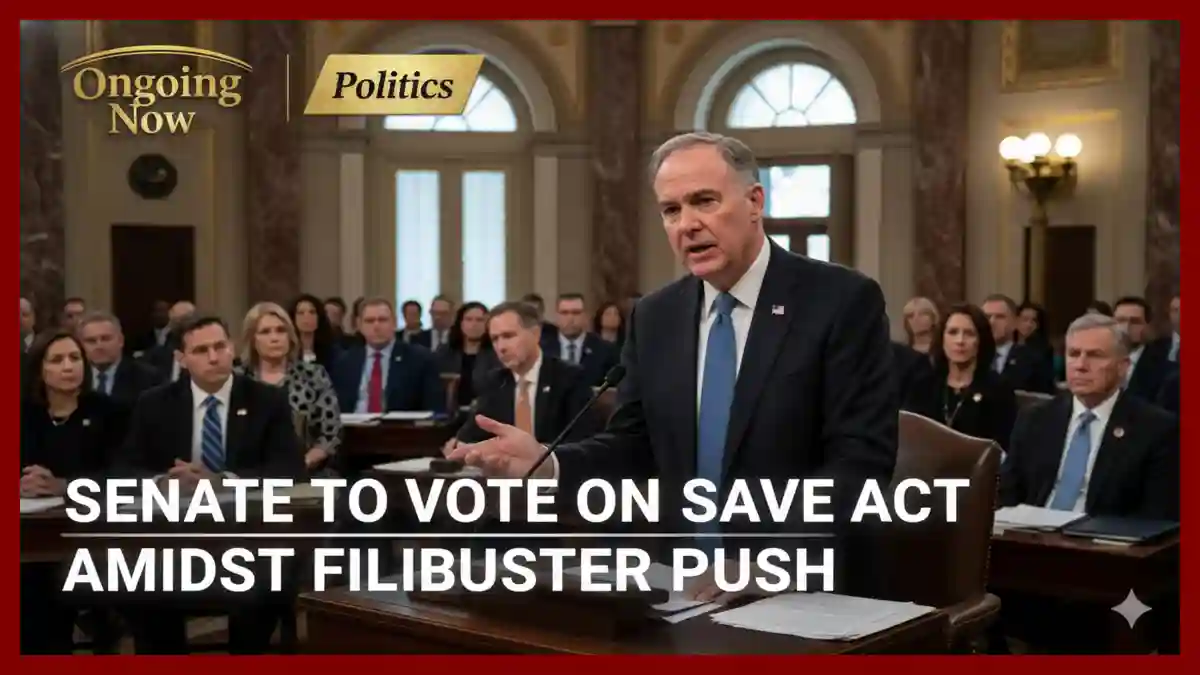
Senate Majority Leader John Thune has announced a formal floor vote schedule for the Safeguard American Voter Eligibility (SAVE) Act, identified as S.1383, marking a significant development in the Republican election reform debate. The legislation, which mandates documentary proof of citizenship for voter registration, passed the House in February 2026 by a narrow 218–213 margin and now moves to a divided Senate. While Republican leadership faces intense pressure from figures like Cleta Mitchell and President Donald Trump to bypass traditional procedural hurdles, the upcoming debate is expected to focus on the 60-vote filibuster threshold. This measure impacts federal election administration, in-person registration requirements, and the verification of voter rolls across all 50 states.
Senate Majority Leader John Thune Moves S.1383 to Floor Debate
Senate Majority Leader John Thune (R-S.D.) confirmed on March 12, 2026, that the Senate will begin a comprehensive floor debate on the SAVE America Act (S.1383) during the week of March 16. The decision follows months of internal caucus discussions and public calls for a more aggressive stance on election integrity legislation. Thune characterized the bill as a “commonsense” measure designed to ensure that only U.S. citizens participate in federal elections.
The legislative push is framed by the Republican leadership as an essential step toward restoring public confidence in the electoral system. However, the path to enactment remains mathematically challenging due to the current Senate composition. The 60-vote threshold required to end a filibuster means that Republicans would need to secure support from at least eight Democrats or Independent members to advance the bill to a final vote.
Current reports indicate that the Senate will engage in a “marathon debate” style, a strategy intended to highlight the policy differences between the two parties. By scheduling a dedicated window for S.1383, Thune aims to force a recorded vote, compelling all members to declare their position on citizenship verification requirements before the 2026 midterm elections.
Key Provisions of the SAVE America Act and S.1383
The SAVE America Act introduces the most significant changes to federal voter registration since the Help America Vote Act of 2002. At its core, the legislation prohibits state and local election officials from accepting voter registration applications for federal offices unless the applicant provides “documentary proof of United States citizenship” (DPOC).
The bill specifies several forms of acceptable documentation:
A valid U.S. passport or passport card.
A certified birth certificate issued by a state or local government.
A Consular Report of Birth Abroad or Certificate of Naturalization.
A valid government-issued photo ID that explicitly indicates the bearer’s place of birth was within the United States.
Beyond registration, S.1383 mandates that states take “affirmative steps” to remove noncitizens from existing voter rolls using federal databases. It also establishes a private right of action, allowing citizens to file civil lawsuits against election officials who fail to enforce these citizenship requirements. For those without immediate access to documentation, the bill requires states to provide an “alternative process” to demonstrate citizenship, though the specifics of these processes are left largely to state discretion.
House Passed SAVE Act 2026: A Statistical Breakdown
The current Senate debate follows the successful passage of the SAVE America Act in the House of Representatives on February 11, 2026. The vote reflected deep partisan divisions within the 119th Congress, passing with 218 votes in favor and 213 against. Only one Democrat, Representative Henry Cuellar of Texas, crossed party lines to support the measure.
| Vote Metric | House Results (Feb 11, 2026) |
| Total Yea Votes | 218 |
| Total Nay Votes | 213 |
| Republican Support | 217 (99.5%) |
| Democratic Support | 1 (0.5%) |
| Not Voting/Absent | 4 |
The House version of the bill included an amendment that accelerated the implementation timeline, requiring photo identification for federal elections to take effect by November 1, 2026. This adjustment was introduced to ensure the rules would be in place for the upcoming midterm cycle. House proponents, led by Representative Chip Roy (R-TX), argued that the narrow margin of victory in several 2024 contests necessitated immediate federal intervention to secure the registration process.
The Republican Election Reform Debate and Filibuster Pressure
The upcoming Senate floor action occurs amidst a sharpening internal Republican debate over the “talking filibuster.” Influential activists, including Cleta Mitchell of the Election Integrity Network, have applied significant pressure on Thune and the GOP leadership to reform or bypass Senate rules to pass S.1383. Mitchell and other proponents argue that the SAVE America Act is a foundational priority that justifies “nuclear option” procedural maneuvers.
However, institutionalist members of the Republican caucus, including Senators Lisa Murkowski (R-AK) and Susan Collins (R-ME), have expressed varying degrees of skepticism toward changing long-standing Senate protections for the minority. Leader Thune has publicly resisted calls to eliminate the 60-vote threshold, warning that such a move could be used against Republicans in future sessions.
Instead of a rules change, Thune has opted for the marathon debate format. This approach requires Democrats to remain on the floor to maintain their filibuster, potentially creating a “talking filibuster” environment without a formal change to the Standing Rules of the Senate. This strategy is designed to appease the party’s “MAGA” wing while preserving the institutional structure of the chamber.
Analysis: Why the S.1383 Floor Vote Schedule Matters
The scheduling of the S.1383 floor vote serves two primary institutional purposes. First, it clarifies the legislative status of a bill that has been a focal point of Republican rhetoric since the start of the 119th Congress. Second, it serves as a “litmus test” vote for candidates in both parties heading into the 2026 midterms.
“We are going to put Democrats on the record,” Majority Leader Thune stated during a March 10 press briefing. “They will be forced to defend their positions and explain to the American people why common sense and the Democratic Party have parted ways.”
From a policy perspective, the “Analysis” suggests that the debate will center on the definition of “voter accessibility” versus “voter security.” Democrats, led by Senate Minority Leader Chuck Schumer (D-NY), have labeled the bill “particularly oppressive,” arguing it targets low-income and minority voters who may lack easy access to birth certificates or passports. Republicans contend that the 42 states currently using online registration systems without physical document verification are vulnerable to administrative errors.
Societal Impact: How the SAVE America Act Affects Voters
The potential impact of S.1383 on the American electorate is a central point of contention. Policy analysts have highlighted that approximately 21 million U.S. citizens do not have immediate access to documentary proof of citizenship. This group disproportionately includes:
Married Women: Millions of women who have changed their names after marriage may find that their current identification does not match their birth certificates, necessitating additional legal documentation.
Rural and Elderly Populations: Voters in remote areas or those born at home rather than in hospitals may face significant hurdles in obtaining certified birth records.
Students and Low-Income Earners: These groups are less likely to hold a valid U.S. passport, which costs a minimum of $130 for adults, leading some advocates to characterize the requirement as a “de facto poll tax.”
Conversely, supporters of the bill point to the growing number of noncitizens residing in the U.S. and argue that the integrity of the “one person, one vote” principle requires a modernized verification system. They argue that the bill’s requirement for states to provide an alternative process—such as a hearing or an affidavit system—provides a sufficient safety net for eligible citizens who lack standard documents.
Historical Context of Federal Voting Legislation
The current debate over the SAVE America Act mirrors historical shifts in federal oversight of elections. Following the 2000 election, Congress passed the Help America Vote Act (HAVA), which mandated that states upgrade their voting machines and maintain centralized voter registration lists.
While HAVA allowed for a variety of identification methods, including utility bills or bank statements for first-time voters, S.1383 represents a shift toward a “standardized federal requirement” that would override more permissive state laws. This moves the U.S. closer to the “National ID” models seen in many European democracies, though it remains unique in its focus on citizenship verification at the point of registration rather than just identity verification at the polling place.
Key Developments in the 119th Congress Election Reform
January 2026: S.1383 introduced in the Senate; companion House bill gains 200+ cosponsors.
February 11, 2026: House passes the SAVE America Act with one Democratic crossover vote.
March 10, 2026: Senator Thune officially schedules the Senate floor vote.
March 16, 2026: Scheduled commencement of the “marathon” Senate debate.
Broader Implications for the 2026 Midterm Elections
The outcome of the Senate vote on the SAVE America Act will likely set the tone for the 2026 campaign season. If the bill fails to clear the 60-vote hurdle, as is widely anticipated, Republican candidates are expected to use the “no” votes of vulnerable Democratic incumbents as a centerpiece of their election integrity platforms.
If the bill were to somehow pass, it would trigger an immediate administrative overhaul in all 50 states. Election officials would be required to update their software, retrain poll workers, and launch public awareness campaigns regarding the new registration requirements just months before the November elections. Legal experts predict that such a shift would result in a flurry of litigation in federal courts, potentially reaching the Supreme Court before Election Day.
As the Senate prepares for the week of debate, the focus remains on whether the “marathon” format will bridge the gap between the party’s institutionalists and those demanding a more radical break from Senate tradition.
Stay sharp with Ongoing Now!
Source and Data Limitations: This report is based on official congressional records from the 119th Congress, including the full text of S.1383 (Safeguard American Voter Eligibility Act) and House Roll Call #69 (February 11, 2026). Direct quotes and scheduling details are sourced from official press releases by the Office of Senate Majority Leader John Thune and verified reporting from Democracy Docket, LegiScan, and the House Committee on Rules. Impact statistics regarding documentation access are derived from the Brennan Center for Justice and the NAACP Legal Defense Fund. This article excludes speculative claims regarding the motives of individual legislators and focuses on documented legislative procedures and public statements as of March 17, 2026. No predictive claims are made regarding the final outcome of the Senate vote.