The Shells That Sparked a Legal Epic: Inside the James Comey indictment 2026
Legal implications of the James Comey indictment 2026 and First Amendment defenses.
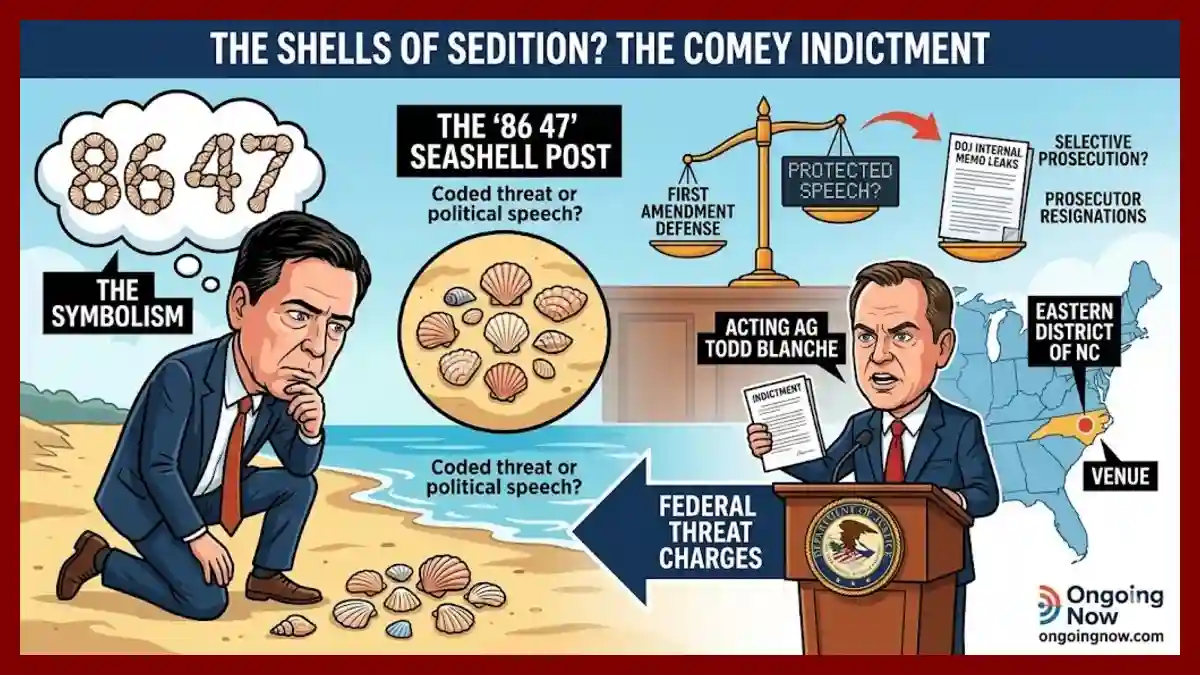
The Department of Justice (DOJ) has formally secured the James Comey indictment 2026, charging the former FBI Director with two federal counts related to a 2025 social media post. Filed in the Eastern District of North Carolina, the indictment centers on an Instagram photograph of seashells arranged to form the numbers “86 47.” Acting Attorney General Todd Blanche announced the charges during a press conference, asserting the post constituted a “true threat” against the 47th President, Donald Trump. Legal experts note the Trump Comey legal battle now pivots on the James Comey 86 47 meaning and whether prosecutors can prove criminal intent under the “true threat” doctrine.
The case emerged from a May 2025 post where Comey depicted shells found on a beach, which the DOJ interprets as slang for “eliminating” the President. In a Todd Blanche DOJ press conference, officials argued that the communication falls outside First Amendment protections. However, a James Comey First Amendment defense has already been signaled by his counsel, Patrick Fitzgerald, who argues the post was protected political speech. Meanwhile, reports of DOJ prosecutor resignations today suggest internal friction over the prosecution’s strategy. Comey has filed a selective prosecution motion Comey, alleging Department of Justice internal memo leaks show the case is retaliatory.
The “86 47” Evidence and Eastern District North Carolina Seashell Case
The federal government’s prosecution focuses on 18 U.S.C. § 871 and § 875(c), involving threats against the President and interstate communications. The Eastern District North Carolina seashell case is localized there because the photograph was allegedly taken on a beach within that jurisdiction. Prosecutors contend that “86” is a widely recognized term for “elimination” or “removal,” which, when paired with “47,” creates an actionable federal threat against president charges.
Key Legal Milestones: James Comey Indictment 2026
| Date | Event | Institutional Context |
| April 28, 2026 | Federal Indictment Filed | Grand Jury in North Carolina returns two felony counts. |
| April 29, 2026 | Initial Court Appearance | Comey surrendered in Alexandria, VA; released without plea. |
| May 8, 2026 | Court Appearance Waived | Judge Louise Flanagan canceled the May 11 Greenville hearing. |
| June 30, 2026 | Scheduled Arraignment | Comey expected to enter a formal plea in New Bern, NC. |
Analysis: The “True Threat” Standard and Todd Blanche DOJ Press Conference
During the Todd Blanche DOJ press conference, the Acting AG emphasized that “no one is above the law,” regardless of their prior status as a law enforcement official. However, to secure a conviction, the DOJ must overcome the high bar set by the Supreme Court in Counterman v. Colorado (2023). This requires proving that Comey acted with at least a “reckless” state of mind, consciously disregarding a substantial risk that his post would be viewed as a threat.
The defense argues that the James Comey 86 47 meaning was purely political, referencing “86ing” a candidate through the electoral process. Comey’s team highlights that he deleted the post once he realized it was being misinterpreted, which they claim negates criminal intent. The James Comey First Amendment defense will likely hinge on whether a “reasonable person” would view seashells as a serious expression of an intent to commit violence.
Institutional Fallout and Department of Justice Internal Memo Leaks
The prosecution has caused notable turbulence within the federal government. Department of Justice internal memo leaks have hinted at disagreements between political appointees and career staff regarding the strength of the evidence. These tensions are underscored by the reported DOJ prosecutor resignations today, as some veteran attorneys allegedly view the case as a departure from traditional prosecutorial norms.
Todd Blanche acting AG news has dominated legal circles, as he was installed following the departure of Pam Bondi. Blanche has maintained that investigators possess evidence beyond the Instagram post itself, though he has not elaborated on its nature. This lack of transparency has fueled the defense’s selective prosecution motion Comey, which seeks to uncover whether the President or other officials directly ordered the charges.
What the Data Shows: Legal and Public Impact
The outcome of the Trump Comey legal battle will have lasting effects on the definition of “true threats” in the digital age. Unlike cases involving explicit verbal threats, the use of numerical symbols and natural objects like seashells creates a complex precedent for future speech-based prosecutions.
By The Numbers: The Legal Stakes
10 Years: Total maximum prison time if convicted on both counts.
$500,000: Cumulative maximum fines possible for the two charges.
Second Attempt: This is the second time the DOJ has charged Comey in 12 months; the first case (false statements) was dismissed.
July 15, 2026: Tentative trial start date set by the court.
Public and Societal Effects
The James Comey indictment 2026 has polarized public opinion regarding the use of federal power. To supporters of the administration, the case represents the equal application of the law. To critics, it appears to be a “vindictive and selective” use of the DOJ to silence a prominent critic. The societal impact is significant, as it questions where political hyperbole ends and criminal conduct begins.
Federal threat against president charges are intended to protect the office from actual harm. As this case moves toward a June arraignment and a potential July trial, the judiciary will be tasked with balancing that protective mandate against the fundamental right to free political expression.
Evidence-Based Political Insights
The procedural history of the case suggests a highly contested trial. The defense has already successfully moved to waive certain appearances, and the planned motions to dismiss will likely center on the “vindictive” nature of the charges. If the case proceeds to trial in North Carolina, the DOJ will need to convince a jury that the seashell arrangement was a literal call to harm, a task that First Amendment scholars describe as a significant legal hurdle.
Stay sharp with Ongoing Now!