Fallout from the Redistricting Vote: How GOP Incumbent Losses 2026 Reshape Indiana
Primary results show a decisive turn as voters favor challengers over veteran legislators following a high-profile dispute over congressional redistricting.
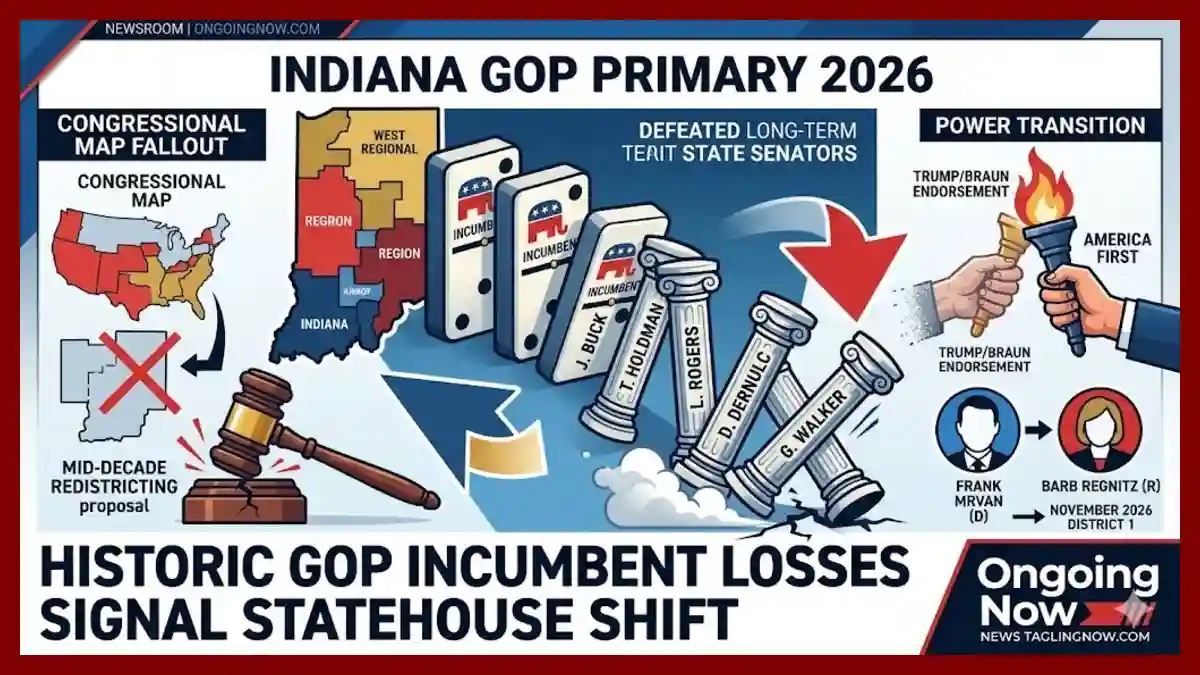
The Republican primary election held on May 5, 2026, has fundamentally altered the composition of the Indiana General Assembly, as a historic wave of GOP incumbent losses 2026 swept through the state Senate. This shift was largely catalyzed by an intra-party conflict regarding a mid-decade redistricting proposal, which several veteran lawmakers had blocked during the preceding legislative session. The resulting vacancies and the advancement of “America First” challengers mark a significant transition in Indiana’s institutional power dynamics, moving the statehouse further toward the political wing aligned with the executive branch and national party leadership.
Institutional shifts of this magnitude are rare in Indiana’s typically stable legislative environment. The primary results reflect a localized referendum on party loyalty, the influence of high-level endorsements from Governor Mike Braun and former President Donald Trump, and a changing electorate in key districts like Kokomo and Northwest Indiana. While the Indiana statehouse political shift dominated the headlines, the primary also solidified the general election matchups for federal seats, including Indiana District 1 election where incumbent Frank Mrvan will defend his seat against Republican nominee Barb Regnitz.
Indiana Statehouse Political Shift: The Redistricting Fallout
The primary served as the final chapter in a months-long dispute over whether Indiana should redraw its congressional maps outside the traditional decennial cycle. In December 2025, twenty-one Republican senators joined Democrats to defeat a redistricting plan that sought to alter the boundaries of the state’s two Democratic-held congressional districts. This act of legislative independence prompted a swift response from party leadership and national figures, who subsequently endorsed a slate of primary challengers.
The impact of this internal fracture was immediate. Five longtime incumbents were defeated in the primary, a figure that represents a significant portion of the Republican caucus up for reelection. These Republican primary upsets targeted some of the most senior members of the chamber, signaling that tenure and institutional knowledge were secondary to current policy alignment in the eyes of the primary electorate.
Notable Republican Primary Upsets
| Incumbent Senator | District / Region | Primary Outcome | Challenger |
| James Buck | District 21 (Kokomo) | Defeated | Tracey Powell |
| Travis Holdman | District 19 (Markle) | Defeated | Blake Fiechter |
| Linda Rogers | District 11 (Granger) | Defeated | Brian Schmutzler |
| Dan Dernulc | District 1 (Highland) | Defeated | Trevor De Vries |
| Greg Walker | District 41 (Columbus) | Defeated | Michelle Davis |
James Buck Primary Defeat and the Kokomo Result
The James Buck primary defeat in Senate District 21 stands as one of the most prominent examples of the night’s trend. Buck, who has served in the legislature since 1994 and chaired the Senate Local Government Committee, lost to challenger Tracey Powell by a substantial margin. Preliminary data from the Kokomo primary election indicated that Powell secured approximately 64.7% of the vote compared to Buck’s 35.3%.
Buck’s loss is particularly noteworthy given his long-standing influence over local government policy and his role in the Senate leadership. His defeat, along with that of Senate Tax and Fiscal Policy Chair Travis Holdman, leaves a void in the upper chamber’s committee leadership. Analysts suggest that these state senate election data points indicate a desire among the GOP base for a more confrontational approach to governance, specifically one that prioritizes national party objectives over traditional legislative norms.
“Everyone in Indiana politics should have learned an important lesson today: President Trump is the single most popular Republican among Hoosier voters,” stated U.S. Senator Jim Banks in a post-election brief. “Indiana is a conservative state, and we deserve conservatives in our State Senate who have a pulse on Republican voters.”
Indiana District 1 Election: Mrvan and Regnitz Set for November
While the statehouse saw significant turnover, the federal races in Indiana remained largely consistent with expectations. In the Indiana District 1 election, incumbent Democrat Frank Mrvan comfortably won his primary against LaVetta Sparks-Wade. Mrvan, who has represented the Northwest Indiana district since 2021, has maintained a focus on labor and manufacturing, which remains a cornerstone of the region’s economy.
On the Republican side, Barb Regnitz emerged as the nominee to challenge Mrvan in November. Regnitz, who has previously campaigned on fiscal transparency and local control, won a multi-candidate primary that included David Ben Ruiz and James Schenke. The 1st District was one of the primary targets of the failed redistricting effort; had the maps been redrawn, the district’s boundaries would have shifted significantly to favor a Republican candidate.
Lake County Election Results (Summary)
The Lake County election results for District 1 highlighted a moderate but stable voter turnout statistics Indiana report for the Democratic primary, while the Republican side saw a more competitive field. The retention of the current district lines means the general election will be fought on familiar geographic and demographic ground, focusing on the industrial corridors of Hammond and Gary.
Analyzing the 2026 Primary Election Winners
The broader list of primary election winners 2026 across Indiana suggests a bifurcated political landscape. While the state Senate is undergoing a populist transformation, the Indiana House of Representatives and the state’s congressional delegation saw more stability. In the 7th Congressional District, incumbent André Carson secured his nomination, ensuring that the two Democratic strongholds in the state remain defended by veteran lawmakers.
The local primary candidates 2026 who were successful often campaigned on “America First” platforms, emphasizing a closer alignment with Governor Mike Braun’s administration. Braun, who is in his first term, has actively sought a more cooperative legislature to advance his policy agenda, which includes tax reform and educational choice. The influx of new senators like Trevor De Vries and Michelle Davis is expected to provide the Governor with a more reliable voting bloc.
Incumbent Performance Reports: A Comparative View
The incumbent performance reports from this cycle show a stark contrast to the 2022 and 2018 midterms. Historically, Indiana Republican incumbents enjoy high retention rates, often running unopposed or with token opposition. The 2026 cycle, however, saw millions of dollars in outside spending directed at primary races that are usually decided on local issues.
Total GOP Incumbents Challenged: 8 (targeted for redistricting vote)
Total Incumbent Losses: 6 (including pending results)
Average Margin of Defeat: 12 percentage points
Total Outside Spending: Estimated $9 million
Voter Turnout Statistics and Regional Impacts
The voter turnout statistics Indiana provided by the Secretary of State’s office showed varying levels of engagement. In Marion County, turnout reached 15.8%, the highest for a midterm primary in over a decade. Interestingly, this turnout was driven largely by Democratic voters, who cast roughly 80% of the ballots in the state’s capital.
Conversely, in rural and suburban districts where the GOP incumbent losses occurred, Republican turnout was lower than in previous high-stakes cycles, but the voters who did participate were highly concentrated in their support for challengers. This suggests that while the “redistricting rebellion” motivated a specific segment of the GOP base, it did not necessarily result in a broad-based increase in overall voter participation.
Indiana Senate District 21 Results: A Microcosm of Change
The Indiana Senate District 21 results reflect the broader trend of suburban and exurban districts shifting toward more ideological representation. Kokomo, a city with a deep industrial history, has traditionally favored pragmatic, business-oriented Republicans like James Buck. The success of Tracey Powell indicates that even in these areas, the national political environment and the influence of high-profile endorsements can override decades of local service.
The Indiana legislative district changes that were rejected by the Senate would have fundamentally altered the state’s political map. By voting against those changes, incumbents like Buck argued they were preserving the integrity of the constitutional process and representing the wishes of their constituents who opposed gerrymandering. However, the primary results suggest that for the core Republican primary voter, the failure to secure a 9-0 Republican congressional delegation was viewed as a tactical error rather than a principled stand.
Broader Implications for Governance and Policy
The immediate consequence of these GOP incumbent losses 2026 is a potential leadership crisis within the Indiana Senate. Senate President Pro Tem Rodric Bray, though not up for reelection this year, faced significant pressure from the pro-redistricting wing of his party. The loss of several of his key lieutenants—Holdman, Buck, and Walker—weakens his coalition and may lead to a challenge for his leadership position when the caucus meets in November.
Anticipated Policy Shifts in 2027
Renewed Redistricting Efforts: With a more compliant Senate, it is highly likely that a mid-decade redistricting bill will be reintroduced in the 2027 legislative session.
Executive-Legislative Alignment: Governor Mike Braun will likely find less resistance to his budget proposals and judicial appointments.
Fiscal Policy: The departure of Travis Holdman as Tax Chair may lead to more aggressive tax-cutting measures, as his successor is likely to come from the more populist wing of the party.
Representation and Community Concerns
Beyond the statistics and political maneuvering, these results have a direct impact on how Indiana communities are represented. For residents of Kokomo or Northwest Indiana, the loss of senior legislators means a loss of “clout” in the statehouse. Seniority often dictates which projects receive funding and which local concerns are prioritized in the state budget.
Voters in District 1, meanwhile, face a clear choice between Frank Mrvan’s labor-centric approach and Barb Regnitz’s focus on conservative fiscal reforms. The stability of the 1st District’s boundaries ensures that the debate remains focused on the specific needs of Lake and Porter counties, rather than being diluted by the addition of more rural, southern territories as originally proposed.
The 2026 primary has demonstrated that Indiana’s “supermajority” is not a monolith. The internal purge of those who defied the party’s national and executive leadership suggests that the future of Indiana politics will be defined by a stricter adherence to partisan mandates, potentially at the expense of the independent legislative tradition that had defined the Senate for decades.
Stay sharp with Ongoing Now!
Source and Data Limitations: This report is based on preliminary election results provided by the Indiana Secretary of State, The Associated Press, and Decision Desk HQ as of May 6, 2026. Official certification of these results typically occurs 14–21 days post-election. Data regarding outside spending and endorsement impact is derived from campaign finance disclosures and public statements from the Braun and Trump campaigns. Voter turnout figures for Marion County are final-preliminary; statewide turnout percentages are estimates based on 95% of precincts reporting. This analysis excludes unverified social media claims regarding specific vote-counting irregularities in Senate District 21, as no official challenges have been filed as of this publication.