Why Stores Are Closed on Easter: Legal Facts Behind the Rise
Statutory restrictions and corporate labor policies converge to limit retail operations on Easter Sunday 2026, creating a complex regulatory landscape for shoppers and workers.
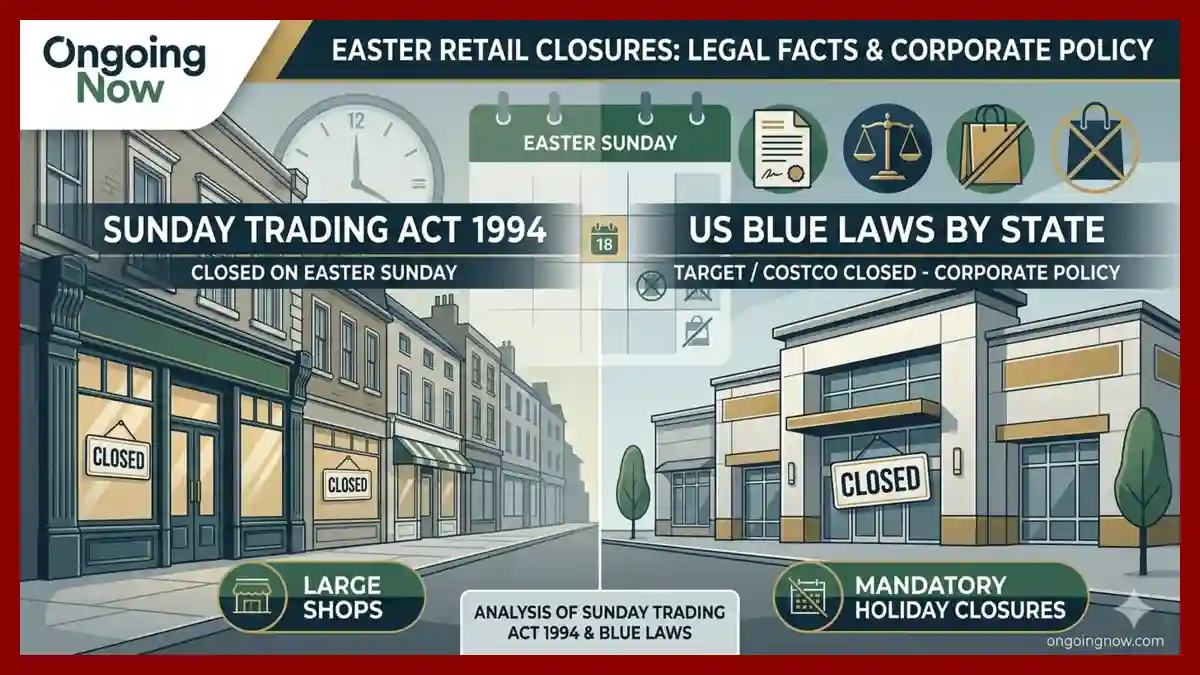
The widespread closure of major retailers on Easter Sunday is driven by a combination of strict statutory requirements, such as the Sunday Trading Act 1994 in the United Kingdom, and voluntary corporate labor policies in the United States. While the U.S. lacks a federal mandate for holiday closures, select US Blue Laws by state still enforce retail bans, while companies like Target and Costco cite employee wellness as the primary driver for their mandatory holiday closures. These closures reflect a broader legal and social debate over religious exemptions for retail, worker protections, and the preservation of a “day of rest” in a 24/7 economy.
The Sunday Trading Act 1994: UK Statutory Framework
In England and Wales, the Sunday Trading Act 1994 serves as the primary legal mechanism governing retail operations on Easter. Unlike the United States, where closures are largely discretionary, the UK Parliament established clear boundaries based on the size of the retail establishment.
Under this Act, a “large shop” is defined as any retail outlet with an internal sales area exceeding 280 square meters (approximately 3,000 square feet). The statute explicitly mandates that these large shops must remain closed on Easter Sunday and Christmas Day. Small shops—those falling under the 280-square-meter threshold—are exempt from these restrictions and may trade without hourly limitations.
The 1994 Act was a significant legislative compromise between four competing interests:
Large Retailers: Sought full liberalization of trading hours to maximize revenue.
Small Businesses: Feared being undercut by the economies of scale of larger supermarkets.
Trade Unions: Expressed concern regarding the erosion of worker rest days and family time.
Religious Groups: Advocated for the preservation of Sunday as a distinct day of religious observance.
UK Sunday Trading Exemptions
Even within this strict framework, the law provides specific exemptions for essential services. Large shops may remain open on Easter Sunday if they fall into the following categories:
Farm Shops: Outlets selling produce grown primarily on-site.
Pharmacies: Registered pharmacies selling medicinal products.
Transport Hubs: Shops located in designated airports or railway stations.
Service Stations: Petrol filling stations and motorway service areas.
US Blue Laws: State-Level Holiday Restrictions
The United States operates under a decentralized legal model regarding Easter holiday labor laws. There is no federal law requiring businesses to close on Easter; however, several states maintain historical Sunday trading bans, commonly known as “Blue Laws.”
While many Blue Laws were struck down in the late 20th century for violating the Establishment Clause of the First Amendment, the Supreme Court ruled in McGowan v. Maryland (1961) that such laws are constitutional if they serve a secular purpose, such as promoting a uniform day of rest for the health and welfare of citizens.
Analysis: Current State of Blue Laws
In 2026, the application of these laws varies significantly:
Maine: Under Title 17, §3204, the state maintains restrictions on “Business, traveling or recreation on Sunday,” though many modern amendments have carved out exceptions for smaller retailers and specific seasons.
Massachusetts & Rhode Island: These states historically had some of the strictest Sunday and holiday regulations. While many have been repealed, certain “Common Day of Rest” statutes still require some businesses to obtain local permits to operate on holidays.
Bergen County, New Jersey: Noted for having some of the most persistent Blue Laws in the country, prohibiting the sale of clothing, electronics, and furniture on Sundays, including Easter.
Corporate Policy vs. Legal Mandate: Why Target is Closed
A common consumer inquiry—why is Target closed today?—often stems from a misunderstanding of legal requirements versus corporate strategy. For major U.S. retailers like Target, Lowe’s, and Costco, closing on Easter is a voluntary internal policy rather than a response to a broad legal ban.
These companies utilize mandatory holiday closures as a recruitment and retention tool. By guaranteeing the holiday off, they signal a commitment to “work-life balance,” a factor that has become increasingly critical in the competitive post-pandemic retail labor market. In contrast, Walmart and many grocery chains like Kroger and Whole Foods remain open, asserting that their service is essential for families preparing holiday meals.
| Retailer | Easter Sunday Status (2026) | Primary Driver |
| Target | Closed | Corporate Employee Wellness Policy |
| Costco | Closed | Standard Holiday Observance |
| Walmart | Open | Consumer Demand/Market Competition |
| Tesco (UK) | Closed (Large Stores) | Sunday Trading Act 1994 |
| Aldi (US) | Closed | Corporate Policy |
Historical Context: The Evolution of Sunday Bans
The legal roots of why stores are closed on Easter trace back to colonial-era statutes designed to enforce religious observance. In the 17th and 18th centuries, failure to observe the Sabbath could result in fines or corporal punishment.
Over time, the legal justification shifted from religious “holiness” to secular “health and welfare.” By the mid-20th century, labor unions became the strongest defenders of these laws, viewing them as a vital protection against the 24/7 work week.
“The 1994 Act was not merely a religious relic; it was a socio-economic truce that balanced the needs of the modern consumer with the fundamental rights of the retail worker to a predictable day of rest.” — Legal Analysis, UK Parliamentary Briefing 2025
Human and Societal Impact of Retail Closures
The debate over Easter retail closures highlights a tension between consumer convenience and worker rights. For the estimated 15 million retail workers in the U.S., a mandatory closure represents one of the few guaranteed breaks in an industry that rarely pauses.
From a societal perspective, these laws and policies create a “forced pause” that advocates argue strengthens community ties. However, critics suggest that these closures disproportionately affect low-income workers who rely on holiday premium pay (where applicable) and consumers who work non-traditional hours and need access to goods on their only day off.
What the Rulings Mean for Workers
In jurisdictions with strict trading laws, such as the UK, workers also have the legal right to “opt-out” of Sunday trading even on non-holiday Sundays, provided they give their employer three months’ notice. This protection ensures that even when stores are open, the law prioritizes individual conscience and family life.
Comparative Legal Analysis: US vs. UK
| Feature | United Kingdom (England/Wales) | United States |
| Primary Legislation | Sunday Trading Act 1994 | State-level “Blue Laws” (varies) |
| Closure Criteria | Square footage (>280 sqm) | Product category or County/State law |
| Easter Sunday | Mandatory closure for large stores | Generally voluntary (corporate choice) |
| Worker Protection | Statutory right to opt-out of Sundays | Limited; varies by state labor contract |
Legal Significance
The divergence between the UK’s centralized statutory approach and the US’s market-driven corporate approach reflects deeper differences in legal philosophy. The UK model prioritizes a structured, regulated market to ensure fair competition between small and large businesses. The US model prioritizes commercial freedom, leaving the decision to close primarily in the hands of the “invisible hand” of the market, with occasional intervention from vestigial state statutes.
Future Trends in Holiday Legislation
As e-commerce continues to grow, the legal relevance of physical store closures is being challenged. Online retailers are not subject to the Sunday Trading Act 1994 in the same way physical stores are, as “trading” is often defined by the physical movement of goods or the opening of a storefront.
In the US, some states are seeing a push to repeal remaining Blue Laws to increase tax revenue and modernize the economy. However, as long as major retailers like Target continue to find value in “employee-first” closure policies, the tradition of the closed Easter storefront is likely to persist as a hallmark of the retail calendar.
This is informational only and not legal advice. Consult a licensed attorney for your situation.
Stay sharp with Ongoing Now!
Source and Data Limitations: This report is based on the Sunday Trading Act 1994 (as amended by the Regulatory Reform Order 2004) and current 2026 corporate holiday schedules for major U.S. retailers. State-level data regarding U.S. Blue Laws is derived from the Maine Revised Statutes (Title 17) and recent legislative summaries from Massachusetts and New Jersey. Analysis of Target and Costco policies is based on official corporate communications regarding 2026 holiday hours. This article excludes unverified rumors regarding potential 2027 legislative repeals of Sunday trading bans, focusing strictly on enacted statutes and established case law such as McGowan v. Maryland. All retail opening statuses are subject to change based on local municipal ordinances and specific site-level exemptions.


