Transgender youth health care restored as Colorado civil rights litigation triumphs.
The Colorado Supreme Court issued a landmark 5–2 ruling reversing a lower court decision, blocking a hospital's care restriction under state civil rights laws.
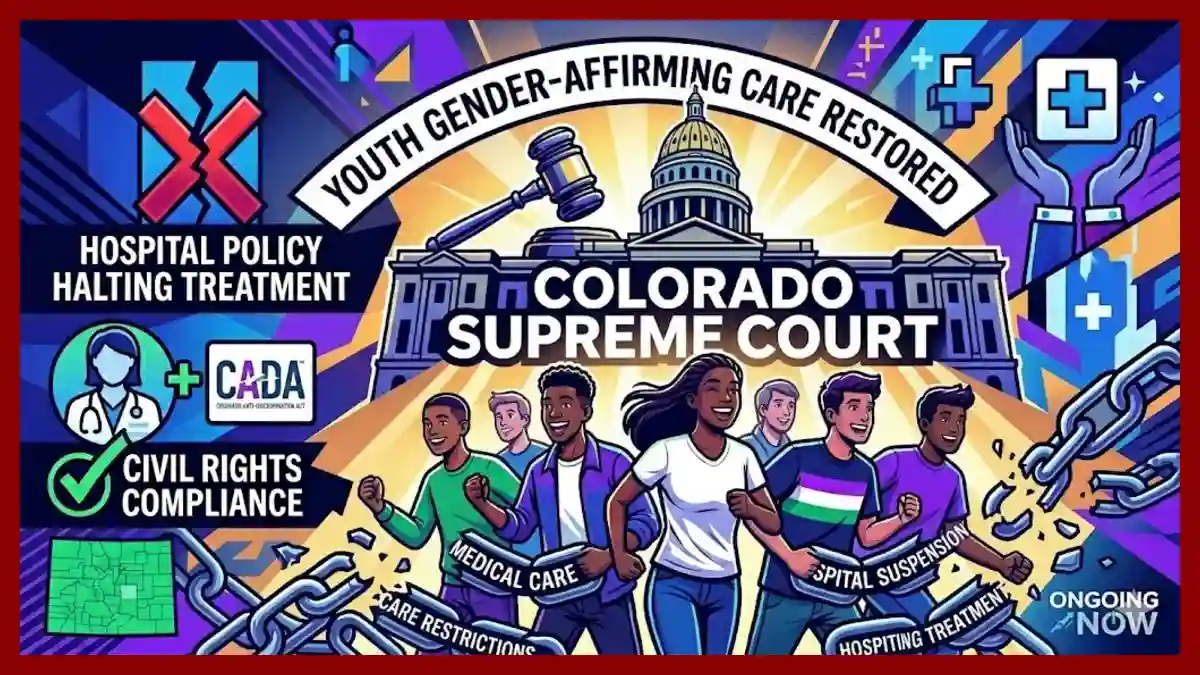
In a significant development for civil rights litigation Colorado, the Colorado Supreme Court on May 18, 2026, issued a 5–2 opinion overturning a lower court’s refusal to grant a medical gender affirming care preliminary injunction. The ruling in the supreme court case 26sa66 colorado orders Children’s Hospital Colorado to resume providing specific medical treatments for transgender youth, which the hospital had suspended following federal policy directives. The high court determined that the hospital’s blanket suspension of these treatments for minor patients with gender dysphoria likely violates the colorado anti discrimination act lawsuit framework under cada section 24 34 601. This decision directly impacts how public accommodation statutes interact with hospital medicaid contract regulations and federal funding threats.
================================================================================
                                 KEY FACTS
================================================================================
• Case Citation: In Re: Boe, Bella v. Children's Hospital, 26SA66 (Colo. 2026)
• Core Legal Issue: Does a hospital policy halting hormone therapies for minors
  constitute unlawful public accommodation discrimination under CADA?
• Supreme Court Ruling: 5–2 in favor of Plaintiffs; preliminary injunction granted
• Lower Court Action: Denied by Denver District Court on Feb. 13, 2026
• Statutory Basis: Colorado Revised Statutes (C.R.S.) § 24-34-601
================================================================================
Colorado High Court Reverses Denial of Preliminary Injunction
The Colorado Supreme Court’s ruling resolves an expedited appeal brought by four transgender minors and their families. The plaintiffs initiated civil rights litigation Colorado after Children’s Hospital Colorado abruptly altered its treatment availability policies. The majority opinion found that the plaintiffs demonstrated a reasonable probability of success on the merits and faced irreparable harm without immediate relief.
The high court’s ruling shifts the legal status quo established by Denver District Judge Ericka H. Englert on February 13, 2026. Judge Englert had previously ruled that while the families had a strong case, the risk of the hospital losing federal funding outweighed the immediate benefit of ordering the medical care to resume. The Supreme Court rejected that balancing test, stating that the public interest is best served by enforcing state civil rights laws and protecting health care access.
Federal Pressures Meet State Civil Rights Protections
The litigation originated from a December 18, 2025, declaration by U.S. Secretary of Health and Human Services Robert F. Kennedy Jr., which labeled youth gender-affirming care as falling outside accepted medical standards. The federal directive warned healthcare institutions that continuing such treatments could lead to a loss of access to federal healthcare programs. Fearing non-compliance with evolving hospital medicaid contract regulations, Children’s Hospital Colorado announced on January 5, 2026, that it would suspend puberty blockers and hormone therapies for gender dysphoria in patients under age 19.
The plaintiffs filed their colorado anti discrimination act lawsuit on January 20, 2026. They asserted that the policy was facially discriminatory because cisgender minors continued to receive the exact same hormonal medications for alternative medical diagnoses. The legal defense focused on the tension between compliance with federal funding administrative mandates and state-level anti-discrimination compliance.
Statutory Breakdown of CADA Section 24-34-601
The central statutory mechanism in this dispute is C.R.S. § 24-34-601, which regulates places of public accommodation within Colorado. The statute explicitly prohibits businesses and public-facing facilities from denying full and equal enjoyment of services based on protected characteristics, including sex, sexual orientation, gender identity, and gender expression.
+----------------------------------------------------------------------------+
|             CADA § 24-34-601 PUBLIC ACCOMMODATION COMPLIANCE               |
+--------------------------+-------------------------------------------------+
| Protected Categories     | Sex, Sexual Orientation, Gender Identity,       |
|                          | Gender Expression, Race, Creed, Disability, etc.|
+--------------------------+-------------------------------------------------+
| Definition of Place      | Any business offering services, facilities,     |
|                          | privileges, or advantages to the public.        |
+--------------------------+-------------------------------------------------+
| Unlawful Practice        | Directly or indirectly withholding or denying   |
|                          | full and equal services based on a category.    |
+--------------------------+-------------------------------------------------+
| Statutory Exceptions     | Restricted admission with a bona fide           |
|                          | relationship to sex (e.g., specific restrooms). |
+--------------------------+-------------------------------------------------+
Caveat: While CADA provides broad public accommodation protections, healthcare provider non discrimination compliance must balance these state requirements against overriding federal healthcare regulations where explicit conflicts exist.
Legal Analysis: Why This Matters for Healthcare Provider Compliance
Legal analysts and high cpc legal defense attorney keywords observers note that this ruling establishes a firm precedent for healthcare provider non discrimination compliance. The court clarified that an institution cannot utilize a fear of potential federal enforcement to justify a facial violation of state civil rights protections. Because the hospital continued to offer the same medications to non-transgender patients, the court deemed the restriction a discriminatory barrier.
In the district court proceedings, Judge Englert noted that “refusing to offer these treatments to transgender patients for the purpose of gender-affirming care facially differentiates between transgender and cisgender patients.” The Supreme Court took this finding to its logical conclusion, determining that under Colorado law, such a distinction requires the issuance of a medical gender affirming care preliminary injunction when irreparable harm is present.
Comparative Precedents and Broader Impact on Medicaid Funding
The conflict between state anti-discrimination laws and federal executive actions is being litigated across multiple jurisdictions. Parallel challenges to federal funding restrictions are proceeding in federal courts. For instance, a Maryland federal judge recently granted a preliminary injunction in PFLAG v. Trump, which temporarily blocked federal agencies from withholding funds from hospitals providing gender-affirming care.
The Colorado Supreme Court’s decision underscores that state civil rights statutes operate independently of federal policy shifts. For healthcare administrators, the ruling emphasizes that state public accommodation laws carry mandatory obligations that cannot be set aside due to administrative guidance or conditional funding threats, unless Congress explicitly preempts the state law.
Human and Societal Impact of the Injunction
The immediate result of the supreme court case 26sa66 colorado ruling is the restoration of specialized medical access for patients currently enrolled in treatment programs at Children’s Hospital Colorado. Prior to the policy change, the facility stood as the largest single provider of pediatric gender-affirming care within the Rocky Mountain region. Parents testified during a two-day evidentiary hearing about severe, negative mental health outcomes and the onset of irreversible physiological changes after their children’s care was halted.
Conversely, the hospital noted its position as a safety-net institution that relies heavily on federal programs. This ruling forces healthcare facilities to evaluate their legal defense frameworks when state civil rights litigation Colorado clashes directly with federal enforcement goals.
Source and Data Limitations
This analytical report is compiled exclusively from verified public records from the Colorado Judicial Branch, including the Supreme Court case announcements for May 18, 2026, the case record for In Re: Boe, Bella v. Children’s Hospital (Case Number 26SA66), and published statutory text for C.R.S. § 24-34-601. It references documented text from the February 13, 2026, order issued by the Second Judicial District Court. This summary excludes unverified trial court testimony not adopted into the official record, speculative outcomes concerning permanent injunction arguments, and ongoing federal litigation where a final order has not been entered.
This is informational only and not legal advice. Consult a licensed attorney for your situation.
Stay sharp with Ongoing Now!