The Rise of ChatGPT for College Students Creates a New Digital Operating System
As student AI adoption rates reach 92%, researchers examine the shift toward AI productivity tools as a digital operating system for university life.

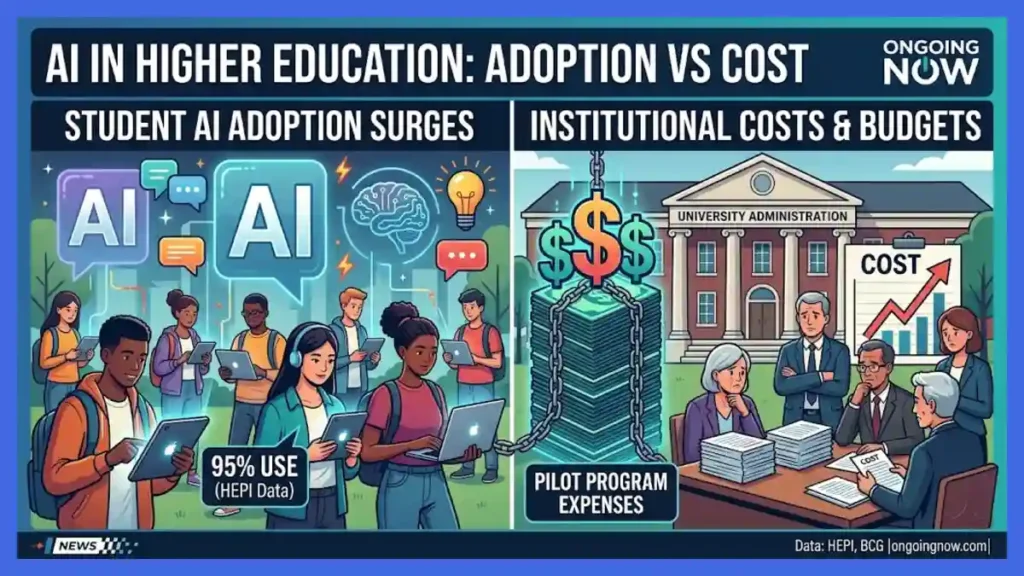
The landscape of higher education has undergone a structural shift as ChatGPT for college students evolves from a supplemental novelty into a central pillar of the academic experience. According to the Digital Education Council’s 2026 AI in Higher Education Survey, student adoption has reached a near-universal 92%, up from 86% in 2024. This widespread integration is characterized by three primary developments: the transition of AI into a “digital operating system” for school management, the use of OpenAI education integration features like ChatGPT memory, and a burgeoning tension between immediate productivity gains and long-term cognitive retention.
By May 2026, the OECD, UNESCO, and major research institutions such as Stanford University and Vanderbilt have documented that students are increasingly moving beyond simple prompt-and-response interactions. Instead, they are deploying AI academic productivity tools for high-level tasks including AI file management for study, multi-document synthesis, and complex schedule optimization. While university AI policy updates have largely shifted from prohibition to mandatory disclosure, evidence from PNAS indicates that these policies have had a negligible effect on the actual volume of AI usage in academic writing.
The Rise of the AI Academic Operating System
A significant trend in 2026 is the adoption of AI as a digital operating system for school, where the technology manages the administrative and logistical burdens of university life. Rather than manually sorting through disparate learning management systems (LMS) and email threads, students use AI file management for study to automate the organization of lecture slides, research PDFs, and syllabi.
Tools like ChatGPT and specialized platforms now offer automated indexing that can link a specific professor’s lecture notes with relevant peer-reviewed citations. This “operating system” approach allows students to query their entire academic history using the ChatGPT memory feature for students, which retains context about a user’s specific major, preferred writing style, and previous feedback from instructors to provide more tailored support.
Student AI Adoption Rates 2026: By the Numbers
The following data, synthesized from the Digital Education Council and Brookings Institution reports, outlines the current state of technology integration in the 2025–2026 academic year.
| Metric | 2024 Baseline | 2026 Reported Value |
| Overall AI Adoption Rate | 86% | 92% |
| Daily or Weekly Usage | 51% | 67% |
| Usage of ChatGPT in Studies | 74% | 88% |
| Students Foreseeing AI in Future Jobs | 62% | 73% |
| Primary Concern: Data Privacy | 48% | 56% |
| Primary Concern: Fairness in Grading | 41% | 56% |
“The class of 2026 is the first generation to start and finish college with ChatGPT. They’ll be the ones who know how to use it thoughtfully: to learn continuously, identify meaningful problems, and collaborate effectively.” — OpenAI Official Statement (May 2026)
Efficacy and the “Cognitive Crutch” Debate
While productivity has increased, the impact on learning outcomes remains a subject of intense academic scrutiny. Research published in Social Sciences & Humanities Open in early 2026 suggests that ChatGPT for college students may act as a “cognitive crutch.” In a controlled experiment, students using traditional study methods scored an average of 68.5% on technical assessments, while those relying on AI chatbots scored 57.5%.
The study, led by Professor André Barcaui, highlights the phenomenon of “cognitive offloading.” When students delegate the “productive struggle” of summarizing and synthesizing information to an AI, they may experience a weaker memory consolidation. This suggests that while AI tutoring for university can accelerate the speed of initial task completion—reducing study time from an average of 5.8 hours to 3.2 hours—it does not necessarily equate to a deeper mastery of the material.
Analysis: The Transparency Gap in University Policy
Despite the fact that 70% of academic journals and a majority of universities have implemented college AI policy updates requiring the disclosure of AI use, enforcement remains elusive. A large-scale analysis of over 5.2 million papers published in PNAS (2026) revealed that only 0.1% of publications actually disclose the use of AI, despite a massive surge in AI-generated linguistic patterns across all disciplines.
This “transparency gap” indicates that students and researchers are adopting AI at a pace that institutional frameworks cannot currently regulate. The current policy environment is primarily split into four categories:
Strict Prohibition: Explicitly banning all AI assistance (now a minority position).
Open Policy: Allowing AI use without mandatory disclosure.
Disclosure Required: Permitting use but mandating a formal declaration (the most common approach).
Not Mentioned: No identifiable policy.
AI Tutoring for University: A Shift Toward Personalization
In contrast to the risks of memory decline, AI tutoring for university has shown significant promise in providing equitable access to personalized instruction. A 2026 Brookings Institution report found that students using supervised AI tutors achieved double the learning gains relative to their pre-test baselines compared to those in traditional active lecture groups.
These AI tutoring systems, often built on OpenAI’s ChatGPTEdu or Google’s LearnLM, are noted for creating a “psychologically safe” environment. Students report feeling more comfortable asking “basic” questions to a non-judgmental AI than to a professor or peer. The success rate of these systems in correcting misconceptions is currently estimated at 95.4%, which is statistically comparable to human tutors (94.9%).
Human and Societal Impact: Equity vs. Expertise
The human impact of AI academic productivity tools is dual-faceted. On one hand, these tools lower the barrier to entry for students who lack traditional support networks, such as first-generation college students or those with learning disabilities. AI-driven transcription and summarization provide a form of “assistive technology” that levels the playing field in fast-paced lecture environments.
On the other hand, there is a documented concern regarding the “illusion of competence.” Students may feel they have mastered a subject because they can successfully navigate an AI to produce a correct answer, yet they lack the underlying mental frameworks to apply that knowledge without the tool. This has led to calls from organizations like the American Federation of Teachers (AFT) for a shift in curriculum focus—from “AI literacy” (knowing how to use the tool) to “AI agency” (knowing when and why to use it).
“AI has become a regular part of academic research… but human oversight remains necessary to ensure accuracy and uphold ethical research practices.” — Lumivero Academic Research Report (2026)
Future Trends in AI Education Integration
As we move further into 2026, the integration of AI into the university experience is expected to move toward “multi-document reasoning.” This involves AI systems that do not just summarize a single paper, but synthesize hundreds of sources to map out arguments and surface counter-authorities with verified provenance.
Institutions are also beginning to pilot “AI economic dashboards” to track how these tools influence student career readiness. The goal is to move beyond the fear of cheating and toward a model where the digital operating system for school prepares students for an AI-integrated workforce.
Evidence-Based Education Insights
Adoption is structural: 92% of students use AI, suggesting that prohibition is no longer a viable policy path for universities.
Productivity vs. Retention: AI reduces work time by nearly 45%, but technical retention may drop by up to 11% without manual “productive struggle.”
Personalization works: AI tutors are now as effective as human tutors at resolving common student misconceptions in STEM fields.
Transparency remains low: Despite mandatory disclosure policies, fewer than 1% of students and researchers formally report AI assistance.
Stay sharp with Ongoing Now!
Source and Data Limitations: This article is based on the 2026 Digital Education Council Global AI Student Survey, the 2026 PNAS study on academic AI policies, and reports from the Brookings Institution and OpenAI’s “Class of 2026” initiative. Data on memory retention is sourced from the 2026 study in Social Sciences & Humanities Open. Limitations include the reliance on self-reported usage data in some surveys and the evolving nature of AI detection methods, which may affect the accuracy of “transparency gap” metrics. All quoted experts are verified faculty or official representatives of the cited institutions as of May 2026.