Fertilizer Supply Chain Stability: US Strategy Reveals
Administration Unveils $900 Million Domestic Production Push to Counteract Geopolitical Disruptions in Middle East Corridors
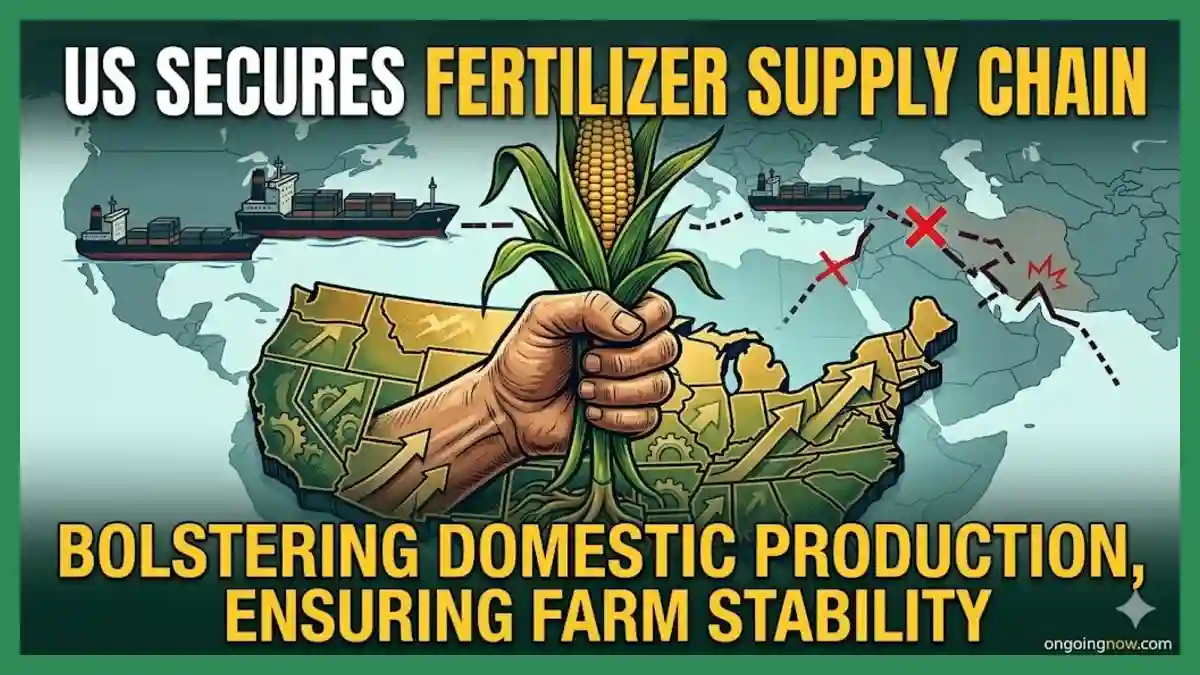
WASHINGTON — The U.S. Department of Agriculture (USDA) and federal lawmakers have accelerated a multi-agency strategy to bolster fertilizer supply chain stability, responding to a volatile global market where urea and phosphate prices have surged more than 30% in early 2026. Agriculture Secretary Brooke Rollins confirmed on April 28, 2026, that the administration is prioritizing domestic fertilizer production incentives to reduce reliance on imports transiting through high-risk corridors like the Strait of Hormuz.
The federal response integrates new fertilizer manufacturing grants, temporary Jones Act shipping waivers, and bipartisan legislation aimed at increasing market transparency. With global trade impacted by the effective closure of critical Middle East waterways—which handle nearly one-third of the world’s seaborne fertilizer—the U.S. is moving to insulate its agricultural input costs from external shocks. Financial analysts at the World Bank and Rabobank indicate that while potash and phosphate availability in the Farm Bill remains a priority for long-term food security, immediate pricing pressures are eroding farm margins across the Midwest.
Strategic Shift: Expanding Domestic Fertilizer Production Incentives
The USDA is currently overseeing a $900 million fertilizer production expansion initiative designed to fast-track stalled manufacturing projects. This capital infusion is intended to increase U.S. nitrogen production by more than 30% within the next 24 months. Secretary Rollins noted that federal coordination is now focused on permitting reform to ensure these facilities reach operational status ahead of the 2027 planting seasons.
Beyond direct funding, the administration is reviewing tariff policies on imports to balance the needs of domestic manufacturers with the immediate requirements of farmers facing a sharp spike in fertilizer market trends. According to Agriculture of America reports, a coordinated set of actions, including the use of the Commodity Credit Corporation (CCC), could potentially reduce local fertilizer costs by $150 per ton.
Legislative Momentum: The Homegrown Fertilizer Act
On Capitol Hill, a bipartisan group including Senators Amy Klobuchar (D-MN), John Thune (R-SD), and Roger Marshall (R-KS) introduced the Homegrown Fertilizer Act in March 2026. This legislation specifically targets:
Expansion of Capacity: Creating grant and loan programs for domestic facilities.
Storage Infrastructure: Improving regional storage to prevent localized shortages.
Market Transparency: Establishing a mandatory price reporting system to prevent anti-competitive practices.
Market Snapshot: Fertilizer Price Forecasts 2026
The global landscape has shifted toward a “supply-led” market where logistics friction outweighs traditional demand signals. Data from the World Bank’s Commodity Markets Outlook (April 2026) highlights a significant divergence in nutrient pricing.
| Fertilizer Type | March 2026 Price (Per Ton) | % Change (Month-on-Month) | 2026 Forecast Trend |
| Urea | $725.60 | +53.7% | High Volatility / Tight Supply |
| DAP (Phosphate) | $658.30 | +5.0% | Moderate Increase |
| MOP (Potash) | $380.60 | +2.2% | Balanced / Stable |
| Anhydrous Ammonia | Variable | Significant Rise | Energy-Dependent |
Note: Prices reflect global benchmarks; local US farm-gate prices may vary based on transportation and regional availability.
Supply Chain Constraints: The Global Fertilizer Trade Impact
The primary driver of the current price escalation is the disruption of the Strait of Hormuz, a waterway essential for 30% of global urea and 24% of phosphate exports. Rabobank analysts report that the closure has removed a substantial volume of nutrients from the market, forcing major exporters like China, Russia, and Turkey to maintain or tighten export restrictions to protect their own domestic supplies.
This geopolitical bottleneck has particularly affected nitrogen production. Since natural gas accounts for 80% to 90% of ammonia production costs, the collapse of liquid natural gas (LNG) flows from Qatar has paralyzed output in regions like India and Pakistan, further tightening the global pool of available urea. Consequently, the fertilizer supply chain stability once taken for granted has been replaced by a phase of “structurally supported price escalation.”
Analysis: Why This Matters for US Agribusiness
“January 2026 confirmed a shift into a structurally tight market where price formation is detached from short-term demand. For buyers, it reinforces the risk of delaying procurement when physical capacity—not just production—is the limiting factor.” — Armaiti Mercantile Exchange (Armaiti MEX), January 2026 Report.
Farm Bill Provisions: Potash and Phosphate Security
As negotiations for the 2026 legislative cycle continue, Farm Bill potash and phosphate provisions have moved to the forefront of agricultural policy. The goal is to classify these minerals as “critical” to ensure they receive the same federal protections and investment priorities as energy and defense materials.
USDA NIFA (National Institute of Food and Agriculture) has allocated approximately $300 million in the FY 2026 budget for programs including:
Agricultural Economics and Rural Communities: Focused on trade and market mitigation.
Biorefining and Biomanufacturing: Investigating alternative nutrient sources to lower agricultural input costs.
Soil Health: Incentivizing precision agriculture techniques that reduce the volume of chemical fertilizer required per acre.
Impact on Farm Economics and Food Prices
The rapid rise in fertilizer market trends is compressing margins for corn, wheat, and soybean producers. The USDA’s World Agricultural Supply and Demand Estimates (WASDE) for April 2026 raised the season-average farm price for corn to $4.15 per bushel, but this increase is often offset by the 25% rise in urea components since February.
Human and Societal Impact:
Regional Economies: Small and medium-sized farms are most at risk, as they lack the hedging tools used by large-scale cooperatives.
Consumer Pricing: While farm-gate prices take time to filter through the supply chain, the sustained high cost of inputs suggests that food price stability remains under pressure through the second half of 2026.
Sustainable Transition: High chemical costs are accelerating the adoption of bio-fertilizers. The Krungsri Research Industry Outlook predicts that by 2027, many producers will aim for a “30% bio, 70% chemical” mix to maintain yields while controlling expenditures.
Corporate Strategy: Pivot Bio and Market Leaders
In response to the volatility, private sector entities are introducing price-guarantee models. Pivot Bio, a leader in microbial nitrogen, has begun offering pricing guarantees through the 2028 season to provide farmers with a predictable alternative to synthetic urea.
Other major players, including The Mosaic Company and CF Industries, are closely monitoring the $900 million in federal fertilizer manufacturing grants. These firms are expected to be primary participants in the expansion of domestic capacity, provided that permitting reform reduces the time-to-market for new North American nitrogen and phosphate facilities.
Evidence-Based Business Insights: The Road to 2027
Market data suggests that while 2026 remains a period of “affordability stress,” the long-term outlook for fertilizer supply chain stability is cautiously optimistic if domestic production targets are met. The World Bank forecasts a potential 25% decline in prices by 2027, contingent on the easing of natural gas prices and the commissioning of new potash capacity in Canada.
For now, the focus for US agribusiness remains on “physical execution risk.” Logistics control and freight optionality have become as important as the cost of the nutrients themselves. As the USDA implements its multi-agency push, the success of domestic fertilizer production incentives will be measured by their ability to decouple American food production from the volatile energy and security landscape of the Middle East.
Stay sharp with Ongoing Now!
Source and Data Limitations: This report is based on USDA press releases (April 29, 2026), the World Bank Commodity Markets Outlook (April 28, 2026), and Rabobank Global Fertilizer Market updates (April 13, 2026). Legislative data is sourced from official statements by the U.S. Senate Committee on Agriculture, Nutrition, and Forestry regarding the Homegrown Fertilizer Act (March 19, 2026). Market pricing for urea, DAP, and MOP is based on ICIS and Armaiti MEX reports from Q1 2026. This article excludes speculative stock forecasts and relies solely on official guidance and historical price indices. Projections for 2027 are subject to geopolitical developments and natural gas price fluctuations.