Why the Brutal Bungie Asset Impairment Charge Has Forced Massive Corporate Restructuring
Sony interactive entertainment financials face sharp adjustments after Destiny 2 falls short of expectations.
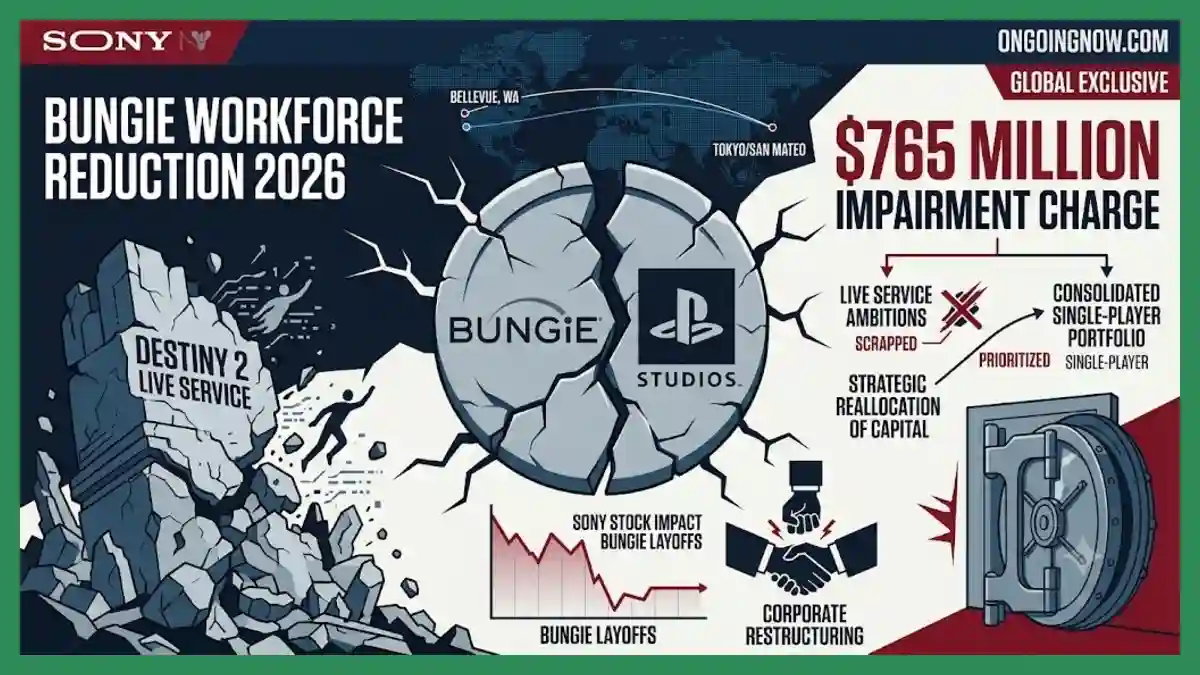
The global video game industry is experiencing a significant structural realignment, exemplified by a massive workforce reduction at Bungie, Inc. announced by PlayStation Studios. This decision directly follows a staggering $765 million ($765,000,000) bungie asset impairment charge recorded by parent company Sony Group Corporation during its fiscal year 2025 financial reports. The combination of destiny 2 sales lower than expected and the underperformance of the newly launched extraction shooter, Marathon, forced a severe bungie acquisition value write down on Sony’s balance sheet. As part of a broader corporate restructuring sony gaming division is enacting to stabilize its sony interactive entertainment financials, this development illustrates the deep financial friction currently facing major publishers who heavily invested in the “live-service” ecosystem. The broader market implications highlight a sharp correction within the video game industry layoffs 2026 trend, profoundly impacting bungie financial performance destiny 2 operations and showing a direct sony stock impact bungie layoffs connection as investors demand fiscal discipline over expensive long-term speculative development.
Technical Analysis: Breaking Down the $765 Million Impairment Loss
To understand the scale of the financial corrections taking place within Sony’s Game & Network Services (GN&S) segment, it is necessary to separate cash expenditure from non-cash accounting adjustments. An impairment loss occurs when the market value or projected cash flows of an acquired asset drop below its recorded book value.
When Sony Interactive Entertainment acquired Bungie in 2022 for $3.6 billion, a significant portion of that valuation was allocated to intangible assets, including intellectual property (IP) and future revenue projections for Destiny 2 and Marathon. The recent financial filings reveal that these projections were over-optimistic.
Sony Group Corporation: FY25 Valuation Adjustments for Bungie, Inc.
┌───────────────────────────┬───────────────────────────┐
│ Fiscal Quarter            │ Impairment Amount (Yen)   │
├───────────────────────────┼───────────────────────────┤
│ Q2 FY25 (Ended Sept 2025) │ 31.5 Billion Yen          │
│ Q4 FY25 (Ended Mar 2026)  │ 88.6 Billion Yen          │
├───────────────────────────┼───────────────────────────┤
│ Total FY25 Writedown      │ 120.1 Billion Yen         │
└───────────────────────────┴───────────────────────────┘
Note: Based on official Sony Investor Relations disclosures. Dollar equivalents calculated at prevailing historical exchange rates, totaling approximately $765 million.
During a recent investor-focused Q&A session, Sony Chief Financial Officer Lin Tao explained the administrative necessity behind the accounting shift:
“In our studio business, earnings from Bungie’s title portfolio did not reach our expectations, so we downwardly revised our business plan and impaired the full amount of the fixed assets related to Bungie except for goodwill.”
By wiping more than 20% of Bungie’s purchase valuation off its balance sheet, Sony has officially acknowledged the bungie market valuation loss 2026 realities, setting up a leaner asset base for future quarters.
Corporate Realignment: The Restructuring of PlayStation Studios
The technical accounting write-downs directly materialized as organizational cuts on June 25, 2026, when Hermen Hulst, CEO of Studio Business Group at Sony Interactive Entertainment, issued an official internal communication. The statement confirmed a sweeping workforce reduction affecting a major portion of Bungie’s staff, particularly targeting the long-standing live-service support groups.
The restructuring parameters outlined by the executive team emphasize the following operational changes:
Destiny Team Reductions: The majority of the development team assigned to maintaining Destiny 2 has been downsized, following the rollout of the game’s final planned content updates.
Marathon Re-scoping: While support remains active for the high-budget extraction shooter Marathon, a portion of its specialized development staff was eliminated following lower-than-expected commercial traction during its initial launch phase.
SIE Integration: Operational pipelines that previously existed independently within Bungie are being consolidated into central Sony Interactive Entertainment shared services to eliminate redundant overhead.
This move marks a definitive end to the hands-off approach Sony initially promised Bungie during the 2022 acquisition, transitioning the independent subsidiary into a fully managed unit under PlayStation’s corporate governance framework.
Macro Context: The Scale of Video Game Industry Layoffs in 2026
The structural issues observed at Bungie do not exist in isolation. They reflect a broader, macroeconomic correction occurring across the global interactive entertainment landscape throughout 2025 and 2026. Following an era of aggressive, low-interest-rate capital expansion from 2020 to 2022, corporate entities are prioritizing high-margin operations over speculative, multi-year production models.
| Metric / Financial Category | FY24 Operational State | FY25/FY26 Adjusted State |
| GN&S Segment Revenue | Approximately Flat | Flat to Marginal Growth (+12% Operating Income) |
| Dominant Revenue Drivers | Hardware Sales (PS5) & Add-on Content | Digital Software Sales & Network Services Subscriptions |
| Strategic Portfolio Focus | Aggressive Live-Service Pipeline (12+ Titles) | Consolidated Single-Player Releases & Curated Live Ops |
| Organizational Footprint | Distributed Independent Subsidiaries | Centralized Consolidated Studio Groups |
The industry-wide shift has caused several legacy publishers to shutter experimental studios, cancel early-stage multiplayer projects, and pivot resources toward proven intellectual properties. Within Sony’s own perimeter, the reorganization has already seen the closure of Concord developer Firewalk Studios, alongside severe structural cutbacks at Bluepoint Games and the complete dissolution of London Studio.
Economic and Policy Implications: The Core Risk of the Live-Service Model
From a corporate finance perspective, the sony purchase of bungie disaster narrative shared among retail investors underscores a fundamental structural flaw in modern video game monetization design: the unsustainability of overlapping live-service platforms. Live-service games require ongoing capital injection to maintain servers, create seasonal content updates, and manage player retention metrics.
Unlike traditional single-player premium software, which generates the vast majority of its returns within the first 60 days of launch, live-service software models operate on long-tail monetization logic. However, the total addressable market (TAM) for these products is constrained by user attention span. A consumer playing one persistent multiplayer title is statistically locked out from committing time or discretionary spending to competing ecosystems.
When Destiny 2 engagement experienced a sharp downtrend and Marathon failed to capture a wide, sustainable baseline of active players upon arrival, the fixed overhead costs of maintaining Bungie’s infrastructure transformed into an active drain on Sony’s operating margins. The financial math left executives with little choice but to downsize internal teams to match current, reduced active player run-rates.
Human and Societal Impact: Labor Realities in High-Tech Entertainment
While corporate balance sheets view these events through the lens of operating income and asset optimization, the local economic fallout for the tech corridors of Bellevue, Washington—where Bungie is headquartered—is immediate. The elimination of hundreds of highly specialized software engineering, narrative design, and community management roles adds significant pressure to a highly competitive regional labor market.
The direct workforce casualties of this corporate contraction encounter several microeconomic challenges:
Market Saturation: Because multiple tier-one publishers are implementing simultaneous layoffs, displaced tech workers are competing for fewer open requisitions globally.
Severance and Transition Vulnerabilities: The reliance on localized corporate benefits leaves workers exposed to sudden gaps in healthcare coverage, despite Sony’s public assurances of institutional transition assistance.
Contractor Displacements: Beyond full-time employee headcount metrics, external QA agencies, local localized outsourcing partners, and administrative support businesses tied to Bungie’s facilities feel secondary contraction impacts.
The structural transition highlights an ongoing labor debate inside the software industry regarding project longevity and corporate transparency, especially when staff reductions follow closely on the heels of major product delivery milestones.
Evidence-Based Insights: Capital Reallocation and Future Strategy
Despite the financial headwind presented by the Bungie writedown, Sony’s broader Game & Network Services division managed a 12% increase in operating income during the same fiscal year. This resilience was largely driven by stable digital software distribution margins, foreign currency exchange tailwinds (a weaker Yen inflating international revenue reporting), and sustained growth in PlayStation Plus network subscription fees.
Moving forward into the remainder of the 2026 financial year, Sony’s public financial guidance indicates a clear shift in capital allocation strategies. The company is re-prioritizing its core single-player flagship software pipeline—leveraging upcoming exclusive releases like Saros and Marvel’s Wolverine—to drive high-margin premium software units.
The era of unconstrained corporate funding for unreleased live-service projects has given way to strict milestone-based auditing. While Sony Interactive Entertainment continues to fund Marathon in an effort to gradually build its niche audience, the studio’s operational independence has been permanently replaced by strict institutional oversight from Tokyo and San Mateo management teams.
Stay sharp with Ongoing Now!
Source and Data Limitations: This business report relies exclusively on authenticated public disclosures, including Sony Group Corporation’s FY2025 Consolidated Financial Results issued on May 7, 2026, and official regulatory filings (Form 20-F) filed for the fiscal year ended March 31, 2026. Structural details regarding employee communications are sourced from the verified June 25, 2026, PlayStation Studios corporate disclosure statement penned by Hermen Hulst. All figures regarding asset impairments are tied directly to reported yen metrics (120.1 billion yen total) and converted via standard institutional exchange tracking. This analysis intentionally excludes unverified social media commentary, speculative projections regarding unannounced console hardware specifications, and unauthorized employee leaks regarding exact internal personnel numbers.